Arctic Wolf employees: Don’t leave six figures on the table
4 min
0 result
If you work at Arctic Wolf, your equity might be one of the most valuable parts of your compensation. But if you don’t plan ahead, it could also be one of the easiest things to lose out on.
With Arctic Wolf’s rapid growth in cybersecurity, a valuation in the billions, and over $400 million in annual recurring revenue*, all signs point to a potential IPO. When that happens, the people who planned ahead will likely be grateful. Those who didn’t might be stuck with a larger tax bill and fewer options.
Why? Because what you decide now could make a big difference in what you actually take home later.
Exercising early could help you:
As a company prepares to go public, its Fair Market Value (FMV) usually increases. That’s important because FMV plays a big role in how much it costs to exercise your options and what you might owe in taxes.
When the FMV goes up:
Right now, Arctic Wolf’s FMV is still relatively low. That can give employees a window to make strategic decisions before prices climb higher.
Let’s imagine Sam, a Senior Engineer, joined Arctic Wolf in 2019.
So what happens if Sam exercises now compared to waiting until an IPO?
Sam has two possible paths with Incentive Stock Options (ISOs):
Sam has two possible paths with Incentive Stock Options (ISOs):
| Exercise now | Wait until the IPO |
|---|---|
Pay the strike price (and AMT) now | Do nothing now; cashless exercise later |
Hold the shares for 1 year after exercise (and 2 years after grant) | No holding period advantage |
Pay long-term capital gains (~15-20%) | Pay income taxes (~40%+) |
Outcome: $1,430,000 after taxes | Outcome: $1,110,000 after taxes |
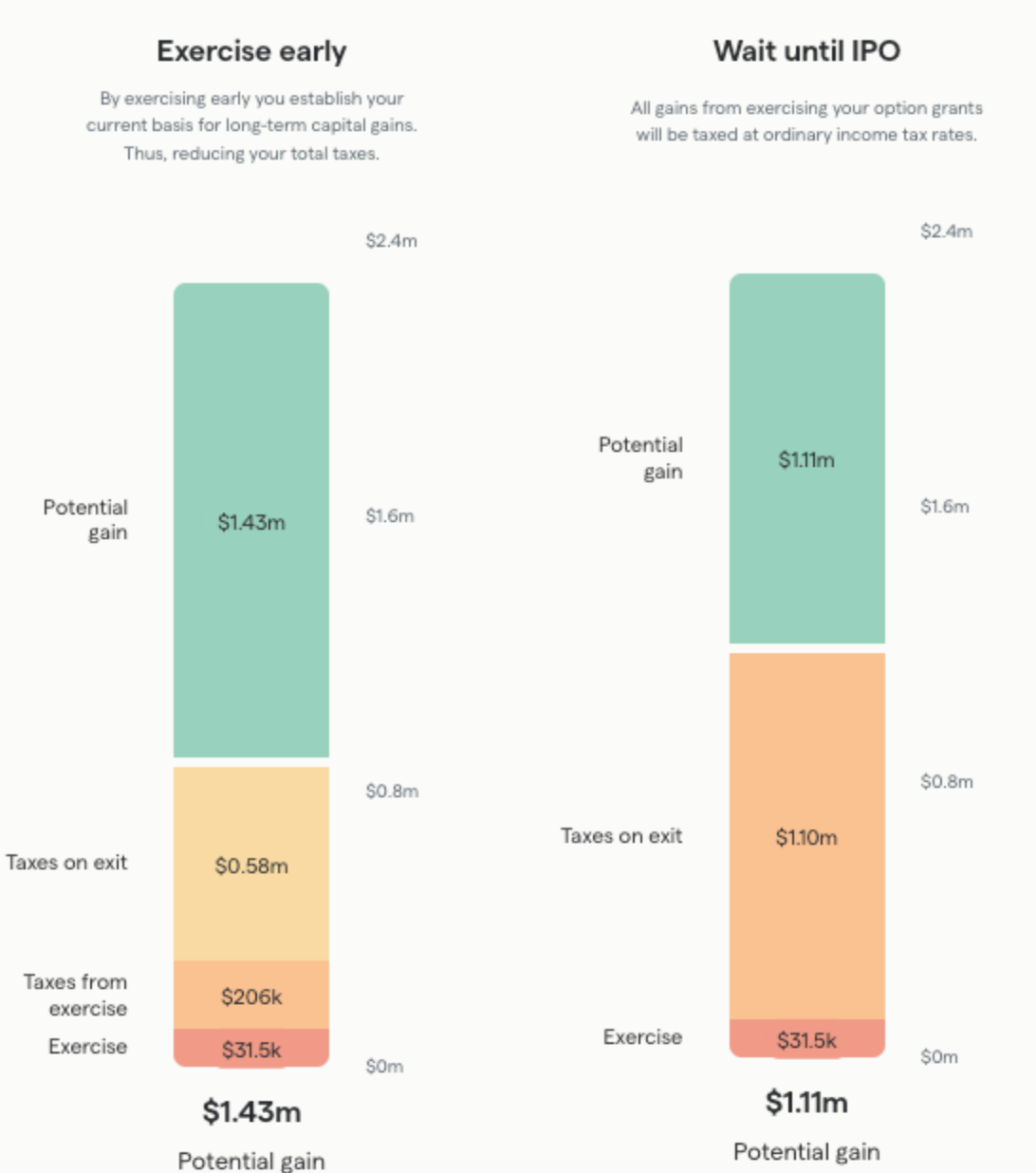
For this case study, we’re also assuming Sam is able to sell his shares at $15 per share, an 82% premium to Arctic Wolf’s most recent preferred price of $8.24 (as of Dec. 2022). That’s not a guaranteed IPO price, but we think it’s a reasonable estimate based on how many high-growth companies are priced relative to their last funding round. The actual price could be higher or lower, depending on market conditions, and the FMV may be lower than the strike price.
Assuming the FMV continues rising in the lead-up to an IPO, employees who exercise now can establish a lower cost basis and potentially qualify for long-term capital gains tax treatment, helping to reduce their future tax burden. On the other hand, waiting until the IPO to do a cashless exercise could result in significantly higher ordinary income taxes on the difference between the FMV and the strike price.
The issue is, by the time the IPO is announced, it may be too late to act. AMT (Alternative Minimum Tax) can hit you with a surprise bill if you wait until shares are worth more.
Exercising early can be expensive. That’s where Secfi’s non-recourse financing comes in:
✔ Exercise without tying up personal savings
✔ If the stock doesn’t increase, you owe nothing
✔ May help reduce AMT surprises with a personalized strategy
Arctic Wolf’s growth shows no signs of slowing down, and when the company eventually goes public, things could move quickly. Making a plan now ensures you’re ready when the time comes, whether that means exercising early, understanding your tax exposure, or preparing for liquidity.
We’re ready to help Arctic Wolf employees evaluate their options, navigate tax implications, and access financing so they can make the best decision for their equity before an IPO changes the game.