What is the true cost of a cashless exercise?
The real cost is opportunity cost.
You are giving up shares today that could be worth significantly more later.
Example
- You sell shares at $20 to cover costs
- The company exits at $80
The difference ($60 per share) is the upside you gave up.
This is why a cashless exercise can be more expensive in strong outcomes, even though it feels simple.
What is the true cost of non-recourse financing?
The cost is the financing structure, which may include:
- Platform or access fees
- Financing charges
- A share of proceeds at exit
This cost is explicit and easier to see upfront.
However, whether it is “expensive” depends on:
- How much your shares increase in value
- How long it takes to reach liquidity
How do you actually compare the two options?
We believe most reliable way is to model multiple future scenarios, not just one.
Use at least three scenarios
- Low exit: company underperforms
- Base case: expected outcome
- High exit: strong growth
For each scenario, calculate:
- Shares owned at exit
- Total proceeds after costs
- Taxes owed
- Net outcome
How to model this using Secfi tools
Secfi is a platform built for startup employees to understand, model, and act on equity decisions, combining tax modelling, scenario analysis, and financing in one place. This makes it easier to compare strategies like cashless exercise and non-recourse financing using consistent assumptions.
We designed our tools to compare these decisions side by side.
Step 1: Estimate exercise cost and taxes
Use Maeve – our AI calculator – as a stock option tax calculator to model:
- Strike cost
- Tax liability (NSO or ISO)
- AMT exposure where relevant
This step is critical because taxes often change the outcome significantly.
Maeve allows you to see whether the cost and opportunity is small or high
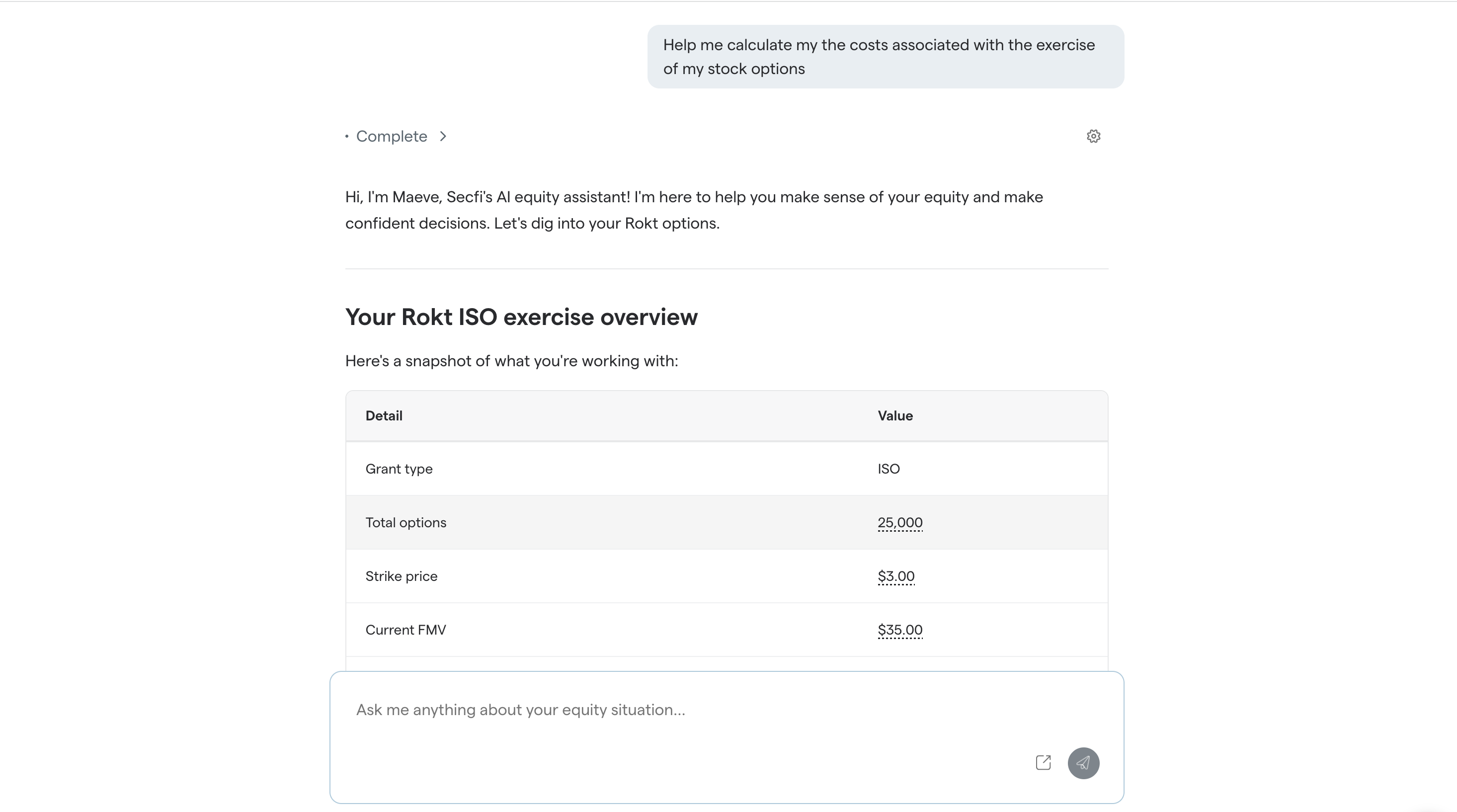
Chat directly to Maeve to understand the actual costs
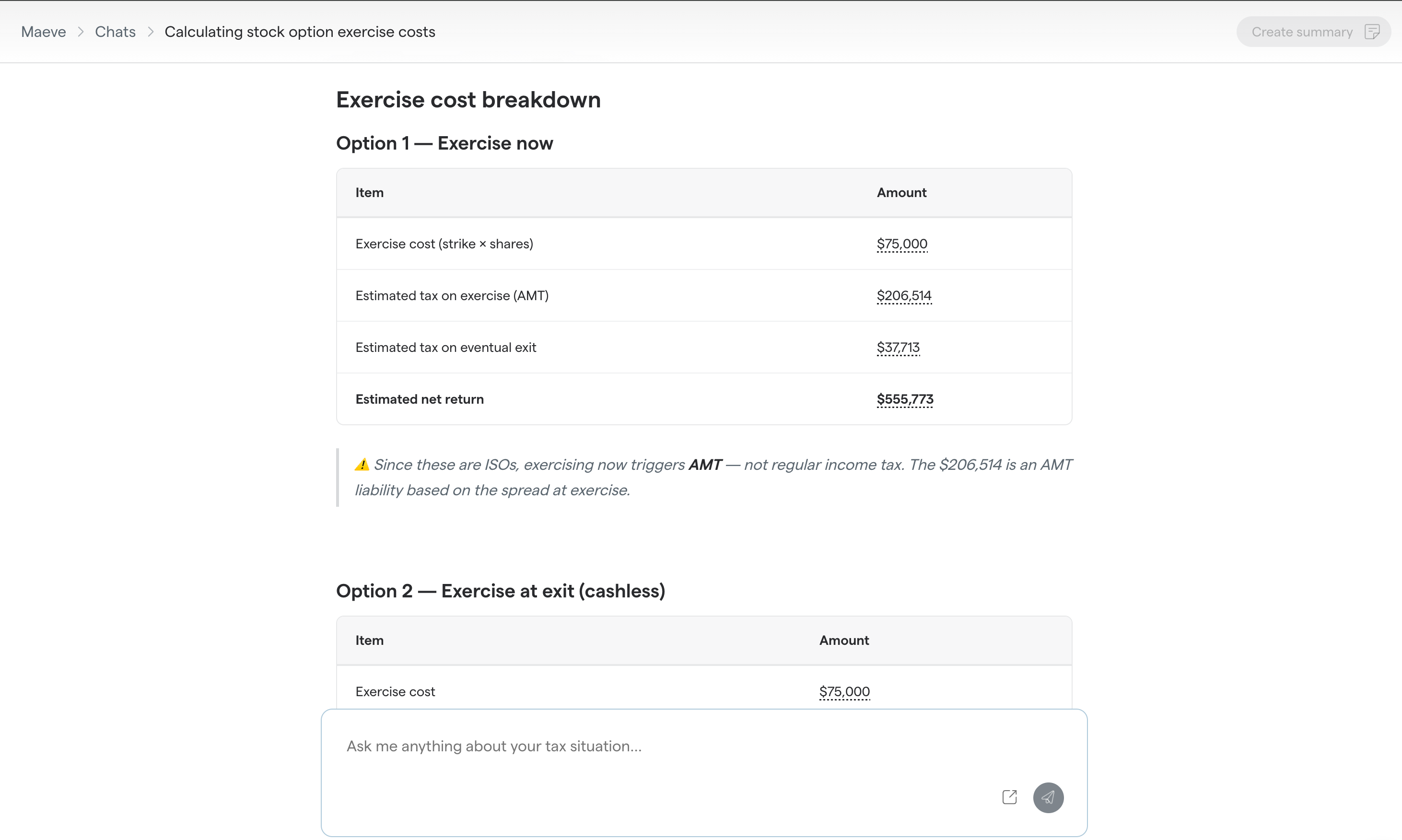
Analyze your different options and what they would cost you
For illustrative purposes only. Actual results may vary and there is no guarantee of any particular outcome.
Step 2: Model future equity value
Use Maeve to:
- Test different share prices
- Estimate potential proceeds
- Compare retained vs sold shares
Step 3: Compare strategies directly
Model:
- Cashless exercise outcome
- Non-recourse financing outcome
Across the same assumptions.
This shows whether:
- Selling shares now is cheaper
- Or keeping shares and paying later creates more value
How to compare the two manually
If you are building your own model:
1. For a cashless exercise
- Calculate how many shares are sold
- Estimate their future value at exit
Cost = future value of shares sold
2. For non-recourse financing
- Estimate total financing cost:
- Fees
- Charges
- Share of proceeds
Cost = total financing economics at exit
Key insight
- Cashless exercise looks cheaper when future growth is lower
- Non-recourse financing looks better when future growth is higher
What other factors should you consider?
1. Taxes
- Cashless exercise usually creates an immediate taxable event
- Exercising and holding may allow for capital gains treatment (depending on ISOs vs NSOs)
2. Growth expectations
Your belief in the company matters:
- High conviction → keeping shares may be more valuable
- Low conviction → locking in value may be safer
3. Downside protection
Non-recourse financing can help provide protection because:
- No personal assets are at risk
- No repayment if there is no exit
We feel downside protection can have real value, even if it is not always obvious in models.
4. Simplicity vs flexibility
- Cashless exercise is simple and immediate
- Financing adds complexity but increases flexibility
Decision checklist
Choose a cashless exercise if:
- You do not care about giving up potential upside
- You do not want third parties involved
- You do not mind paying higher taxes to exercise
Choose non-recourse financing if:
- You want to maximise upside exposure
- You believe in the company’s growth
- You prefer to keep shares rather than sell early
- You want to pay lower taxes when exercising
Make sure to model all scenarios when deciding on an option
You are not just choosing between two costs. You are choosing between:
- Fewer shares with a bit more certainty today
- More shares with a future cost attached
The better option is the one that delivers the strongest after-tax outcome across realistic scenarios, not just the best-case outcome.
FAQs on non-recourse financing vs cashless exercise
Is a cashless exercise always cheaper than financing?
No. It can be cheaper in the short term, but more expensive in the long term if the shares you sell would have increased significantly in value.
How do you measure the cost of giving up shares?
You measure it by estimating what those shares could be worth at exit. This is known as opportunity cost.
When does non-recourse financing make more sense?
It tends to make more sense when you expect strong growth and want to retain as many shares as possible while limiting personal financial risk. There may be tax consequences to a non-recourse loan if there is no exit.
Do taxes affect this comparison?
Yes. Taxes can significantly change the outcome, especially for NSOs and ISOs with potential AMT implications.
The tool shown here uses artificial intelligence and is for illustrative purposes only and not necessarily indicative of future results and there is no guarantee that similar results can be achieved. The information provided by the tool is not professional advice and is not intended by Secfi, Inc., its affiliates, and Secfi representatives, to be deemed as investment, legal, tax or other professional advice or recommendations of any kind, or to form the basis of any decision to do or to refrain from doing anything. Secfi does not review the accuracy or completeness of the information provided to us within the tool.