📃 Anthropic’s S-1: The Equity Takeaways
0 result
San Francisco native (yes, really). @uw and Lowell High alum. I like to nerd out on fintech, stock options and taxes.
Hey All,
Vieje back again. Happy daylight savings weekend to those who celebrate. It’s a special year as we fall back on the day after Halloween. For those who still go out, enjoy the bonus hour of partying. For me, I’m going to savor the extra hour of sleep, or more realistically, an extra hour of scrolling on my phone in bed after waking up at 5am.
It’s an exciting week for all of us as Anthropic’s S-1 just dropped. Congrats to all those at Anthropic! Unprecedented is one way to describe their success. Special shoutout to Dario and Daniela Amodei who, like yours truly, are Lowell High School alumni from San Francisco. Dario is a bit older than me, but Daniela and I overlapped for a couple of years. I do remember her, though I’m fairly sure we never spoke. If only I had a time machine to go back to high school, I might have been able to get an allocation in one of Anthropic’s early funding rounds.
There’s a lot to unpack in Anthropic’s S-1 and given that this is Founders & Funders, I’ll stick to a few quick hits on equity. Let’s jump in.
One of the interesting parts of a public S-1 is that key shareholders have to disclose just how much of the company that they own. Anthropic was started by 7 co-founders including Dario and Daniela Amodei and their equity grants at founding are unusually, almost equally split.
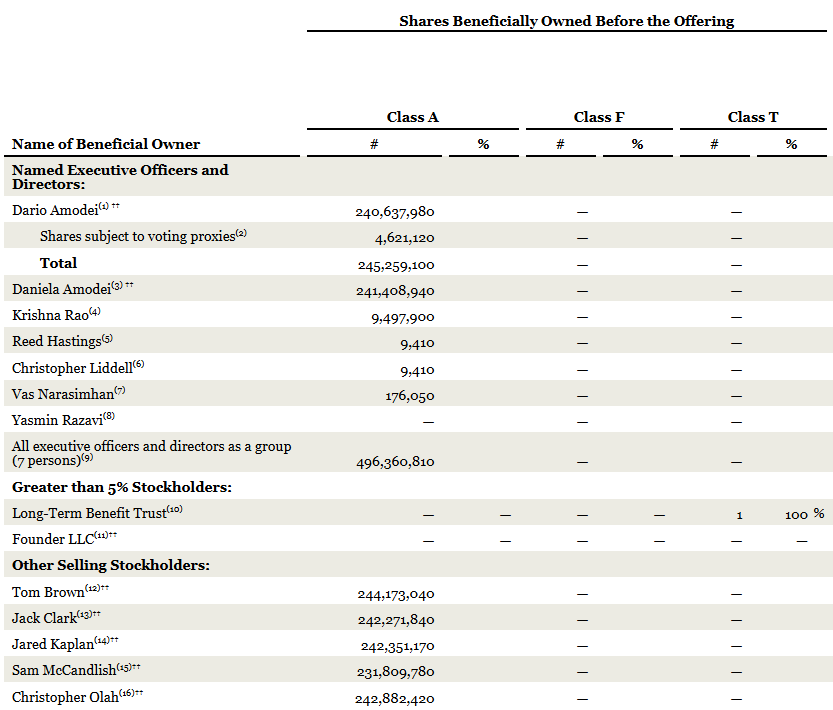
Source: S-1, Principal and Selling Stockholders (p. 288)
Not including any additional equity awards, each co-founder owns between 231 and 241 million shares of the company, with Dario holding 240 and Daniela holding 241 million. The price of the last round Series H was $58.90 after adjusting for stock splits. That means that Dario and Daniela each own about $14 billion worth of shares at the last round price. At a $2 trillion valuation, that could double their holdings to over $28 billion each.
For comparison sake, let’s go back in time to the Uber IPO in 2019. Co-founder and former CEO Travis Kalanick held just over $5B of Uber shares on the IPO date.
The co-founders have all pledged to donate 80% of their Anthropic equity to charity. Paging Dario and Daniela: Lowell High School could use some renovations and upgrades. Amodei Football Stadium has a nice ring to it.
The biggest equity numbers will sit with the founders and executives, but the employees will make out incredibly well. Let’s take a look at the option pool.
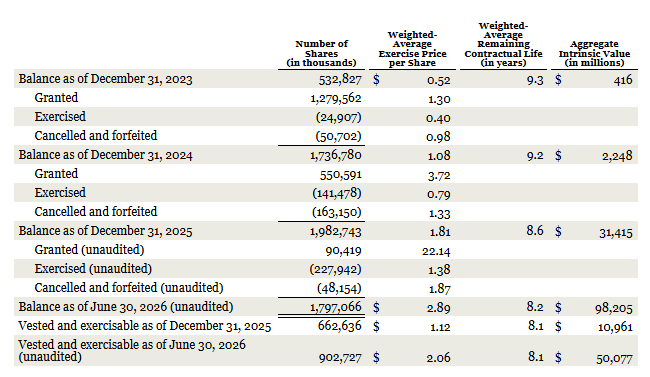
Source: S-1, equity plan note (F-50 to F-51)
In total, that’s just under 2.5 billion stock options issued, or in dollar terms ~$147 billion worth of shares handed out to executives and employees at the latest Series H valuation of $965 billion, or $58.90 per share. At a $2 trillion rumored IPO price, that would roughly double to ~$294 billion. What about the RSUs? There’s a little more than 1 billion RSUs outstanding adding another $117 billion shares to employees at the IPO price.
Let’s isolate just the 2023 and 2024 employees now and just the stock options. The S-1’s risk factor section mentions that employee headcount was about 940 employees as of December 31, 2024. By then, about 1.8 billion options were granted at a weighted average strike price of $1.08. Split evenly amongst all 940 employees, it would mean 1.9 million shares or roughly $112 million on paper at the Series H price and ~$224 million at the $2 trillion valuation.
The reality is that the equity is distributed unevenly including executives so think of it as an average, not a typical employee. But even as an average, that's still an incredibly amount of wealth for ~3 years at a company.
Because of the recency of these hires, a lot of these options have actually not vested yet. Only about 900 million are vested and exercisable as of June 30, 2026. Out of the just under 2.5 billion stock options granted, about 400 million have been exercised and another about 250 million have been forfeited. The IRS and California are likely salivating.
There are ~1.8 billion options outstanding at an average strike price of $2.89. Assuming the current 409A is also the price of the last round of $58.90, that’s an estimated $100 billion of ordinary income. If everyone lived in California, exercised, and sold today, that’s about $53 billion of taxes coming in just on the option pool if they are sold as unexercised options.
Almost every company that goes public via an IPO will implement some sort of lock-up period where existing shareholders are not allowed to sell. The investment bankers put in the lock-up period to stabilize the stock price as a flood of sellers right after the listing could pus the price down. The classic lock-up period is 180 days.
However, the recent trend in tech IPOs has been much more complex than the 180 days. The trend that Anthropic is following is a much more staggered lock-up period. Page 307 and 308 of the S-1 provides a detailed table.
Insiders such as certain employees that are not founders or key named individuals will be able to sell 10% of their holdings on day 1. This group will also be able to sell an increasing portion of their shares after the 27th, 48th, 62nd, and 76th day after the IPO. An additional percentage of shares get unlocked following the FY 2026 earnings release and again after the Q1 FY 2027 earnings release. This group will be able to sell all their shares following the 180th day after the IPO.
Anyone that owns more than 0.5% of the shares and the founders will be subject to a full 365 day lock-up period, though founders may sell 29% after 180 days.
In addition, double-trigger RSU holders will net settle on the IPO date. Those holding RSUs that have already met their time-based vesting condition will vest and net settle. That means that they will pay taxes by writing a check or selling shares back to the company, and start the clock on capital gains on the remaining shares.
Congratulations again to all those who helped build Anthropic. For the rest of us, let’s hope for a successful IPO which will help open the window for others down the road.
As always, feel free to reply and let me know what you think. Until next time!
Things we're digging: