💫Teamwork Makes the Dream Work

0 result
Hi there. We are truly in the depths of the dog days of summer. If you haven’t had an outdoor activity or flight canceled because of the weather (heat, thunderstorm, wildfire smoke, or… tornado warning?), count yourself lucky. If you’re in New York and have managed to procure tickets to see the Odyssey in IMAX 70mm, also count yourself lucky.
Let me introduce myself. I’m Aria Woodley, and I’ve recently joined the Secfi team as the Head of Ecosystem Partnerships. I’ve spent my career in financial services, starting my career as a financial advisor during the Great Recession. I remember when Facebook went public and when NVIDIA traded for literal pennies (I had a client who was well ahead of his time and would call me every week to buy shares). I saw the writing on the wall and “the democratization of finance” in real time before my eyes when robo-advisors started disrupting the industry (Wealthfront, Betterment, I’m looking at you), decided to go to business school, and pivoted into product management.
Since I’ve worked primarily at fintechs focused on personal finance, including as a CEO and co-founder. You can imagine that after almost 20 years in the world of finance and startups, I’ve seen a few things. Not as many as Thomas Middleditch or Harper Stern, but enough to know that there is a lot of confusion around startup equity.
Starting with…. You (usually) need to buy it
Last week, Carta shared an astonishing stat. According to their research, roughly two-thirds of options issued to startup employees are never exercised. And while options going unexercised are inevitable since the vast majority of startups fail, unexercised options due to a lack of education or cash on hand are pretty heartbreaking for the employees who help a company succeed.
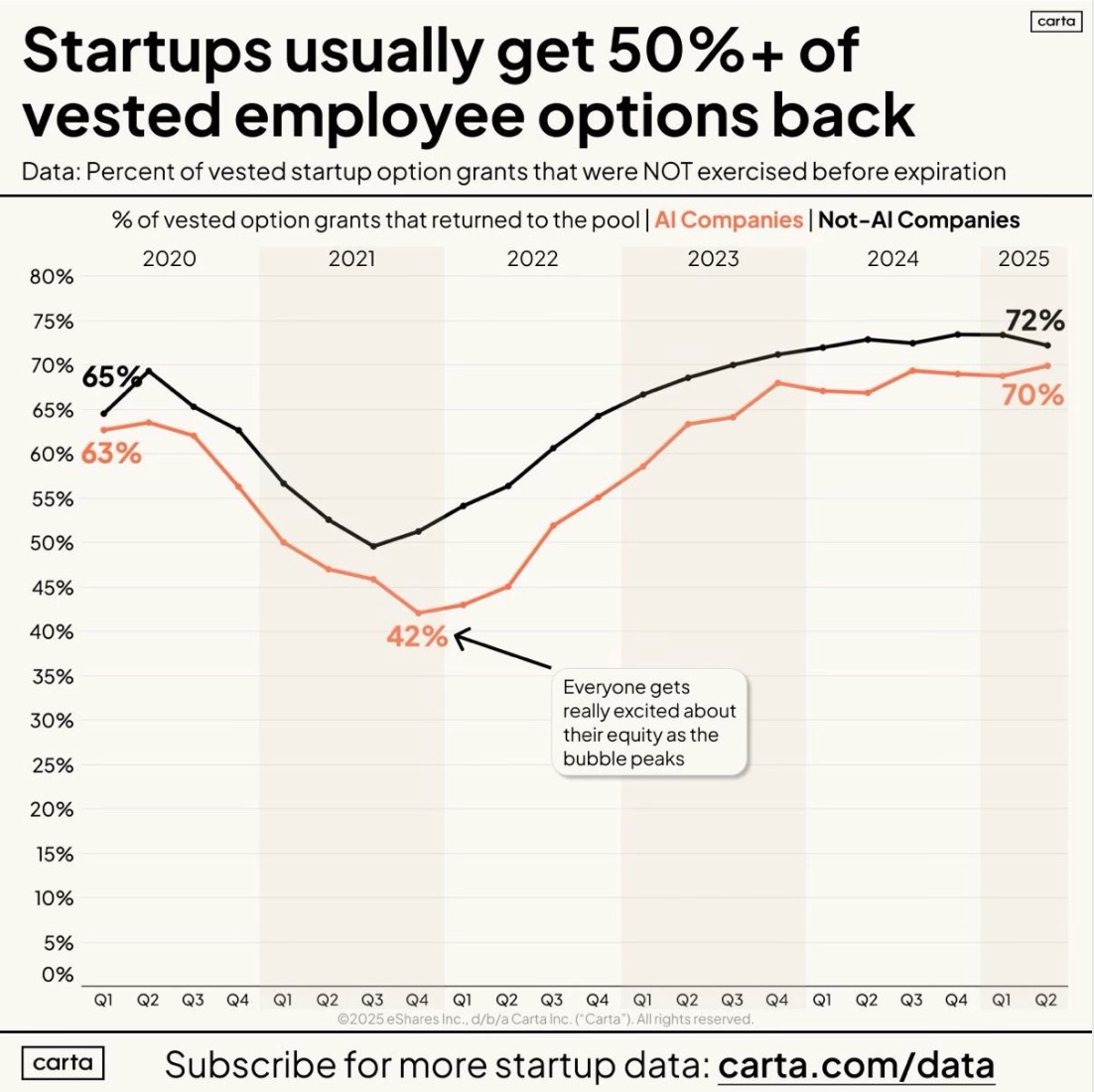
Source: Peter Walker Linkedin Post as of 8/26/2026
Two of the top reasons? They don't know they have to. And if they do know, they don't have the cash on hand to pay the exercise cost. Despite what many believe, the ISOs that startup employees generally receive are not company shares. Instead, they are stock options that give the holder the right to purchase shares in the future at a set price (the strike price), as outlined when the grant is issued. To participate in a liquidity event, you must own the shares, not just the options.
How much are we talking?
The cost of each of those options plus the difference in the change in value at the time you purchase the options could (and most likely will) result in taxes that you need to pay, either at the time of exercise, at the end of the year when you file your taxes, or both. This comes as a shock to many, especially those who have seen their options grow through multiple funding rounds and rising valuations, and now face a large differential between their strike price and the company’s 409A valuation. You can do all the right things, get the good news that there is an exit on the horizon, and exercise your options, expecting a massive payday, only to be surprised by a massive tax bill.
Another heartbreaker is the person whose company IPOed at a hefty share price but never divested their concentrated position (go big or go home, right?), and they end up losing a large chunk of their net worth because their company's stock accounted for 80% of their portfolio. (Disclosure: I’m not a financial advisor, so I’m definitely not your financial advisor, and this isn’t investment advice.)

Teamwork makes the dream work
As a startup employee, having a team—a financial advisor and a CPA—to go to for advice is crucial. You’re already taking on more risk than most by working at a startup, and having a team to help you navigate the investment and tax implications associated with owning equity improves the likelihood that you can reap the full reward for the risk you’re taking.
To be clear, this isn’t just something you should wait to do until an exit event is on the horizon. Benjamin Franklin said it best. Only two things in life are inevitable: death and taxes. (But, at least the taxes you can see coming.) Working with a financial advisor, planner, and tax specialist to plan ahead for various scenarios can help you proactively strategize around taxes, cash flow, income, and vesting schedules so that, if a liquidity event occurs, you can help maximize your upside.

Take some time this summer before things get crazy with back-to-school, conference season, college football season, and the GTA 6 drop. Meet with your team and review your equity situation. And if you’re a financial advisor or someone who helps startup employees navigate the complexities of their equity situation, feel free to reach out.
Things we’re digging: