🚀 SpaceX Employees Just Had Their Best Day. The IRS Too.

0 result
San Francisco native (yes, really). @uw and Lowell High alum. I like to nerd out on fintech, stock options and taxes.
Hey All
Vieje back today writing from New York. Between the Knicks run, the World Cup, and the SpaceX IPO, the city is absolutely buzzing. It’s been a great start to summer, but today especially marks a historic day.
SpaceX officially debuted on the Nasdaq under ticker SPCX making the largest IPO in history at a $1.77 trillion valuation. To put that in perspective, SpaceX is currently valued higher than Tesla and Meta.
For the tens of thousands of SpaceX employees, it’s the day that everyone’s been waiting for. Congratulations to all those who helped build the company! Any employee at SpaceX has had the opportunity to participate in their annual tender offers and obtain liquidity prior to the IPO so this isn’t their first opportunity to cash in. However, with the valuation at $1.77 trillion, the numbers are staggering and the stakes have skyrocketed.
This wouldn’t be Founders & Funders if we didn’t talk about employee equity, so let’s talk about what today means for SpaceX employees, their equity, and why the IRS may be excited too.
With a gigantic market cap and large capital expenditures comes a significant stock option plan. Afterall, rocket scientists are not cheap to employ. Per SpaceX’s S1, there were approximately 492 million unexercised stock options outstanding.
At the $135 IPO price, this represents almost $60 billion dollars of value after subtracting the strike price of the options. In addition, that is simply just the unexercised stock options and does not include the actual exercised options and resulting common stock. The unexercised options represent just about 3.9% out of the ~13 billion outstanding shares.
Of course, that does not mean that the full $60 billion goes to employees. The government needs to take their cut too. If all those unexercised options were exercised and sold the same day in California, the tax bill could be up to 52% or about $31.5 billion.
How big of a cut entirely depends on a critical employee decision: when to exercise those stock options.
Assume that Carly joined SpaceX in 2019. She lives in California and was granted 100,000 ISOs at $4.40 strike price. We’ll use rounded post-IPO stock split numbers to be consistent.
An option grant does not mean you own the shares, you first have to exercise those stock options by paying the company the strike price, and likely also pay a tax bill. Carly’s decision on when to exercise has different consequences.
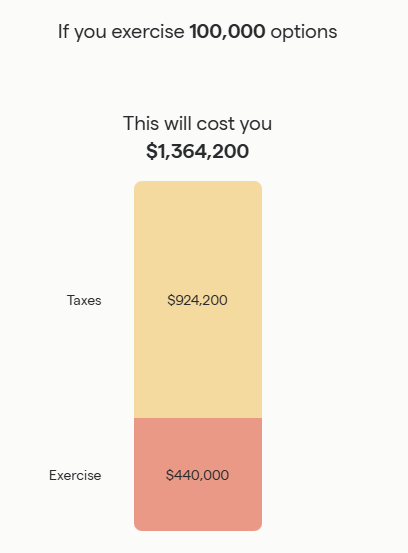
In 2024, with the 409A at $30, she exercised and paid $440k to SpaceX for the strike price plus roughly $924k in taxes, totaling about $1.4M. With the IPO still years away at that point, she locked in long-term capital gains treatment for when she eventually sells. The government got their cut early, and a smaller cut at that.
For illustrative purposes only. Actual results may vary and there is no guarantee of any particular outcome. Assumptions: CA resident, married filing jointly, $200k base income
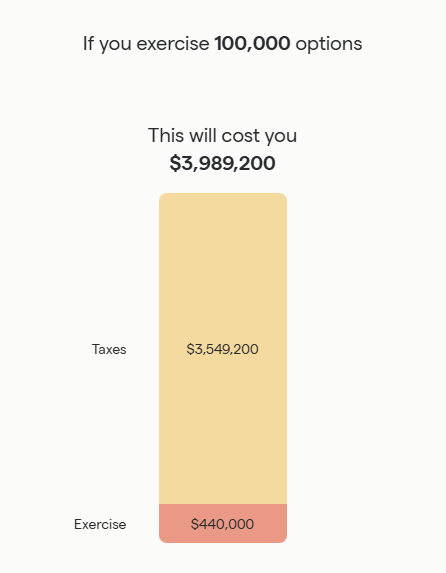
Let’s say she decided to hold off. Earlier this year in 2026 with the 409A at $105, she exercised her options. Her tax bill came to over $3.5M, roughly three times what she would have paid in 2024. Compared to exercising in 2024, she paid an extra $2.6M to the government for the same shares.
For illustrative purposes only. Actual results may vary and there is no guarantee of any particular outcome. Assumptions: CA resident, married filing jointly, $200k base income.
As tough as you think this employee has it for paying over $3M in taxes, she’s still likely in better shape than someone who chooses not to exercise. That is because with ISOs, you get preferential tax treatment if you exercise the options and hold for at least one year before selling the shares. You can effectively convert all the gains above the strike price to long-term capital gains tax rates at ~37% compared to ordinary income tax rates of ~52% (combined Federal and California rates).
By exercising earlier this year, she paid lower taxes on exercise than she would have at the IPO price, and also started the clock on the preferential tax treatment. Voluntarily paying almost ~$4M to exercise her stock options sounds like a crazy idea, but let’s see why someone would want to do this.
For illustrative purposes only. Actual results may vary and there is no guarantee of any particular outcome.
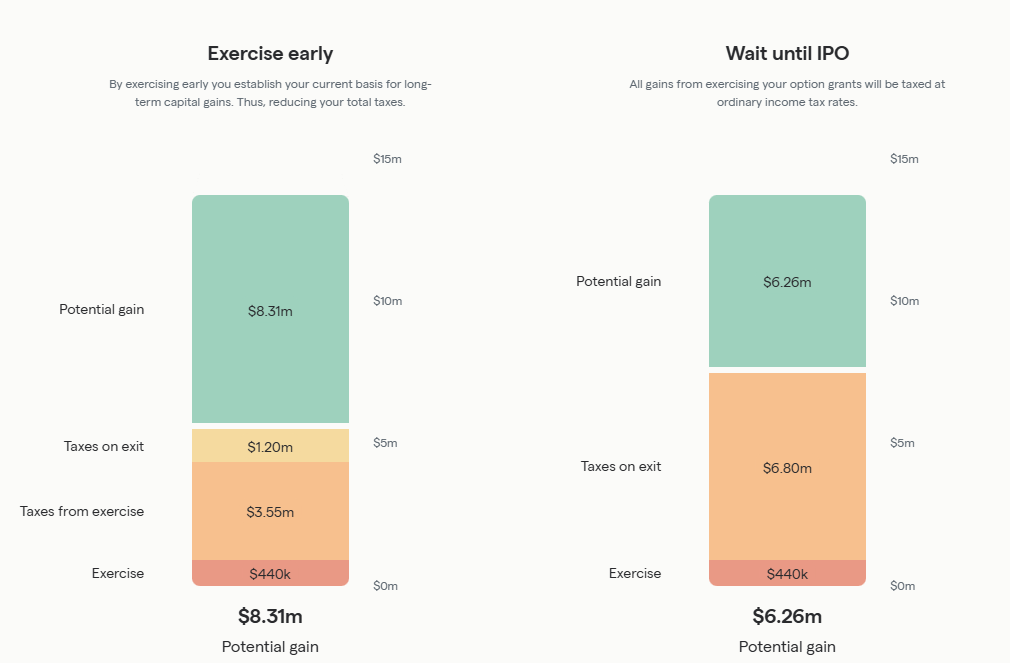
The employee who exercised and held a year before selling at the IPO price of $135 came out with ~$8.31M after taxes compared to someone who did a cashless exercise effectively exercising and selling the same day resulting in a gain of ~$6.26M.
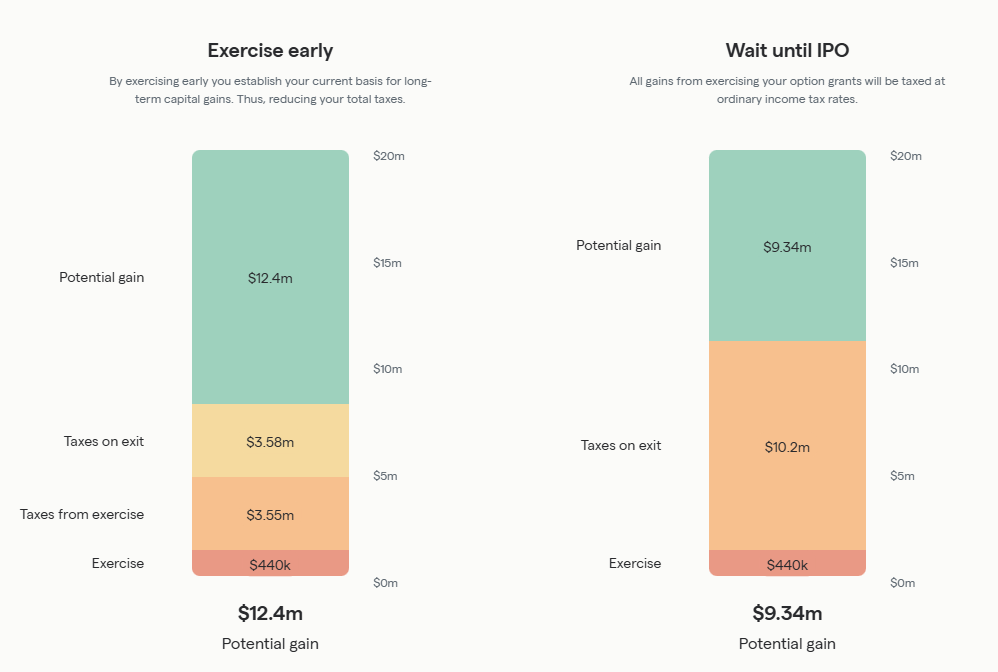
Let’s say that in the next few months, the stock price continues to climb up to $200 per share and the employee decides to sell her shares.
For illustrative purposes only. Actual results may vary and there is no guarantee of any particular outcome.
In this case, she’ll sell her shares for $20M, pay long-term capital gains tax on all the appreciation above the strike price, and recover the previous alternative minimum tax (AMT) she paid resulting in a potential gain of ~$12.4M. Compare that to paying ordinary income tax on the full $20M which results in a ~$9.3M gain.
Both are great outcomes of course. Most people do not get the chance to work for a company that goes through a major IPO, let alone get to a multi-million dollar payout, but millions of dollars in an extra tax bill is a hard pill to swallow.
Of course, the decision to write the check to exercise is a difficult one and not every company will have a great outcome like SpaceX, but if you are on a rocketship (sorry, I had to) then you should at least consider the thought of exercising especially given SpaceX’s regular tender offers in the past.
Regardless of the employees tax bill, SpaceX employees made out well and perhaps better than most thought this would have been possible when they joined. So regardless, it’s a day of celebration rather than mulling over what could have been.
The next important decision for the employee base with equity is when to sell their shares. There is a staggered lock-up period starting with a 20% release in July. Where does the stock go from here? Of course, no one knows for sure. The post-IPO world is a volatile one and there will be a lot of attention whichever way the stock trades in the next few quarters.
That’s it for now. We’ll be back with lots of coverage of SpaceX and perhaps other IPOs this summer. In the meantime, I hope everyone enjoys this historic day and tops it off with an epic US Men’s National Team win!
Feel free to reply and let us know what you think.
Things we're digging: