QSBS vs AMT: should I exercise my ISOs now?

7 min
0 result
John’s a Director at Secfi, helping founders, executives and employees navigate equity compensation and access to liquidity through his expertise in finance.
Deciding when to exercise your incentive stock options (ISOs) often comes down to a tension between locking in a massive tax break and managing an immediate tax bill. While the Qualified Small Business Stock (QSBS) exclusion can potentially let you exclude up to 100 percent of your capital gains from federal taxes, qualifying requires you to exercise your options and hold the shares for at least five years.
At Secfi, we feel that understanding this trade off is the first step in making a strategic decision about your equity.
In our view, the choice of when to exercise depends on your startup's stage, how certain you are that the company qualifies for QSBS, and your personal comfort with financial risk.
Your timing should be driven by the specific circumstances of your grant and the company's valuation.
You may want to consider exercising your shares immediately if you meet several of the following criteria:
This approach is common for employees at early stage startups where the price spread is still modest.
In our experience, waiting to exercise can be a reasonable strategy if:
We believe that accurate modeling is the only way to see the true impact of AMT versus potential QSBS savings.
Maeve is our AI equity assistant designed to handle the nuances of stock option math. You can import your grants directly from Carta or enter them manually to get started.
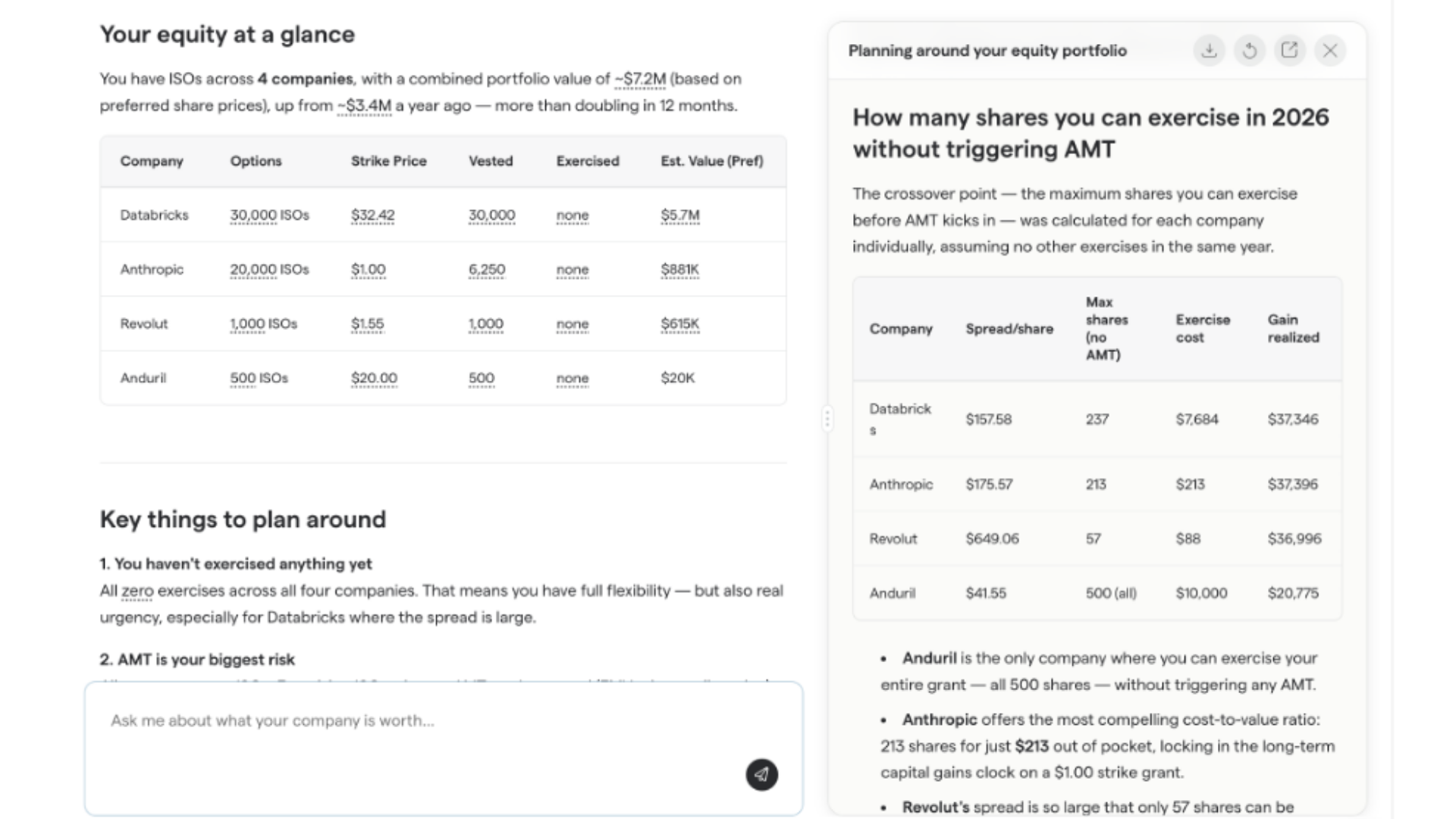
For illustrative purposes only. Actual results may vary and there is no guarantee of any particular outcome.
Some employees prefer to build their own models to track their vesting schedule. While this allows for full control, it requires a deep understanding of parallel tax systems. We have found that manually calculating AMT is often difficult because the IRS runs two parallel systems every year, and the delta between them determines your bill.
Before you write a check to your company or the IRS, we feel you should answer these questions:
"For the IRS to make a determination that it is qualified small business stock, you basically have to prove your case... with all the proper documentation and all the details necessary." – Eric Thompson, Equity Strategist at Secfi
For many startup employees, the biggest barrier to exercising stock options is the upfront cost. Depending on your company and the type of options you hold, you may also face a significant tax bill when you exercise.
If you're still within the window to qualify for QSBS, it's worth exploring your funding options as early as possible. Exercising before your company exceeds the QSBS eligibility thresholds may allow you to start the holding period sooner and potentially maximise the tax benefits available.
For employees at later-stage private companies, non-recourse financing can make exercising possible without requiring you to use your own savings. This is the type of financing Secfi specialises in.
Non-recourse financing is a cash advance designed to cover both the cost of purchasing your shares and the taxes you may owe. While it may sound like a traditional loan, we believe the structure is quite different:
While Secfi financing is generally designed for later-stage private companies (where QSBS eligibility may no longer be available) it can still help employees exercise their options, help manage liquidity needs and participate in future upside without taking on personal financial risk.
Secfi was one of the first providers to offer this at scale. Beyond just funding, we provide wealth management for startup executives and employees to ensure that financing fits into a broader financial plan. If financing is not the right fit, we can also operate as a broker to help you sell pre-IPO shares on secondary markets.
Read more: How Secfi financing works
We believe your decision depends largely on the balance between your long term financial goals and your current risk tolerance. Capturing the benefits of the Qualified Small Business Stock exemption can be a powerful way to build wealth, but it requires joining a company early and being prepared for the complexities of the AMT.
To make an informed choice, in our experience it helps to have a clear understanding of your company's current asset levels and a solid plan for managing any immediate tax obligations. Whether you decide to exercise now or wait for more certainty, we feel that careful modeling of different scenarios can help you navigate the process with more confidence.
The tool shown here uses artificial intelligence and is for illustrative purposes only and not necessarily indicative of future results and there is no guarantee that similar results can be achieved. The information provided by the tool is not professional advice and is not intended by Secfi, Inc., its affiliates, and Secfi representatives, to be deemed as investment, legal, tax or other professional advice or recommendations of any kind, or to form the basis of any decision to do or to refrain from doing anything. Secfi does not review the accuracy or completeness of the information provided to us within the tool.