Can I buy a house using my startup equity?

9 min
0 result
San Francisco native (yes, really). @uw and Lowell High alum. I like to nerd out on fintech, stock options and taxes.
Startup equity can sometimes help you buy a house, but it usually has to become cash, collateral, or part of a financing plan first.
People often ask this question when:
Your company just raised a big funding round, or there are rumors of an IPO.
Owning a home is starting to feel less like a distant dream and more like a real goal.
Something in your life changed, and you're hoping to buy a house sooner than expected.
Buying a house with your startup equity may be possible by selling shares through an approved sale or tender offer, borrowing against eligible stock, using non-recourse financing from a company like Secfi, or waiting for a future liquidity event.
The path for you depends on what kind of equity you have, whether your company is public or private, how soon you want to buy, and how much cash you may actually have after taxes, fees, and exercise costs.
Lenders usually view paper wealth differently than cash. Your equity could be worth millions in a grant portal, but unvested equity, unexercised stock options, and private company shares generally don't count as down payment funds unless they can become documented cash.
That said, startup equity may still help with mortgage qualification in some cases. A lender may consider public company stock, vested RSUs, or documented stock-based income, depending on their rules. Private company equity is usually harder to count because it may be illiquid, restricted, or difficult to value.
If your company is public, your vested shares may be easier to sell, borrow against, or document for a mortgage lender, though trading windows, taxes, and concentration risk still matter.
If your company is private, your equity is usually harder to use because it may be illiquid, restricted, or difficult to value. You may need company approval, a permitted liquidity event, or a financing option before it can help with a home purchase.
| Path | What it can help with | We believe this is best for | Main trade-off |
|---|---|---|---|
Sell shares through an approved sale or tender offer | Down payment and closing costs | Employees with public shares or an approved private-company liquidity window | You give up future upside on the shares you sell |
Use non-recourse financing | Exercising options while preserving cash | Eligible private-company employees who want to keep potential upside without using personal assets as collateral | Financing costs and giving up a portion of future proceeds after a successful exit |
Borrow against eligible public stock or liquid assets | Cash for a down payment without selling | Buyers with public stock or diversified brokerage assets | Interest costs, repayment obligations, and possible margin-call risk |
Use stock-based income or assets for mortgage qualification | Mortgage approval or borrowing capacity | Buyers with documented stock-based income, vested shares, or liquid assets | Lender-specific rules, documentation requirements, and possible asset haircuts |
Wait, save, or plan around a future exit | A future home purchase | Buyers with private equity and a flexible timeline | The company's valuation could fall, or liquidity could take longer than expected |
It can be tempting to just sell whatever shares your company approves, either through a tender offer or secondary sale. And in some cases, if the timing aligns, it can be a great way to get cash right away for a down payment.
If you need to exercise and sell quickly, the tax consequences may be less favorable than exercising earlier and holding longer, depending on your option type and timing. You also may not get as high of a valuation as you might have if you waited for an IPO, acquisition, or another more competitive liquidity event.
Most importantly, you lose out on potential income if your company grows more in the future.
The decision to sell is often a choice between certain cash today and potential wealth tomorrow. As Vieje Piauwasdy, Head of Secfi Liquidity, notes:
"The upside is the big one. When you sell your shares, you lose that upside. People can end up thinking, 'This company is doing really well, why did I do that?'"
Non-recourse financing is one way to keep potential upside without selling your shares.
Read more: What is non-recourse financing for stock options?
The number that matters for your house fund is your after-tax take home amount, not the gross value of your shares. If you have Incentive Stock Options (ISOs), you may face a large bill for the Alternative Minimum Tax (AMT) upon exercise.
If you don't take this into account and model with a tool like Secfi's Maeve, you might find the money available for an expected down payment significantly reduced.
Read more: The surprise factor in equity planning.
Non-recourse financing can be an option for eligible employees who want to exercise options without draining the cash they may need for a home purchase. Instead of selling shares to create cash today, financing may help cover your exercise cost and associated taxes while letting you keep potential future upside.
The trade-off is that you may give up a portion of future proceeds after a successful exit.

At Secfi, we provide non-recourse financing that's typically repaid only after a successful IPO or acquisition. That means you are not required to make monthly payments like you would with a traditional loan, and your personal assets aren't used as collateral. In some instances we provide additional liquidity from your shares, though it may not be enough to fund a full down payment on its own.
Secfi has provided more than $800 million in funding to eligible startup employees and executives. That funding can help bridge the gap between equity that looks valuable on paper and shares you actually own, without forcing you to use personal savings right before a major life decision like buying a home.
Secfi's AI equity assistant, Maeve, is designed to help you model different scenarios if you're interested in buying a house using your startup equity and other milestones.
Maeve lets you import grant details directly from Carta to see your actual vesting schedule and strike price.
Get started in seconds with Maeve by connecting to Carta.
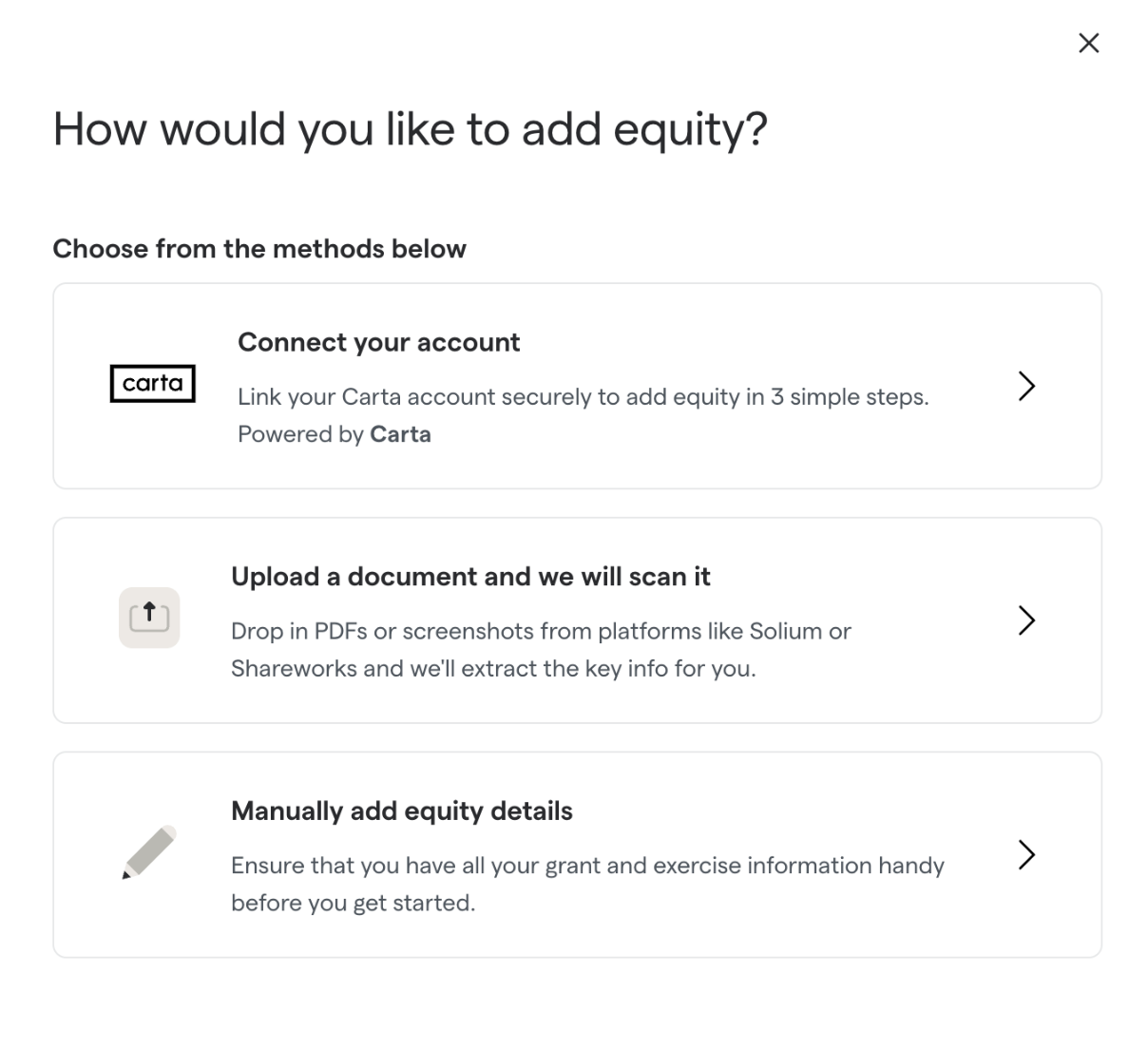
For illustrative purposes only. Actual results may vary and there is no guarantee of any particular outcome.
You can use Maeve to:
Estimate how much home-buying cash your equity could realistically create after exercise costs, taxes, and fees.
Compare whether selling shares, using financing, or waiting for a future exit could leave you in a stronger position to buy a house.
Model how much personal cash you may preserve for a down payment, closing costs, and reserves.
See how different company outcomes could affect your ability to use equity for a home purchase.
If you prefer to work with a team, Secfi's Wealth team includes certified financial planners who can help you build a personalized plan around equity, liquidity, taxes, and major goals like buying a home.
Amanda is a startup employee who wanted to exercise her options without draining her savings. She knew that taking out a traditional bank loan could increase her debt to income ratio, potentially making it harder to qualify for a mortgage later.
By choosing non-recourse financing, Amanda was able to own her shares without putting personal assets at risk or adding traditional debt to her credit profile. This move was designed to help keep her financial options open for a personal home purchase down the road.
Testimonials are specific to an individual Client's experience and may not be representative of all Clients. Unless otherwise indicated, Clients offering a Testimonial do not receive compensation and their statement does not present a conflict of interest.
Startup equity can potentially support a home purchase, but only if the path fits your timeline, lender requirements, tax situation, and comfort with risk. Before you build a home budget around your equity, model the after-tax cash you may actually have available and talk to your lender early.
You also don't always have to choose just one path. You could choose a blended strategy, such as selling some shares if an approved sale is available, using financing to exercise or hold others, and keeping enough personal cash for the home purchase. Basically, don't treat exercising or financing as an all-or-nothing decision.
Generally, no. Most lenders require funds to be in a verified bank account. You usually need to sell the shares or obtain financing to turn that equity into documented cash before it can be used for a down payment.
Some specialized lenders may consider a history of vested RSUs as part of your total compensation. However, unvested units are typically excluded from income calculations because they are not yet guaranteed.
The tool shown here uses artificial intelligence and is for illustrative purposes only and not necessarily indicative of future results and there is no guarantee that similar results can be achieved. The information provided by the tool is not professional advice and is not intended by Secfi, Inc., its affiliates, and Secfi representatives, to be deemed as investment, legal, tax or other professional advice or recommendations of any kind, or to form the basis of any decision to do or to refrain from doing anything. Secfi does not review the accuracy or completeness of the information provided to us within the tool.