How can I buy a house without selling my startup stock?

8 min
0 result
John’s a Director at Secfi, helping founders, executives and employees navigate equity compensation and access to liquidity through his expertise in finance.
You may be sitting on startup stock that could be worth a lot, but selling it to buy a house can feel painful.
A sale gives you cash today, but it also means giving up future upside on the shares you sell. And if your company is still private, selling may not even be available unless there is a tender offer, approved secondary sale, or other liquidity event.
You may be able to buy a house without selling startup stock with an SBLOC (Securities-Backed Line of Credit), savings, non-recourse financing from companies like Secfi, or a mortgage based on income. Your path depends on whether your shares are vested, exercised, transferable, and valuable enough to support financing without creating too much personal risk.
Before assuming you can use your equity to help with a home purchase, you need to understand the constraints of your specific grant.
Vested vs. unvested. You generally cannot finance or sell unvested options. Most financing providers only work with vested equity.
Exercised vs. options. Some lenders require you to own the shares (exercised) before they can be used as collateral. Others, like Secfi, provide financing specifically to help you exercise those options.
Transfer restrictions. Private companies often have rules in their bylaws that prevent you from pledging, transferring, or selling shares without board approval.
Eligible collateral. Many traditional banks don't recognize private startup stock as usable collateral because it is illiquid and difficult to value accurately.
There are several ways to buy a house without selling your startup stock, each with their own trade-offs. Let's start with a side-by-side comparison of popular ways to buy a house, then get into each in a bit more detail.
| Method | Best for | Impact on startup upside | Main trade-off |
|---|---|---|---|
Use a traditional mortgage with income and savings | Buyers who can qualify without touching their startup stock | None, because you keep the stock | Requires enough income, savings, and reserves to qualify |
Use non-recourse financing | Eligible employees who want to exercise options while preserving personal cash | Preserves potential upside, but you may owe a portion of proceeds after a successful exit | Eligibility requirements, financing costs, and private company risk |
Borrow against public stock with an SBLOC | Buyers with publicly traded, eligible securities | You keep potential upside, but share some future proceeds after a successful exit | Margin-call risk, variable rates, and potential mortgage underwriting impact |
Borrow through a traditional loan | Buyers who need extra cash but want to avoid selling stock | None, because you keep the stock | Adds personal debt and may affect your debt-to-income ratio |
Wait, save, or reduce the home budget | Buyers whose equity is too restricted, expensive, or risky to use | None, because you keep the stock | Delays the purchase or limits the home budget |
This is often the most straightforward path. If your base salary, bonus income, and cash savings are enough to satisfy a lender's debt to income ratio, you can keep your startup stock untouched. This is a strong option if you have enough liquid assets to cover a down payment. But with the high cost of housing in many areas, it's not always a possibility.
If you don't have the cash to exercise and pay the related taxes, or just want to avoid putting a lot of it into a single investment like your company, non-recourse financing could be a fit. It provides the capital needed to own your shares outright. By exercising earlier, you may also start the capital gains holding period sooner.
Non-recourse financing is usually designed so that if your company doesn't have a successful exit, the funder takes on the downside risk.
If you hold public stock or other brokerage assets, you might consider a Securities-Backed Line of Credit (SBLOC). This lets you borrow against the value of a liquid portfolio without selling the underlying investments.
A traditional personal loan may also provide cash without selling startup stock, but it usually creates monthly repayment obligations. Those payments can affect your debt-to-income ratio, which may matter if you're applying for a mortgage.
In some cases, the cost of financing or the uncertainty of the equity makes waiting the most prudent choice. Reducing your home budget can also help you avoid liquidating stock that you believe will grow significantly in value.
Traditional loans or SBLOCs are usually recourse debt, meaning you are personally liable for the full amount. If the collateral value drops, the lender can often come after your other personal assets. Non-recourse financing is fundamentally different.
Repayment is typically tied to a successful liquidity event, such as an IPO or acquisition. As John Klingler, Equity Strategist at Secfi, explains "Non-recourse financing is a way for startup employees and executives to have cash today, exercise their stock options, or access liquidity without creating a sale of the equity."
Because non-recourse financing typically doesn't have monthly payments like a traditional loan, it can help free up cash. It also usually means your debt-to-income ratio isn't negatively impacted like a traditional loan, which may help when getting a mortgage.
Learn more: How Secfi financing works – our business model explained.
Deciding how to fund a home purchase requires seeing the math behind each path. Secfi helps startup employees and executives understand these choices through modeling and with our team of equity strategists and financial planners.
Secfi's free AI equity assistant, Maeve, can help you model different scenarios if you're thinking of buying a house without selling your startup stock. You can:
Estimate whether you can exercise or keep shares without draining cash needed for a home purchase.
Compare non-recourse financing, selling shares, waiting for an exit, or using personal cash.
Model how much personal cash you may preserve for a down payment, closing costs, and reserves.
See how different exit outcomes could affect the value of keeping your startup stock.
You can also import your grant details directly from Carta to ensure the modeling is based on your actual vesting schedule.
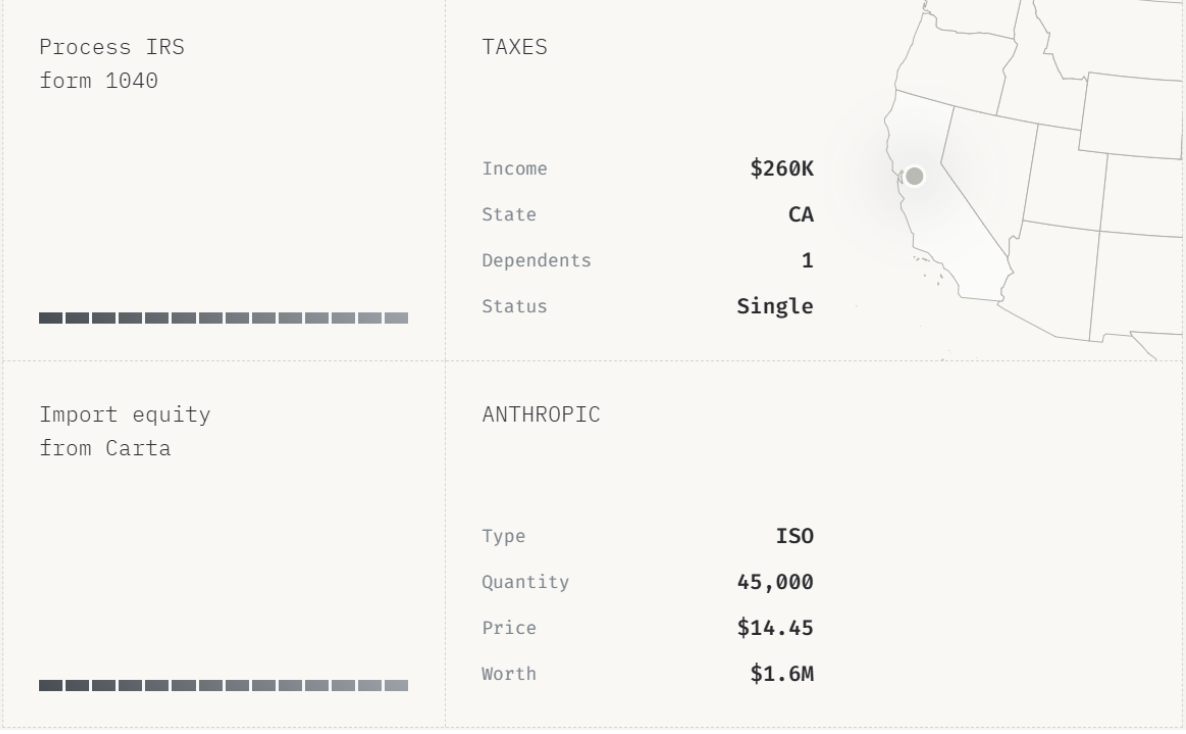
Image: Maeve providing personalized equity suggestions based on equity information from Carta.
For illustrative purposes only. Actual results may vary and there is no guarantee of any particular outcome.
If you prefer to work with people directly, our Wealth team can help you come up with a personalized financial strategy to help you achieve your goal of buying a home. You don't need to use our financing to work directly with our team of advisors.
While preserving upside might be your goal, sometimes selling a portion of your equity makes sense if you need cash right away for a down payment. However, depending on your option type, holding period, and transaction structure, the tax outcome may be less favorable than holding longer. In a private secondary sale, the price may also be lower than the company's latest preferred valuation or a future exit price.
Also, you need to double check with your company, as not all will allow the sale of shares on secondary markets.
Learn more: Should you sell your pre-IPO shares? Explore secondary markets and alternatives.
Choosing the best way to use stock options for a home purchase is a personal decision. The goal is not just to keep as much stock as possible, but to buy a home without creating a fragile financial plan. Modeling your liquidity options and tax exposure can help you make a decision that protects your future while letting you enjoy your life today.
Sometimes, but it depends on whether your stock is vested, exercised, transferable, and eligible for financing or collateral. Private company stock is often harder to use than public stock because it may be illiquid or restricted.
In some cases, yes, but it is not always available. Private company shares may be subject to transfer restrictions, company approval, valuation limits, or lender eligibility requirements.
Borrowing may help you keep some future upside, while selling can create clearer cash for a down payment. The better choice depends on your liquidity needs, tax impact, company outlook, concentration risk, and comfort with debt or financing costs.
It might. Traditional loans can affect your debt-to-income ratio and monthly obligations, while other financing structures may be reviewed differently depending on the lender. Ask your mortgage lender before using financing close to a home purchase.
Some of the main risks are concentration risk, valuation uncertainty, limited liquidity, and taking on too much financial pressure while much of your wealth is still tied to one private company. Keeping the stock may preserve upside, but it can also leave you exposed if the company's value falls.
We recommend that you estimate your down payment, closing costs, reserves, exercise costs, taxes, financing costs, and monthly mortgage payment. Then compare those costs with your liquid cash, income, and realistic equity scenarios.
The tool shown here uses artificial intelligence and is for illustrative purposes only and not necessarily indicative of future results and there is no guarantee that similar results can be achieved. The information provided by the tool is not professional advice and is not intended by Secfi, Inc., its affiliates, and Secfi representatives, to be deemed as investment, legal, tax or other professional advice or recommendations of any kind, or to form the basis of any decision to do or to refrain from doing anything. Secfi does not review the accuracy or completeness of the information provided to us within the tool.