What is the $100k rule? A guide to the ISO/NSO split
16 min
0 result
Stock options can be one of the most valuable parts of your compensation package, but they come with complex tax rules that might catch you off guard. One rule that affects almost anyone who has a substantial options grant: the $100k limit, also known as the $100k rule or ISO/NSO split.
This rule determines whether your options qualify as Incentive Stock Options (ISOs) or whether part of your grant is treated as Non-Qualified Stock Options (NSOs).
That distinction can change how your options are taxed when you exercise. You could:
Owe ordinary income tax on the NSO portion
Face alternative minimum tax (AMT) on the ISO portion
Discover that your exercise costs with taxes are much higher than expected
Notice the split only when you're preparing to exercise or leave your company
Understanding how it works before you exercise can help you estimate the cost, plan around the taxes, and avoid finding out too late that your grant is taxed in two different ways.
Note: Secfi's free AI equity assistant, Maeve, can review your grant details, help identify whether the $100k rule creates an ISO/NSO split, and model how the split may affect your exercise costs and taxes.
Both Incentive Stock Options (ISOs) and Non-Qualified Stock Options (NSOs) are types of employee stock options, meaning that they give the right to purchase stock at a predetermined price (your strike price). The key difference between them is how they're taxed.
ISOs offer preferential tax treatment. When you exercise them, you generally don't owe ordinary tax income immediately. In fact, if you hold the shares for long enough, any gains are taxed as long-term capital gains - meaning at a lower rate than your regular income tax.
NSOs are taxed differently. When you exercise them, the difference between your strike price and the current fair market value (FMV) is taxed as ordinary income immediately. You'll also owe capital gains tax on any additional appreciation when you eventually sell the shares.
The $100k rule limits the tax benefits of ISOs. By capping how much can vest as ISOs each year, it ensures that larger option packages still generate ordinary income tax revenue through the NSO portion.
Here's how it works: only $100,000 worth of stock underlying ISOs can first become exercisable in a calendar year, measured using the shares' fair market value on the grant date. Anything above that threshold must automatically be treated as NSOs.
There are a few things to keep in mind:
Vesting schedule determines the split. The rule applies based on how many options vest each calendar year. Within any year, the first $100k to vest are ISOs, and everything beyond that automatically becomes NSOs.
The limit resets annually. The cap resets every year on January 1st, as it's a per calendar-year calculation.
It happens automatically, in vesting order. You don't get to pick which options stay ISOs and which become classified as NSOs.
Early exercise affects split upfront. With early exercisable options, the entire grant counts toward the $100k limit in the grant year, potentially creating more NSOs immediately.
The alternative minimum tax (AMT) is a federal tax calculation designed to ensure certain taxpayers pay at least a minimum amount of tax. Exercising and holding ISOs can increase the income used in that calculation, even though you haven't sold the shares or received any cash.
The $100k rule doesn't directly create alternative minimum tax. However, it determines which options keep ISO treatment, and that affects how your exercise could be taxed.
When you exercise ISOs and hold the shares beyond the end of the calendar year, the difference between the strike price and the fair market value may count as income for AMT purposes. NSOs are treated differently: the difference is generally taxed as ordinary income when you exercise.
That means a single exercise involving an ISO/NSO split could create extra tax calculations. You may owe ordinary income tax on the NSO portion, and potentially trigger AMT on the ISO portion.
Secfi's AI equity assistant, Maeve, can help you identify which options are ISOs or NSOs and model the estimated tax impact before you exercise.
For illustrative purposes only. Actual results may vary and there is no guarantee of any particular outcome.
Here's a quick example, but remember always check with a tax professional for your own situation:
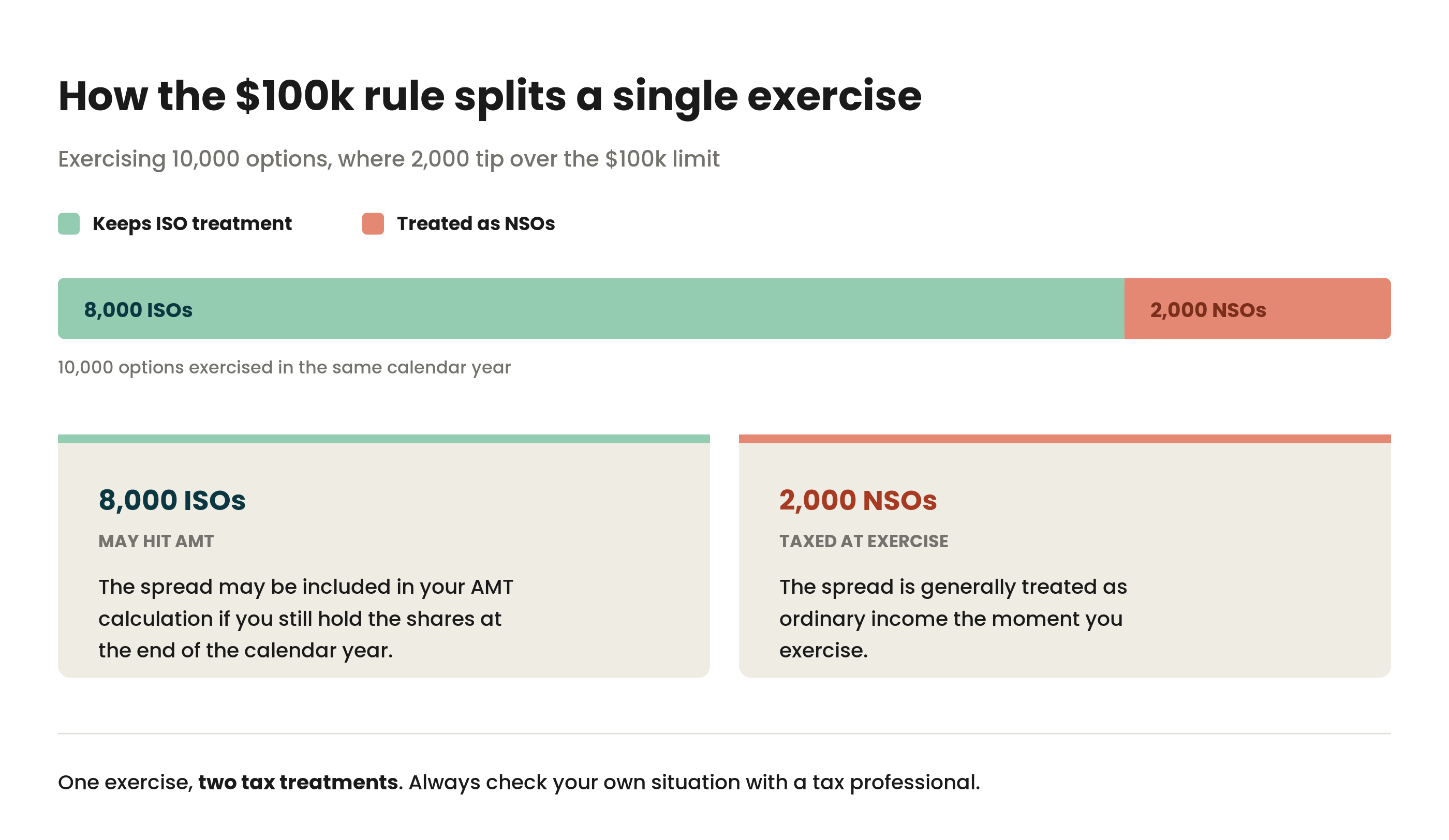
Suppose you exercise 10,000 options and 8,000 qualify as ISOs while 2,000 are treated as NSOs under the $100k rule. The spread on the 2,000 NSOs would generally be treated as ordinary income at exercise. The spread on the 8,000 ISOs may be included in your AMT calculation if you continue holding the shares after the end of the calendar year.
The size and timing of your exercise matter. Your income, filing status, strike price, current 409A valuation, and number of options exercised can all affect the result. Another consideration is that if you pay AMT after exercising ISOs, you may generate an AMT credit. It could potentially reduce your federal tax bill in a future year, but recovering the full credit can take time and depends on your tax situation.
Some companies offer early exercise options, which allow you to exercise options before they vest. This can be attractive for tax planning purposes, but it has a significant impact on how the $100k rule applies.
With early exercisable options, the entire grant is treated as exercisable in the year that it's granted. For example, if you receive a grant of 50,000 options at a $5 FMV with early exercise rights, all $250,000 counts towards the $100k limit in year one. Only the first $100k would qualify as ISOs, and the remaining $150k would be NSOs from day one.
Early exercise may help you start the ISO holding period sooner and potentially reduce the spread that could trigger AMT. However, it also means paying the exercise cost before your options vest and putting cash into illiquid private-company shares.
If the cost of exercising early is too high to cover out of pocket, non-recourse financing may be able to help. For eligible employees, it can cover both the exercise and tax costs, without putting your other personal assets on the line.
The best way to understand how it all works is to see it in action. Let's walk through a few common scenarios to show you how the calculations work and when you're likely to end up with a mix of ISOs and NSOs. Assume that each grant in each example is not early exercise options.
Remember that these are just examples and not tax advice; check with your tax professional before making any decisions.
Let's say you received 50,000 options on January 1st 2024, at a fair market value (FMV) of $5 per share (this is the same as the strike price at grant). The options vest over 4 years with a standard schedule, i.e., 25% after one year, monthly after that.
Total grant value: 50,000 * $5 = $250,000
Vesting schedule
| Year | Options vesting | Value at grant date | ISOs | NSOs |
|---|---|---|---|---|
2025 | 12,500 | $62,500 | 12,500 | 0 |
2026 | 12,500 | $62,500 | 12,500 | 0 |
2027 | 12,500 | $62,500 | 12,500 | 0 |
2028 | 12,500 | $62,500 | 12,500 | 0 |
Since only $62,500 worth of options vest each year, you stay under the $100k annual limit, and all 50,000 options remain ISOs.
You received 50,000 options on January 1st 2024, at a FMV of $12 per share. The options vest over 4 years with a standard schedule, i.e., 25% after one year, monthly after that.
Total grant value: 50,000 * $12 = $600,000
Vesting schedule
| Year | Options vesting | Value at grant date | ISOs | NSOs |
|---|---|---|---|---|
2025 | 12,500 | $150,000 | 8,333 | 4,167 |
2026 | 12,500 | $150,000 | 8,333 | 4,167 |
2027 | 12,500 | $150,000 | 8,333 | 4,167 |
2028 | 12,500 | $150,000 | 8,334 | 4,166 |
Since $150,000 worth of options vest each year, you exceed the $100k limit. Each year, approximately 8,333 options stay as ISOs, while the remaining 4,167 automatically become NSOs.
You have two options grants from the same company:
Grant A (January 1st, 2023) - 15,000 options at $8 FMV = $120,000 total value
Grant B (January 1st, 2024) - 20,000 options at $10 FMV = $200,000 total value
In 2025, there are portions of both grants that are vesting.
Vesting schedule 2025
| Grant | Options vesting | Value at grant date | ISOs | NSOs |
|---|---|---|---|---|
Grant A | 3,700 | $30,000 | 3,750 | 0 |
Grant B | 5,000 | $50,000 | 3,750 | 0 |
Total | 8,750 | $80,000 | 8,750 | 0 |
The combined value is only $80,000, meaning all of the vesting options for 2025 remain ISOs. Grant A gets priority because it was granted first.
In 2026, you get a new grant and more options vest:
Grant C (January 1st, 2026) - 10,000 options at $5 FMV = $150,000 total value
Vesting schedule 2026
| Grant | Options vesting | Value at grant date | ISOs | NSOs |
|---|---|---|---|---|
Grant A | 3,700 | $30,000 | 3,750 | 0 |
Grant B | 5,000 | $50,000 | 5,000 | 0 |
Grant C | 2,500 | $37,500 | 1,333 | 1,167 |
Total | 8,750 | $117,500 | 10,083 | 1,167 |
Understanding how the $100k rule works can have real financial implications for how you manage your equity compensation. When part of your grants convert to NSOs, your tax bill changes significantly, potentially costing you tens of thousands of dollars. For instance:
Exercise timing becomes strategic. The tax treatment differs between ISOs and NSOs, meaning you'll need to evaluate when to exercise each type based on your individual circumstances.
Cash flow planning is key. NSO exercise requires money for both the shares and tax withholdings on the spread. Without knowing, you could face unexpected upfront costs.
Alternative Minimum Tax (AMT) adds complexity. ISOs can trigger AMT at exercise, which combined with NSOs' ordinary income implications means you need to carefully model different scenarios. Make sure you review your particular circumstances with your tax advisor.
An ISO NSO split can change both the cost of exercising your options and the taxes you may owe. Secfi brings equity planning, financing, and specialized wealth management into one place, so you can understand the split and decide what to do next.
We've financed more than $800 million for startup employees, more than any similar companies.
Here's why employees and executives at companies including Canva, Uber, and Google work with Secfi.
Secfi's AI equity assistant, Maeve, helps you review your grant details and understand how the $100,000 rule may affect your options.
Once you connect your Carta account or enter your equity information, ask Maeve questions about your vesting schedule, ISO NSO split, strike price, exercise costs, and potential taxes. Maeve helps you compare different scenarios, such as exercising now, waiting, or exercising a smaller number of options over several years. It can help you decide if financing is worth considering based on your situation and comfort level.
Maeve combines AI with Secfi's specialized calculation engines and your equity information, so it can account for more of your personal context than a basic online calculator or generalist LLM. You can also double-check assumptions and see the reasoning behind Maeve's calculations if you ever want to confirm the information it's sharing.
Here's more on Why we built Maeve.
For illustrative purposes only. Actual results may vary and there is no guarantee of any particular outcome.
Understanding the ISO/NSO split is only part of the problem. You may decide that exercising makes sense, then discover that the strike price and tax bill are more than you can comfortably pay out of pocket.
Secfi offers non-recourse financing that covers both the cost of exercising your options and the associated taxes for eligible employees. Non-recourse financing means:
You retain ownership of your shares, so if your company does well in the future, you can still benefit from its success.
Repayment is generally only due after a successful liquidity event, such as an IPO or acquisition. You don't need to make monthly payments like a traditional loan.
If your company doesn't have a successful exit, you aren't personally liable for repayment. The funders can't come after your savings or other assets if the company doesn't perform as you'd hoped.
Based on our experience, your debt-to-income ratio isn't impacted. So unlike a bank loan, it likely won't impact your ability to get a mortgage or take out other unrelated loans.
If you're curious about non-recourse financing from Secfi, here are the details: How Secfi financing works – our business model explained.
An ISO/NSO split can affect more than one exercise decision. It may also influence your AMT exposure, ordinary income tax, cash flow, investment concentration, and long-term financial plan.
Secfi's Wealth Management team specializes in working with startup employees and executives. If you're confused about the ISO/NSO split and how it might impact your taxes or investments, and you want a person who works with these complexities every day, that's where we come in.
As certified financial planners (CFP®), our Wealth Team is required to act in your best interest. You don't need to take part in our financing or secondary sales to work together. They can tell you what you need if you choose to exercise or how to make the most of your NSOs. And importantly, they'll help you figure out how your stock options fit alongside other priorities, like planning for retirement or paying for your children's education.
That's different from many tax planners and financial advisors, who we find have often never dealt with AMT and the $100k rule. At the same time, our team can happily work with your existing financial planner if you just want another experienced voice at the table.
No matter who you work with, make sure they can answer these 5 questions startup employees should ask a prospective financial advisor.
After working for several years at a startup, Amanda and her team were given the option to convert their ISOs to NSOs. It wasn't an ISO NSO split under the $100k rule, but it forced her to weigh many of the same tax and planning trade-offs.
"That meeting set me off on this little bit of a panic," she said. "So I did a Google search and a lot of reading, and a lot of trying to understand tax implications."
She soon realized just how complicated (and expensive) stock options could become. Learning about AMT and capital gains tax muddied the waters further. It was time to bring in the specialists.
Working with Secfi and our tools helped her better understand ISOs, NSOs, and AMT.
"Knowing that I don't really have a safety net myself," she said, non-recourse financing made the most sense because it lowered her personal financial risk.
Read more: Why a startup employee used Secfi to buy her stock options.
Testimonials are specific to an individual Client's experience and may not be representative of all Clients. Unless otherwise indicated, Clients offering a Testimonial do not receive compensation and their statement does not present a conflict of interest.
The $100k rule can change how your grant is taxed, so it's worth confirming your ISO NSO split before making an exercise decision. With the right modeling, financing, and specialist support, you can make that choice with a much clearer view of the trade-offs.
Give Maeve a try if you want to start modeling your equity today, or reach out to our team directly.
An ISO NSO split happens when part of a stock option grant qualifies as incentive stock options and the remainder is treated as non-qualified stock options.
This commonly happens because of the $100,000 ISO rule. Under this rule, only the first $100,000 worth of ISOs that become exercisable in a calendar year can receive ISO tax treatment. Any amount above the limit is generally treated as NSOs.
Because ISOs and NSOs are taxed differently, it's important to know how your grant is divided before you exercise. Secfi's AI equity assistant, Maeve, can help you review your grant details and understand whether the $100,000 rule may have created an ISO NSO split.
No. The $100k rule only applies to Incentive Stock Options. RSUs never qualify for ISO treatment in the first place, so there's no ISO/NSO split to worry about with them. If your grant mixes ISOs and RSUs, the $100,000 limit only touches the ISO portion.
Learn more: RSUs vs stock options: Which is the best solution for startups?
Nothing happens at the moment of conversion itself, no tax is due yet. Once you exercise, the spread between your strike price and the fair market value at exercise counts as ordinary income instead of the more favorable long-term capital gains treatment ISOs can get. You'll also owe capital gains tax later on any further appreciation when you sell.
No. The conversion is automatic and follows vesting order. The first $100,000 worth to vest in a calendar year stays ISOs, everything past that in the same year becomes NSOs. There's no opt-in or opt-out.
Yes, on January 1st, based on the fair market value at grant, not at exercise. That's why a lumpy vesting schedule (a large one-year cliff, for example) can push more of a grant into NSO territory than a smoothed-out monthly schedule would, even for the same total grant size.
The limit is based on the fair market value of the shares when the options were granted, rather than their current value or the amount you may eventually make from them.
To calculate it, multiply the number of shares that first become exercisable during the calendar year by the stock's fair market value on the grant date. If the result exceeds $100,000, the options above the limit are generally treated as NSOs.
The calculation can become more complicated when you have multiple grants or overlapping vesting schedules. Maeve can help organize your equity details and answer questions about how the rule may apply to your options.
Yes. The ISO NSO split can affect when you owe tax and which type of tax may apply.
When you exercise NSOs, the difference between your strike price and the shares' fair market value is generally treated as ordinary income. ISOs don't usually create regular taxable income at exercise, but the same difference may count toward the alternative minimum tax if you exercise and continue holding the shares.
As a result, exercising a split grant could create ordinary income tax on the NSO portion and potential AMT exposure on the ISO portion. Maeve can help you estimate exercise costs and compare possible tax outcomes before you decide how many options to exercise.
You may be able to pay with savings, proceeds from selling other investments, a personal loan, or financing specifically designed for private company stock options.
Remember that your total cost may include both the strike price and taxes. The NSO portion could create ordinary income tax at exercise, while the ISO portion could contribute to AMT.
Maeve can help you estimate the potential cost first. If exercising makes sense but you don't want to use a large amount of personal cash, Secfi may also provide non-recourse financing to cover eligible exercise costs and taxes. With non-recourse financing, your personal assets aren't used as collateral, and repayment is tied to a future liquidity event under the terms of the agreement.
The tool shown here uses artificial intelligence and is for illustrative purposes only and not necessarily indicative of future results and there is no guarantee that similar results can be achieved. The information provided by the tool is not professional advice and is not intended by Secfi, Inc., its affiliates, and Secfi representatives, to be deemed as investment, legal, tax or other professional advice or recommendations of any kind, or to form the basis of any decision to do or to refrain from doing anything. Secfi does not review the accuracy or completeness of the information provided to us within the tool.