How do I turn my private company stock into a home down payment?

9 min
0 result
Mike’s a CPF® at Secfi. He specializes in helping clients make the most of their stock options and integrate equity compensation into their broader financial plans.
When you're about to buy a house, the stock equity that felt a bit nebulous in your grant documents suddenly gets more interesting.
On paper, your equity might be worth enough to cover a down payment. In real life, your mortgage lender probably doesn't care much about paper value unless that equity can become documented cash before closing.
But there are ways to make it work for you. You can turn private company stock into a home down payment through an approved sale, tender offer, future exit, or non-recourse financing from companies like Secfi.
The hard part is figuring out which path is available once you've read all the fine print, how long it could take, and if you actually have enough after taxes, fees, and exercise costs.
Private startup stock isn't the same as cash in a bank account. Most mortgage lenders require verified, documented funds that are already liquid. Because private shares are often illiquid or restricted by company bylaws, they cannot be easily converted to cash on the open market.
Private shares are also difficult for banks to value. Unlike a public stock with a ticker symbol, a startup's value is often based on the last 409A valuation or preferred price from a funding round. Lenders typically view these assets as too risky to count toward a down payment until the cash is sitting in your account.
Before making an offer on a home, verify the specific type of equity you hold. Different instruments have different paths to liquidity.
Unexercised stock options. These are rights to buy shares, not the shares themselves. They may be classified as ISOs or NSOs.
Exercised shares. Shares you already own outright.
RSUs. Often subject to double-trigger vesting, meaning they only become yours after a liquidity event such as an IPO.
Vested vs. unvested equity. Only vested portions can typically be sold or financed.
Transfer restrictions. Many companies have a Right of First Refusal (ROFR) or require board approval for any sale.
If you hold stock options, remember they aren't yet shares. Before your equity can become home-buying cash, your options generally need to vest, then you need to exercise them, then you need an approved way to turn the shares into money.
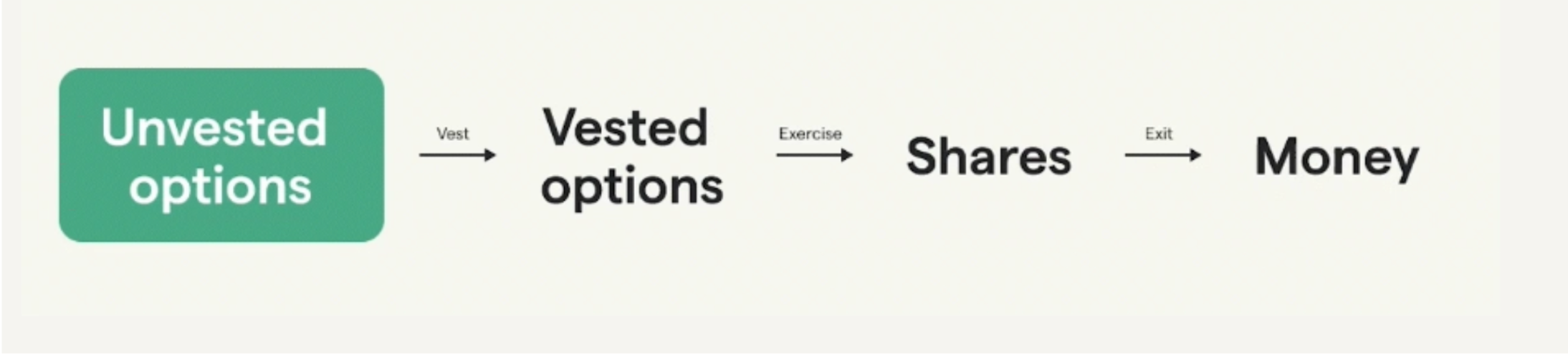
For illustrative purposes only. Actual results may vary, and there is no guarantee of any particular outcome.
The exercise step can come with real costs. You may need to pay the strike price to your company, plus taxes based on the spread between your strike price and the current fair market value.
Those costs can be significant, so it's important to account for them before assuming your equity value is ready for a down payment. The number that matters is not what your stock options are worth on paper, it is what you may actually have left after exercise costs, taxes, and any liquidity or financing fees.
| Path | How it works | Who we believe this is best for | Key considerations |
|---|---|---|---|
Tender offer | The company organizes an approved sale to investors or buyers | Employees whose company is already offering a liquidity window | Timing, eligibility, and sale limits are controlled by the company |
Approved secondary sale | You sell shares through a company-approved secondary transaction or platform | Shareholders at private companies with strong investor demand | It can be hard to find a buyer. Usually requires company approval and may involve fees, discounts, or ROFR review |
Future IPO or acquisition | You wait for the company to go public or be acquired | Employees who don't need home-buying cash soon | Timeline is unpredictable and the eventual value may be higher or lower than expected |
Non-recourse financing | Eligible employees use financing to exercise options, cover taxes, preserve personal cash, or potentially access additional liquidity depending on the structure | Employees who want to keep potential upside without using personal assets as collateral | Eligibility is limited, and you may give up a portion of future proceeds after an exit |
Exercise and sell | You exercise options and sell the resulting shares through an approved sale path | Employees who need cash and have a permitted way to sell | May trigger ordinary income tax, AMT, or capital gains depending on equity type and timing |
Choosing a path to liquidity depends heavily on your specific home-buying timeline.
If you're hoping to buy your house in the next few months, prioritize cash that can be documented for your lender. Mortgage lenders usually want to see where your down payment funds came from, when they arrived in your account, and whether there are any repayment obligations attached to them.
A tender offer or approved secondary sale may be the cleanest path if one is already available, but you can't always rely on your company to offer liquidity on your timeline. You also need to confirm whether you are eligible to participate, and whether the sale can close before your home purchase.
Non-recourse financing from Secfi may also be an option for eligible employees, especially if your company is already approved and the financing timeline works with your home purchase. This could help you exercise shares, cover taxes, or preserve personal cash for the home purchase. In some cases, financing may also provide additional cash at your discretion, though it may not be enough to cover a full down payment on its own.
With more time, you may be able to explore a secondary sale, wait for an expected tender offer, or model whether financing could help you exercise without using the cash you want to keep for your home purchase.
This window may also give you time to consider a staged exercise plan, where you exercise some options in one tax year and more in another. That can sometimes help spread out the tax impact, especially if you have ISOs that could trigger AMT.
The main potential advantage is flexibility. You may not need to rush into the first available option, and you may have more time to compare after-tax cash, lender requirements, company restrictions, and your home-buying timeline.
If you're planning a home purchase years in advance, you may have more room to optimize around taxes and timing. Exercising earlier can start the capital gains holding period sooner, which may improve your after-tax outcome if the company eventually exits at a higher value.
You may also be able to compare more paths: using cash, exercising in stages, using non-recourse financing, waiting for a tender offer, or holding until a future IPO or acquisition.
The trade-off is that private company equity can stay illiquid for a long time. Exercising earlier may improve your planning options, but it also means putting money into shares that may not become cash when you need it.
Gross equity value rarely equals the cash you can put toward a house. Taxes often take a large bite out of your proceeds. We write more about this in The Surprise Factor.
Check which of the below are relevant to your stock options when planning for your home down payment:
Ordinary income tax. Non-qualified stock options (NSOs) are taxed at exercise based on your income bracket.
Alternative Minimum Tax (AMT). Incentive stock options (ISOs) can trigger a large AMT bill even if you haven't sold the shares.
Capital gains. Depending on your equity type and holding period, selling shares may trigger short-term or long-term capital gains tax.
Transaction fees. Secondary sales or financing platforms typically charge a percentage of the deal.
Secfi provides equity planning experience, tools, and financing so you can understand and act on your equity. Using stock options to potentially buy your own home is one of the perks of working hard at a startup, and our Wealth team of certified financial planners can help you create a plan to reach your goals.
Read more: How can a financial advisor help with your equity?
A good starting point is our free AI equity assistant Maeve. Connect with your actual grant details from Carta (or upload them manually) to get personalized calculations. You can compare different scenarios depending on your down payment timelines and stock options.
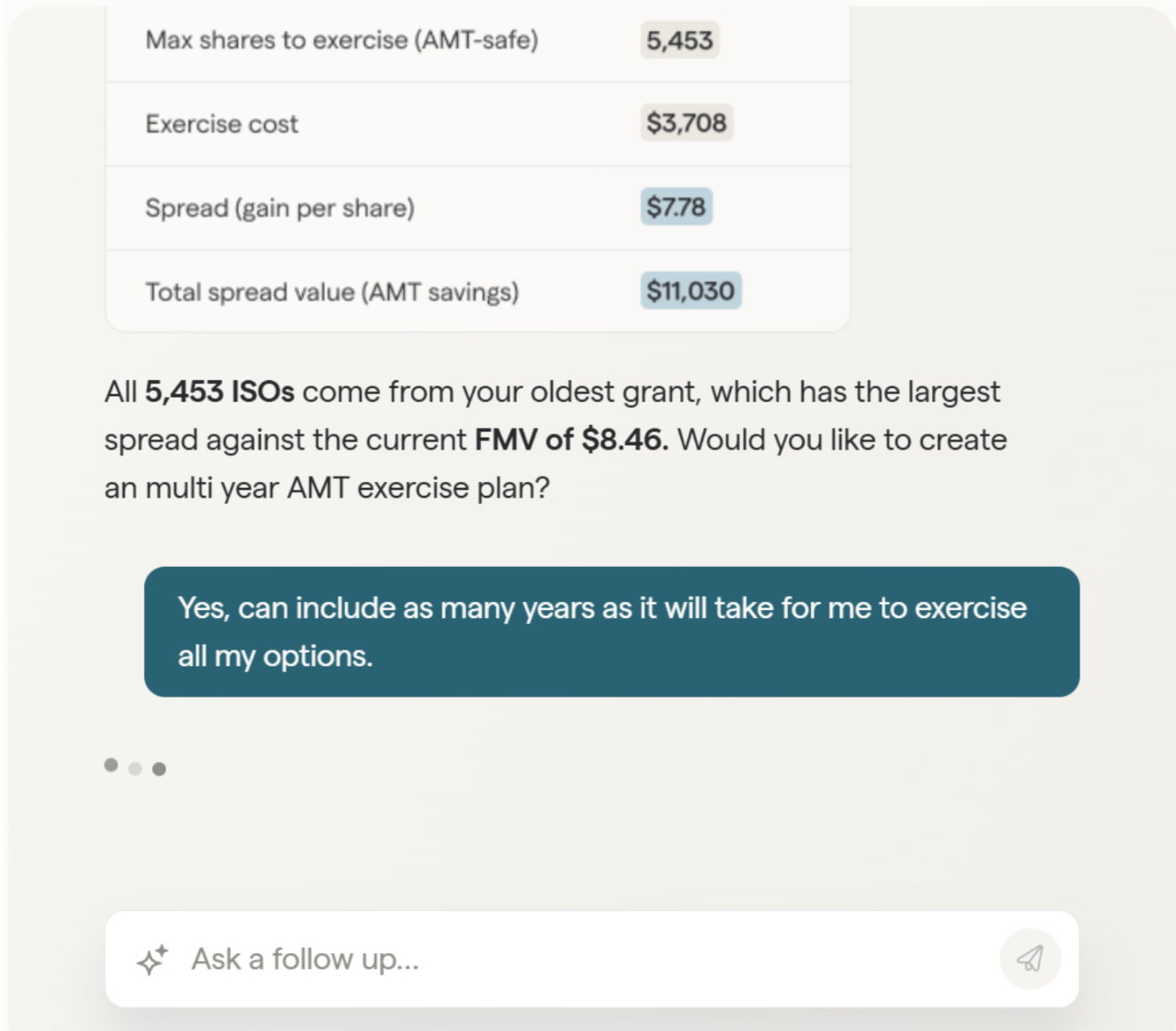
Example of Maeve calculating a plan for a startup employee's private stock options. For illustrative purposes only. Actual results may vary and there is no guarantee of any particular outcome.
We've also provided more non-recourse financing than any comparable company in the industry, with over $800 million in the last decade. If you're eligible, you can receive cash to cover exercise costs, taxes, and sometimes discretionary spending without putting your personal assets at risk.
And if you're leaning towards secondary markets, our team can help you find a buyer for your equity if your company allows for secondary sales. While a secondary sale can trigger taxes, "The benefit is that you get the full amount of cash today, or mostly the full amount. You're no longer at risk, you've cashed out." — Vieje Piauwasdy, Head of Secfi Liquidity
Private company stock can help with a home down payment, but only if the liquidity path, tax outcome, timeline, and lender documentation all work together. It can be risky to sign a purchase agreement based on paper value alone. Before you commit to a mortgage, use a tool like Maeve to see exactly how much cash will remain after everyone else is paid.
The tool shown here uses artificial intelligence and is for illustrative purposes only and not necessarily indicative of future results and there is no guarantee that similar results can be achieved. The information provided by the tool is not professional advice and is not intended by Secfi, Inc., its affiliates, and Secfi representatives, to be deemed as investment, legal, tax or other professional advice or recommendations of any kind, or to form the basis of any decision to do or to refrain from doing anything. Secfi does not review the accuracy or completeness of the information provided to us within the tool.
https://www.axios.com/2024/04/18/walmart-ibotta-stock-debut-ipo
https://www.schwab.com/learn/story/what-is-ipo-lockup-period
https://www.wsj.com/articles/fomo-drives-investors-as-ipo-market-awakens-from-long-slumber-b1449c1
https://corpgov.law.harvard.edu/2022/11/28/the-unicorn-puzzle/
https://www.businessinsider.com/secfi-founders-18-million-tax-bill-led-to-a-550-million-deal-2020-1
https://www.cooley.com/-/media/cooley/pdf/practices/qsbs-cheat-sheet
https://www.investopedia.com/terms/r/rightoffirstrefusal.asp