Exercising stock options as an executive often requires significant capital. While the strike price is one cost, taxes can add considerably to the amount needed to exercise and hold the shares.
Navigating these high-stakes decisions requires specialized tools and expert guidance, which is why many leaders at late-stage startups turn to various tools to model their exit scenarios and access tailored liquidity solutions.
Here are a few ways to finance exercising your stock options, including using your own cash, doing a cashless exercise, getting a personal loan and doing non-recourse financing through a provider like Secfi.
Non-recourse financing
One approach used in pre-IPO equity situations is non-recourse financing. It allows you to exercise your options without using your own capital upfront.
Non-recourse financing involves working with a third-party provider who funds the cost of exercising your options. In many cases, they can also help cover associated taxes. In exchange, the provider is repaid if your company has a successful liquidity event, such as an IPO or acquisition. Repayment usually includes the amount financed, plus a fee or portion of the proceeds.
Unlike a traditional loan, repayment depends on what happens with your company, not your personal finances. If your company does not have a successful exit, you are not personally responsible for repayment.
This type of financing makes sense if: you want to act on your equity but prefer not to use your own cash, you are looking to reduce personal financial risk, and you want to retain ownership and future upside.
The tradeoffs from non-recourse financing include:
- You share a portion of the upside. In exchange for reducing upfront cost and personal risk, you may pay fees or share a percentage of future gains.
- Availability may be limited. These solutions are typically offered to executives and employees at later-stage companies with strong growth profiles.
- Taxes are still part of the equation. However, unlike traditional financing, which leaves you to manage tax costs separately, non-recourse financing can often cover both the exercise and associated taxes in a single structure.
Read more: What is non-recourse financing for stock options?
Use your own cash
You pay:
- The strike price: The fixed cost per share set in your grant.
- Taxes: For non-qualified stock options (NSOs), this usually involves immediate withholding.
- Possibly AMT exposure: Large incentive stock option (ISO) exercises often trigger the alternative minimum tax (AMT).
Best for:
- Strong liquidity.
- Long-term conviction.
- Desire to maximize ownership.
Pros:
- Cleanest structure.
- No lender involvement.
- Maximum upside participation.
Risks:
- Concentration risk.
- Tax bill can be substantial.
- Illiquid private-company shares can trap capital.
For many executives, the taxes are actually larger than the strike cost.
This approach can work well if you want to retain full ownership and upside, and believe strongly in the company’s long-term performance.
Exercising earlier may also help your taxes in a couple of ways. If you hold the shares long enough after exercising, you may qualify for lower tax rates when you eventually sell. It may also reduce the taxable amount at exercise.
Read more: The complete guide to employee stock option taxes
Like any approach, using your own cash comes with tradeoffs:
- You will need to cover the full cost of exercising your options upfront. Depending on the number of shares and strike price, this can mean a lot of cash.
- You may also owe taxes at the time of exercise, including potential AMT. In some cases, this tax bill can be a lot, even though you have not received any cash from your shares.
- More of your money is tied up in one place. Alongside your time and energy in the company, you are putting more personal wealth into the same place. If things go well, that can pay off. But it also means more of your future depends on one startup, and leaves you with less cash for other parts of your investment strategy.
- There is always opportunity cost. You could also put that money into a diversified ETF or as a down payment for a house. By using your own cash you are putting all your money into a risky asset class.
Cashless exercise
A cashless exercise enables you to exercise your stock options without using your own capital upfront. Instead, a portion of your shares is sold at the time of exercise to cover the cost of the shares and any associated taxes.
This can be a strong fit if you want to act on your equity but don't have the money to cover the upfront cost, or you would rather not tie up personal cash. It can also simplify the process by bundling the exercise and selling shares into a single transaction.
The tradeoffs with cashless exercises include:
- You keep fewer shares. Because some shares are sold to cover costs, you will own less of the company if its value grows.
- You reduce your overall ownership and upside. Because shares are sold to cover costs, you retain fewer shares and have less exposure to future growth.
- You are still subject to taxes at the time of the transaction. Depending on the structure, taxes may be withheld or triggered immediately, which can impact your net proceeds.
- You will likely have to discount the value. When you sell private shares, it is often at a discount to the current value.
Note: For Incentive Stock Options (ISOs), selling shares immediately to cover costs may result in a disqualifying disposition, which leads to less favorable tax treatment. As always, taxes can get complicated quickly, so it is good to speak with a specialized advisor for tax advice before proceeding.
It’s more common in public companies, where a broker:
- Exercises the options.
- Immediately sells enough shares to cover strike + taxes.
- Delivers net proceeds/shares to you.
Best for:
- Liquidity events.
- Diversification.
- Avoiding out-of-pocket cash.
Pros:
- No cash required.
- Efficient.
- Simplifies taxes.
Cons:
- You sell immediately.
- Limited long-term upside participation.
- Usually unavailable for private companies.
Personal loan
Another potential approach is to use financing, such as a personal loan or line of credit to cover the cost of exercising options. This gives you access to the capital you need without selling shares upfront.
Traditional financing from lenders may be a good fit if you have enough personal income or assets, are comfortable taking on debt, and want to retain full ownership and upside. In some cases, this lets you exercise your options and benefit from future growth without waiting to accumulate the necessary cash.
The tradeoffs from traditional financing may include:
- You will be personally liable. Unlike equity-based solutions, traditional loans are typically recourse, meaning you are personally responsible for repayment regardless of the company’s outcome.
- It may limit you financially. Taking on debt can limit your ability to pursue other opportunities or make large financial decisions while the loan is outstanding. It can also affect your debt-to-income ratio, which may impact your ability to qualify for additional financing like a mortgage for a home.
- Repayment is required regardless of timing or outcome. If the company’s exit is delayed or does not happen as expected, you are still obligated to repay the loan on its original terms.
- Interest and financing costs can add up. Depending on the structure and duration, borrowing costs can meaningfully reduce your overall returns.
- Financing does not eliminate tax obligations. If exercising your options triggers taxes, including potential AMT, you are still responsible for those costs regardless of how the exercise is funded.
Why work with Secfi for non-recourse financing
Secfi was built because our founders were in a familiar situation for pre-IPO tech executives and employees: they wanted to exercise stock options, but didn’t have the cash to do so.
This platform empowers you to make more informed decisions about your stock options through a combination of proprietary planning tools and specialized financing.
- Exercise options earlier with little personal risk: Secure non-recourse financing designed specifically for pre-IPO equity where you only repay if your company has a successful liquidity event.
- Model complex equity scenarios with Maeve: Use a purpose-built AI equity assistant to model your AMT liability and exit scenarios using your actual grant data and latest market insights.
- Access specialized guidance: Work with equity strategists who specialize in pre-IPO compensation and can help you evaluate high-stakes decisions based on your specific context.
- Protect your personal assets: Utilize a structure where your home and savings are never at risk, as repayment is tied entirely to the outcome of your company.
- Integrate equity into your broader financial life: Connect with a licensed wealth advisor team that has professional expertise in tech compensation, liquidity planning, and tax optimization.
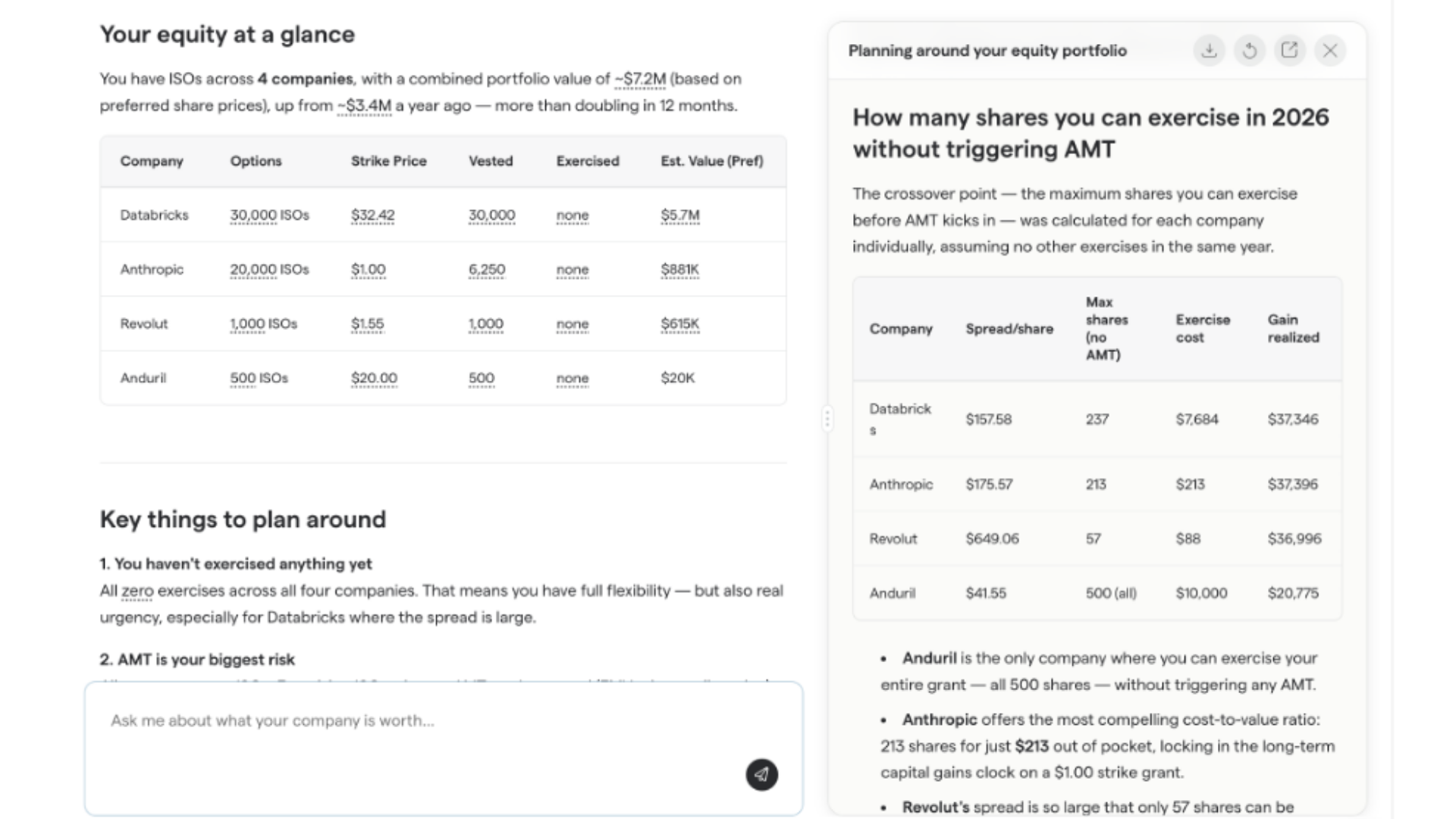
For illustrative purposes only. Actual results may vary and there is no guarantee of any particular outcome.
Choose a financing strategy that matches your high-level financial goals
Choosing how to finance your stock options is a significant decision that can impact your long-term net worth and personal risk profile. For executives, this often means balancing the desire for maximum ownership with the reality of significant upfront costs and complex tax obligations like the alternative minimum tax.
Whether you choose to use personal liquidity, explore a cashless exercise, or utilize non-recourse financing, the right approach depends on your specific financial goals and your outlook on the company's future. Because these decisions involve high stakes and intricate tax rules, it can be helpful to work with specialists who understand the unique dynamics of pre-IPO equity to ensure your strategy aligns with your broader financial plan.
FAQs
Do I owe taxes when I exercise stock options even if I don't sell any shares?
Often, yes. With non-qualified stock options (NSOs), exercising usually triggers immediate income tax withholding on the spread between the strike price and the current value. With incentive stock options (ISOs), a large exercise can trigger the alternative minimum tax. In both cases you can end up with a tax bill before you've received any cash from your shares, which is why the tax cost frequently ends up larger than the strike price itself.
What's the difference between a personal loan and non-recourse financing for exercising options?
A personal loan is recourse debt: you're personally responsible for repaying it on a fixed schedule, no matter how your company performs. It can also affect your debt-to-income ratio and limit other borrowing, like a mortgage. Non-recourse financing ties repayment to your company's outcome instead. A third-party provider funds the exercise (and often the taxes), and you only repay if your company has a successful liquidity event like an IPO or acquisition. If there's no successful exit, you're not on the hook personally. There may be additional tax consequences so its important to speak to your tax professional.
Should I exercise my stock options early?
It depends on your conviction in the company and your cash position, but exercising earlier can help on taxes in two ways. It may reduce the taxable spread at the time of exercise, and if you hold the shares long enough afterward, you may qualify for lower long-term tax rates when you eventually sell. The tradeoff is that you're committing cash to an illiquid, concentrated asset sooner. If you want to act early but don't want to tie up personal cash, non-recourse financing can cover the exercise without the upfront outlay.
The tool shown here uses artificial intelligence and is for illustrative purposes only and not necessarily indicative of future results and there is no guarantee that similar results can be achieved. The information provided by the tool is not professional advice and is not intended by Secfi, Inc., its affiliates, and Secfi representatives, to be deemed as investment, legal, tax or other professional advice or recommendations of any kind, or to form the basis of any decision to do or to refrain from doing anything. Secfi does not review the accuracy or completeness of the information provided to us within the tool.