How to buy a house with stock options

24 min
0 result
Mike’s a CPF® at Secfi. He specializes in helping clients make the most of their stock options and integrate equity compensation into their broader financial plans.
Your company's valuation just climbed, and your stock options are suddenly worth more on paper than they've ever been. That's exciting, until you realize you can't really use any of it yet to buy a house.
Unexercised stock options aren't a financial asset. A mortgage lender won't lend against them, and you can't use them for a down payment until they're turned into cash.
To get there, you'll need to exercise your ISOs or NSOs and find a way to liquidate the shares.
Although it's simple to describe, it's not easy to do: Exercising costs money upfront and the resulting tax bill can run several times higher than the exercise price. Get the timing wrong, and what should help you buy a house can become an expensive mistake instead.
We've written this article to help you navigate the process. In it, we'll cover:
Note: Secfi provides equity planning guidance, tools, and financing so startup employees can own their stock options with confidence. If you're interested in how non-recourse financing could help you, sign up to our platform here: Get Started
Stock options alone won't work for financing a house. You have to exercise them so that the shares are worth anything for when there is a liquidity event (tender offer, acquisition, or IPO). And this comes at a cost.
It's important to know upfront that this amount isn't just the exercise price (the strike price x the number of shares). It's also covering the often shocking tax bill that accompanies it. We've gone into more detail on this below, or you can take a look at our guide to how stock options are taxed.
Being able to pay for both the exercise price and resulting tax bill is often an unexpected challenge that blocks people from being able to liquidate. Especially when the tax bill can be multiple times higher than the exercise cost alone.
You have a few ways to cover this expense:
If you have access to the funds, you can cover everything yourself with cash. This might come from personal savings, liquidity in another investment, or support from your family. Just be prepared for the exercise cost to be one of your biggest lifetime expenses.
Having said that, using your own cash concentrates a lot of your assets into one company. If you're currently planning to buy a home or investment property, this might not be where you want to invest your own capital.
Plus, if you're already facing a cash flow problem for your down payment, then you likely don't have access to enough capital to cover the exercise cost either.
When you do a cashless exercise, a portion of your shares are sold off immediately to cover the exercise cost and taxes. For this to happen, the company either has to be public, or you'll need an upcoming liquidity event such as a tender offer (where the company offers to buy back private shares at a set price).
You personally pay nothing up front, but will only receive the remaining portion of shares/stock. You also should note that when you do a cashless exercise, the spread (the sale price minus the strike price) is taxed as ordinary income, at the highest possible rate. If you live in California, that can reach up to 52.65%.
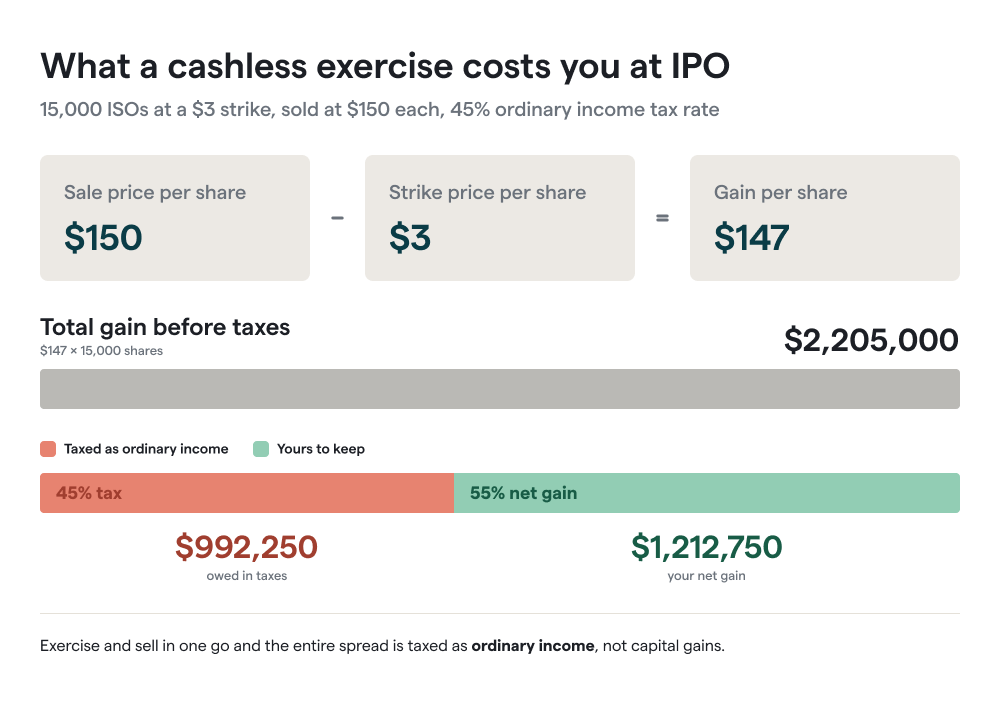
For illustrative purposes only. Actual results may vary, and there is no guarantee of any particular outcome.
So, the advantage of cashless exercising is that you can receive your stocks/shares without needing to pay anything up front. But it is not without its drawbacks:
It is possible to take out a traditional loan or line of credit for exercising options. This is a good potential option if you need a way to access your ISOs or NSOs, but don't want to sacrifice any ownership of them in the process.
Of course, you'll first need reasonable assets or capital for a bank to approve you for a loan, which might be an issue if you're struggling with getting approved for a mortgage. And you'll need to be able to make monthly payments on the loan, not to mention that the interest can rack up quickly, depending on the terms.
A traditional loan also won't necessarily cover your exercise tax obligations. When the tax bill can be multiple times higher than the exercise cost, this might leave you worse off than not exercising at all.
You may now be at a crossroads where you are choosing between spending your money on buying a house or on exercising your options. This is where non-recourse financing can help.
In the simplest terms, non-recourse financing is a type of financing that covers all the costs to exercise your stock options as well as the accompanying tax bill, but removes the risk. That's because you only have to pay the cash advance back if your company has a successful exit, such as an IPO or acquisition.
Some financing companies will also approve you to get additional cash to use as a down payment on a house. In this way, non-recourse funding can solve multiple problems at once.
However, not everyone can be approved. If you are a good fit, this kind of loan can be a great way to pay to exercise your options and buy a home at the same time. At Secfi, we specialize in this type of financing, which we'll share more details about below.
Even after exercising your stock options, you'll still need to find a way to transform them into cash for a down payment. This becomes especially tricky if your company is pre-IPO, especially with more companies like Stripe and Anduril staying private for longer.
With private shares, there are very few exit options available, and often strict rules around sales. Plus, many of the liquidity opportunities come down to events that you have little to no control over.
These are the options you can consider:
A liquidity event at a private company is when there is some form of internal opportunity to sell your shares. A common example is a tender offer, where the company is looking to buy back shares from its employees on a set date and at a set price.
Other examples would be if your company goes through an acquisition and your shares are bought out, or it has a successful IPO.
In certain situations, these liquidity events will allow you to do a cashless exercise as we mentioned earlier. Just remember that even though this will help address a cash flow issue, you will end up walking away with a higher tax bill and fewer shares.
You'll usually find out if one of these events is on the horizon if the company has an upcoming 409A valuation. This is also the reason that you should treat any upcoming liquidity events with a discerning eye: if your company thinks they're going to get an increase in valuation, then they might be interested in buying up your shares before it happens.
Take the recent Anthropic tender offer, for example. In April 2026, Anthropic offered to buy back employee shares based on a $350 billion valuation (around $300/unit), ahead of a Series H fundraising round and new valuation. In May, the valuation went up to $965 billion, with FMV of $589.01/unit. There's also an expectation that the company will IPO in the near future, when stocks could be valued even higher.
So, the tender offer would have been a great opportunity for an Anthropic employee who wanted to buy a house around that time. However, it's also important to be aware that they likely missed out on the upside when Anthropic eventually goes public.
Ultimately, the decision will depend on your personal timeline. If you have flexibility in when you want to cash out and invest in a home, you may not want to sell everything (or anything) during one of these events. Make sure to approach offers with a savvy mindset, and consider if the value may go up even higher in the near future.
Things to consider:
Selling pre-IPO shares looks like finding private buyers, or using a secondary market like Secfi Secondaries. These secondary markets are great for getting cash now, but like tender offers, they do mean losing any potential upside later down the road.
So if you think your company has peaked in valuation, or being able to finance a home with cash sooner is a priority, then selling on a secondary market could be a great fit.
That being said, just because you want to sell on a secondary market doesn't mean there will actually be any secondary buyers. In most real-world cases, matching sellers with buyers can be very tricky. We've seen a lot of attempts to sell shares end up taking a long time to happen at best, or be completely unsuccessful at worst.
Things to consider:
With non-recourse financing, you can access enough financing to exercise your stock options, pay the tax bill, and get additional cash for a down payment at the same time. Even if you've already exercised your options, you can use those in your financing arrangement to get cash for a down payment.
That means the flexibility to reach your personal homeowning goals sooner. This is a great solution if you've been trying to decide between spending your savings on a down payment or investing in your stock options–with this type of financing, you can do both.
Non-recourse financing will also give you more control. Even if you don't want to be a homeowner immediately, you'll have the flexibility to optimize on your stock options and plan for buying in the future.
A great use case for this might be if your company is likely to IPO in the next year. Being able to exercise your options before the value increases means both a lower tax bill now and being able to access the most favorable tax rates when you sell in the future.
And there really is no risk to exercising. You don't have to repay the full amount if or until your company exits successfully, so there's no worrying about exercising becoming an expensive mistake.
Things to consider:
Even if you know you want to use your stock options to buy a house, deciding on when and how many to exercise is difficult. Especially when you factor in the cost of taxes, and that they tend to get more expensive over time.
For both ISOs and NSOs, the spread on your exercise (fair market value at time of exercise minus the strike price) is taxed. With NSOs, it is taxed as ordinary income. But if you exercise ISOs, you'll need to prepare for AMT (Alternative Minimum Tax). This is a separate tax system meant to make sure high-income earners pay enough in taxes.
When you exercise any ISOs, you'll need to work out both your AMT and ordinary tax, then pay whichever is higher. In many cases, triggering AMT can result in a tax bill that is many times higher than the cost to exercise.
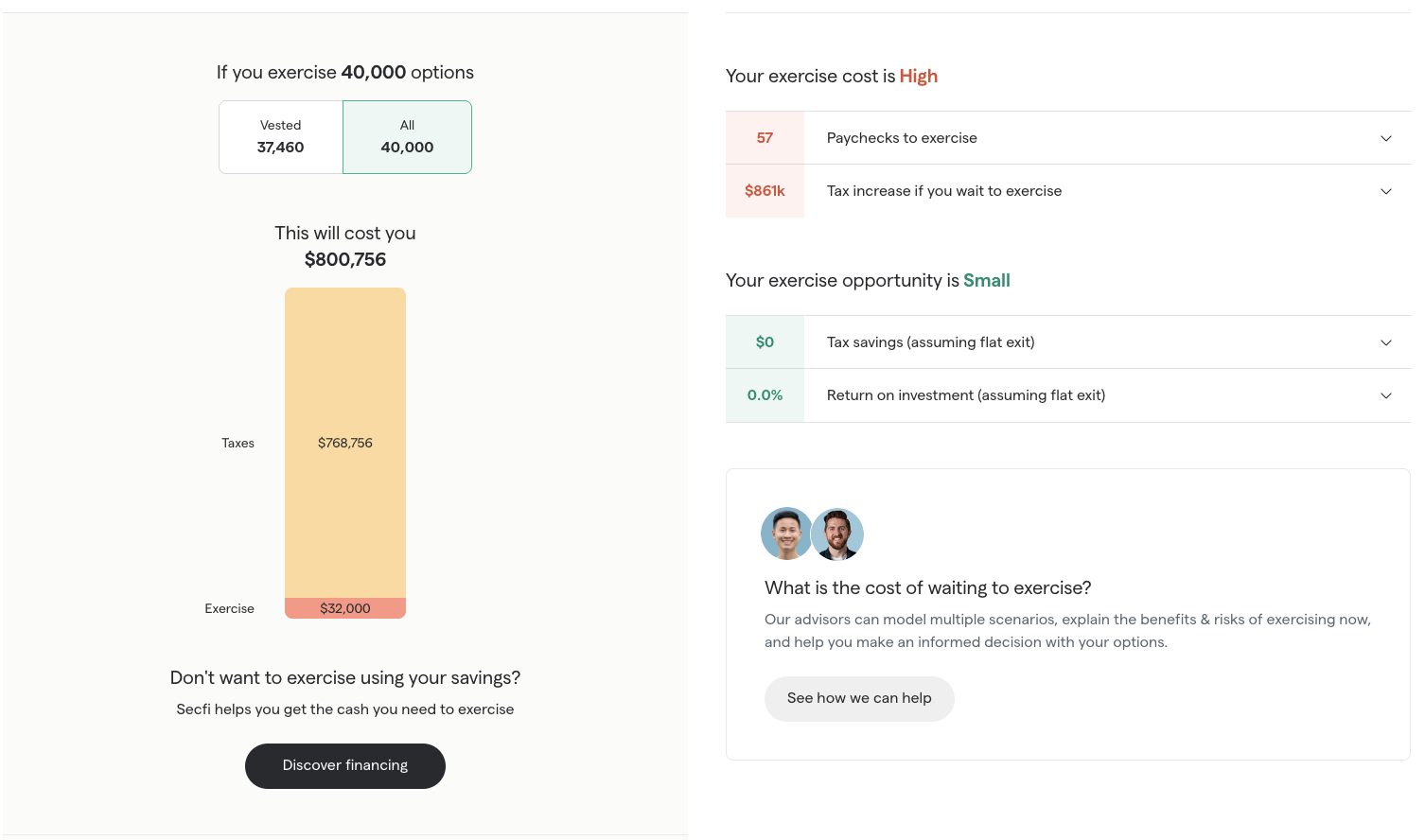
For illustrative purposes only. Actual results may vary, and there is no guarantee of any particular outcome.
You should also know that if you do sell your shares, you'll still need to pay tax on the gains. This could be ordinary income, short-term capital gains, or long-term capital gains depending on the type of options and holding period.
There are several ways you can reduce this tax bill or avoid triggering AMT altogether. But these require you to exercise at the right time and carefully pre-plan the sale of your shares.
We know that for many people, waiting so long to cash out might not make sense. Determining the right time to exercise usually comes down to two totally different factors: the best financial decision vs your deeply personal timeline for homeownership.
There will always be some form of tradeoff in this equation, and every situation is different.
For example, if you go all in on your stock options instead of a house now, it could mean you can buy a much bigger and nicer home in the future. But for a tech employee with a three-year-old child and another one on the way, buying a home as soon as possible in the right school zone will be the bigger priority. Even if it means sacrificing more potential gains down the line.
One good question to ask yourself is: "What would you regret more: missing out on potential stock gains, or missing out on time living in a house you own?"
What could you afford if you cashed out today, and is being able to buy something bigger worth waiting for your company to IPO in the future?
Ultimately, the answer comes down to what you want. The more specific you can be with this, the easier it will be to plan your stock options to align with that vision using the following methods:
We know firsthand how overwhelming all this information can be. And that knowing where to start can stop you from beginning at all. However, there are so many tools to help you get a better understanding of your situation.
There are multiple online calculators for things like AMT, stock option exit value, and capital gains tax. These do the maths for you. Then, you can enter the information into self-guided equity planners. Alternatively, you can use your own spreadsheet to get full control over the numbers.
Another option is to work with an AI assistant like Maeve, which allows you to create personalized scenario projections. These tools give a clearer picture of your current situation, as well as the tax implications and potential gains across differing timelines and outcomes.
The stakes are high when it comes to managing your stock exercise and sale strategy. Particularly if you have personal reasons for wanting to buy a home or investment property in the near future. A mistake can cost you not just a lot of money, but the dream property you've been working so hard towards.
As useful as the equity tools on the market are, working with a wealth advisor can be the most helpful option.
They'll provide a more personal approach that considers factors that can't be input into a calculator. Together, you'll be able to create a strategy to get on top of your cash flow, and build a realistic path toward home ownership. At Secfi, you'll also get the chance to work with wealth advisors who deeply understand stock options: Start here.
If you are facing a cash flow issue, then you may think your only option is to wait for a cashless exercise opportunity and accept the bigger tax bill. The problem? You can't always control the timing, and often end up with a lot less equity.
Secfi was built by tech employees facing this exact problem: a desire to exercise stock options, but no cash to do it. Our founders knew there must be a better alternative, and so they built one for themselves.
The Secfi platform is designed to give employees more control and security over their financial future. We do this through giving you equity planning tools, financing, and wealth management advice.
Here are the features that can help you turn stock options into a home:
If you qualify for Secfi's non-recourse financing, you'll be able to access funding for both the total cost of exercising your options and a down payment on a house. All without taking on any personal risk or monthly payments.
Your shares act as collateral, and if you gain value from them, you pay a percentage of the gains to Secfi (plus the original advance and interest). None of your personal assets are on the line, and there's no impact on your debt-to-income ratio.
This provides you with the flexibility to buy a home on your timeline and optimize your stock options over the long-term. That means you can get a house today, without losing out on the chance to buy a bigger home if your company's value goes up in the future.
Non-recourse financing is what we specialize in, having done more deals by number than any other provider and financed more than $800 million and helped 55,000 employees with their stock options. We've worked with employees from companies like Gusto, Databricks, and Anduril to help them cover the cost of exercising, taxes, and more.
But also be aware that we can't finance the cost to exercise for everyone. We're highly selective about who to approve, and typically work with later-stage companies. To learn more about our business model, check out: How Secfi financing works – our business model explained.
Unlike other major firms, we have experience working with people who are at an earlier point in their wealth journey. That means our wealth team is familiar with the challenges of facing your first major financial decision, such as exercising stock options to buy a home.
To help you through the experience, our advisors will provide you with both relevant information and personalized advice. The goal is for you to feel more confident about whatever stock option strategy you decide to follow.
They'll also help give you the best chance of avoiding a costly mistake. We try to help avoid situations where you are worrying about triggering AMT when it could have been avoided, or selling your appreciated stocks slightly too soon and having to pay ordinary income or short-term capital gains tax on the profit instead of long-term capital gains.
Our wealth team will even advise when a Secfi non-recourse financing loan is and isn't the right fit for you.
When it comes to buying a house with stock options, one of the biggest limitations to liquidity is simply understanding what you've got. Before you can begin to look at home budgets, you need to actually know how much your gains from exercise and sale might be worth after taxes.
We know how intricate and confusing this is. And while there are some great tools on the market to help understand it, Maeve is our purpose-built AI equity assistant that puts everything you need in one place.
As your AI equity assistant, Maeve can help you to understand:
All the results are fully tailored to you and your information. You can upload documents, connect directly to Carta, or simply manually input the numbers that you know. You might even find Maeve already knows the really useful things, like your company's most recent 409A valuation.
We recently worked with a tech employee who was in a situation that may be familiar to you: a great job, good income, amazing ISO grant, but no cash.
Her company was looking likely to IPO in the near future, and she knew her stock options were about to skyrocket in value, but without any cash flow, she wasn't able to act on it.
Then her dream home on the same road as her family finally came on the market.
The frustration was at an all-time high. She knew that she would easily be able to afford this home if only she could exercise the options and hold them until IPO. But without any capital in the present, she was about to miss both opportunities.
Luckily, she was able to take a loan from a family member to cover the cost of exercising her options, but it was not enough to cover the tax bill…let alone put a down payment on the house which might sell at any point.
This was where Secfi stepped in to help. We provided non-recourse financing that allowed her to not only pay back her family and cover the monumental tax bill, but was also enough for her to buy her dream home in cash.
Her company is now moving towards an IPO, with her shares likely to jump up in significant value. On a successful exit and after repaying Secfi, she will retain all of her originally granted stock units to hold or sell as she pleases, as well as already owning the home of her dreams.
This case study is an illustration of our capabilities provided to an individual client. Client results may vary and there can be no guarantee of similar results. It is not known whether the client approves or disapproves of Secfi Advisory Limited or it affiliates as a whole.
Turning your stock options into a home is absolutely possible, but it does come with many decisions, and even more questions. And when you're working within a specific timeline for buying a home, the urgency to understand your employee stock options situation and potential future gains is incredibly important.
By providing planning tools, wealth advisors, and financing opportunities, Secfi allows you to take ownership of your financial situation and make the best possible decisions for you and your family.
If you're ready to explore your options seriously, you can start by modeling equity scenarios with Maeve. Or, to speak directly to our team about what solutions might fit your needs, you can reach out today.
Yes, but you cannot use stock options directly to purchase a home. Lenders typically want liquid, verifiable assets like bonds or stocks/vested RSUs in a public company. You'll need to do this through exercising your options and selling stock. The proceeds can then be used for a down payment.
First, you will need the capital to cover the cost of exercising. For instance paying in cash, looking for non-recourse financing, or considering a cashless exercise.
If you have stock options in a private company, accessing liquidity can get even more complicated. You will need a liquidity event like a tender offer or IPO to turn your options into capital, and employees usually have no control over when these happen.
It's also important to understand your cost basis and potential capital gains taxes before exercising or selling. If held for long enough, this will be at long-term capital gains rates, but if you sell exercised ISO stock before one year (for instance in a cashless exercise) that rate goes up to ordinary income.
Some lenders might allow you to use investment accounts or stocks as collateral for a loan. However, it is extremely rare.
A better option might be through non-recourse financing to exercise your options. This uses your stock as part of the arrangement, and if you make a profit on it, a portion is shared with the lender. If approved, you can access financing for the exercise cost, tax bill, and additional cash to put towards a home.
If your company has a successful exit, you will then be able to use the gains as verifiable assets for a mortgage.
Accessing liquidity from pre-IPO stock options can be difficult because you generally cannot simply sell your options on the open market. You'll typically need a liquidity event, such as a tender offer or IPO, before you can turn your equity into capital.
Selling your private shares on a secondary market might also be possible. It is important to know that many stock option grants have strict rules about how much and who you can sell to. It can also be tricky to find buyers for your shares.
Non-recourse financing can be another option. This allows you to finance the cost of exercising your options, and potentially your tax bill and additional cash needs, using the shares as collateral.
Non-recourse financing allows you to borrow money to exercise your stock options without putting your other personal assets at risk. If the company fails, only the lender takes the loss. You will not be liable to pay anything back.
But if there is a successful exit, then you'll pay a portion of the gains when you eventually sell the shares. This can give employees access to liquidity for the exercise cost and tax bill without having to use their own cash upfront.
However, the terms can vary significantly between providers, so it's important to understand how much of your future upside you are giving up before choosing this option.
There is no single right time to exercise stock options. The decision will depend on factors including the type of options you have, the company's valuation, your exercise cost, whether a liquidity event is likely, and your personal timeline.
For example, exercising earlier may reduce your tax liability and start the long-term capital gains clock sooner, while waiting can give you more certainty about a company successfully exiting.
Before exercising, it can be helpful to calculate the exercise cost, potential tax bill, and expected upside, with an AI tool like Maeve, then speak with a financial planner or tax professional to determine whether the timing makes sense for your situation.