QSBS exemption: How to pay less capital gains on your shares

19 min
0 result
John’s a Director at Secfi, helping founders, executives and employees navigate equity compensation and access to liquidity through his expertise in finance.
The QSBS, or qualified small business stock, exemption is a tax incentive that allows founders and early employees of certain businesses to save on capital gains on their shares.
If you're eligible, it can be an extremely beneficial tax-saving mechanism, potentially saving you capital gains on up to $15 million of profits.
That said, eligibility is strict and it can be difficult to navigate if you're coming to it for the first time. Whether you can benefit from the QSBS exemption depends on how long you've held the shares, how much your company is worth, and the specific line of business you're in. To make matters more complex, the One Big Beautiful Bill Act in July 2025 changed many of the rules — and how much you can benefit.
What's more, as with all taxation, if you get it wrong, it can come at a high cost to you. So, it's really important to get your equity strategy right.
In this guide, we share what you need to know to take full advantage of the QSBS exemption. We cover:
Are you unsure whether you're eligible for QSBS? Or do you simply want to discuss your equity and taxation liabilities with a specialist? Reach out to us, or review your finances with our AI equity assistant, Maeve.
The QSBS exemption is a tax benefit that applies to eligible shareholders of a qualifying small business. It allows founders, early employees, and investors to save up to 100% of federal capital gains tax on the sale of qualified shares.
So, if you're a founder or early employee and you hold stock in your company, you may be able to take advantage of QSBS when your company exits or you sell your shares. However, you and your company will need to meet all the necessary conditions.
Typically, when you sell shares, you need to pay capital gains tax on any profit you make. This can differ depending on the state (state treatment of QSBS varies widely, so federal exclusion does not guarantee the same benefit on your state return), but the federal rate reaches 23.8% of your profits. Plus, depending on how many shares you sell, you can often qualify for federal alternative minimum tax (AMT), which can push your tax bill even higher.
The QSBS exclusion works by excluding profits on qualifying shares from both of these taxes (as well as other taxes including NIIT), up to profits of either:
Say you're an early employee with 100,000 shares that you acquired for $0.50 per share.
If your company exits and your shares are worth $100 each, your shares are worth $10 million. After subtracting your $50,000 cost basis, your gain is $9.95 million.
Because that gain is below the QSBS exemption limit, the entire $9.95 million could be excluded from your taxable income if you otherwise qualify for QSBS.
Now imagine your company performs even better and your shares are worth $200 each at exit. Your shares are now worth $20 million, giving you a gain of $19.95 million.
In that case, only the first $15 million of gain would qualify for the QSBS exemption. The remaining $4.95 million would generally be subject to long-term capital gains tax.
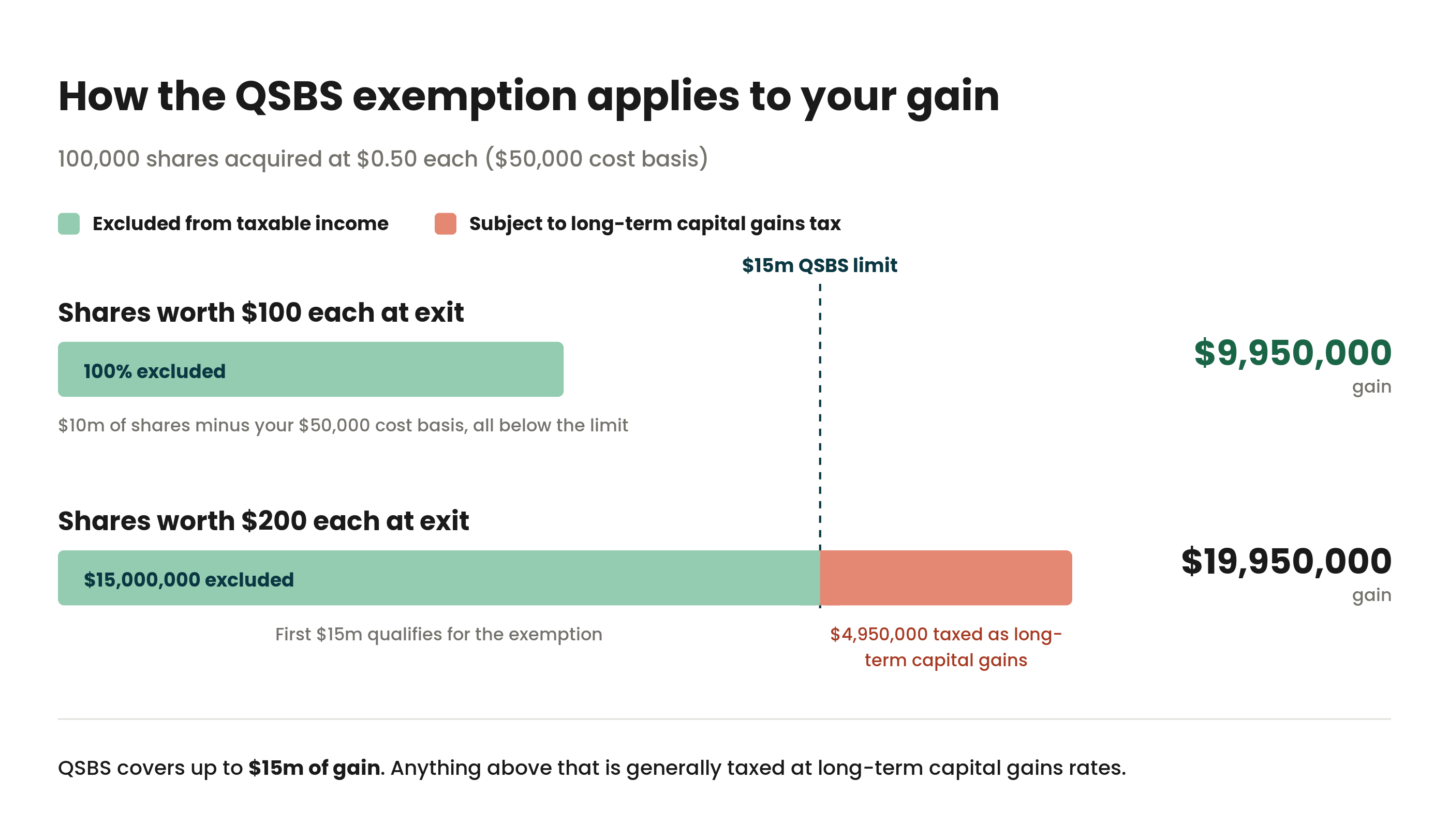
For illustrative purposes only. Actual results may vary and there is no guarantee of any particular outcome.
The key thing to be aware of is that this $15,000,000 is the maximum amount you can exclude from your taxation — and this is only possible if you hold the shares for 5 years (known as the holding period).
You used to have to hold the shares for 5 years to benefit at all. But since the change in rules in July 2025, you now get:
(For any shares issued after July 2025. For shared issued before then, the prior rules apply.)
So, you can now benefit sooner. But to do so, you, your shares, and your company need to meet certain criteria. And it can be quite challenging to get these right.
The QSBS is a considerable tax break, and, as such, it's not available to just anyone. Instead, it was introduced specifically to encourage investment in small businesses, by rewarding entrepreneurs, early employees, and early investors for taking the risk.
So, there are rigorous eligibility criteria:
Let's break these two elements down one by one.
Not all companies qualify for the QSBS exemption. Instead, your company needs to meet the following criteria:
Something to be aware of is that your company can be disqualified from QSBS for a number of reasons over the holding period. For instance, if your line of business changes, it will no longer qualify. And if the company buys back shares above a certain threshold, the same applies.
Whether you're a founder, employee, or investor, you need to meet certain criteria as a shareholder to benefit from QSBS:
The catch here is that, if your company is acquired, then you'll be selling your shares — so you may not reach the full holding period. (In fact, some founders opt to hold off from any acquisitions so as to benefit from the full QSBS exemption.)
One of the problems we commonly see is that employees simply don't start thinking about QSBS soon enough.
For instance, they may not exercise soon enough. This means that, when it comes to selling, they haven't actually held the stock for a sufficient period to qualify. Or, when they do exercise, the company's total assets are above the $75 million threshold, meaning they miss out on the full holding period. In both cases, they're leaving money on the table.
So, if there's one thing to remember it's this: start considering your QSBS situation as soon as you can.
As you can see, to benefit from QSBS, you need to meet a complex range of requirements. That's a challenge enough to begin with. But you also need to prove that you're eligible too.
To take advantage of the exemption, you simply claim the exclusion on your tax return when you sell the stock. It's a case of reporting the stock sale on Form 8949 and Schedule D, and the gain will then be excluded using the Section 1202 rules of the Internal Revenue Code (IRC).
However, you'll need to keep the evidence of your eligibility in case the IRS decides to audit your return.
One common mistake we see is employees taking the company's word on trust when it comes to QSBS eligibility. But before you claim the exemption on your tax return, it's really important that you have the written proof of eligibility in hand.
Typically, you'll need to have proof:
Note. You'll likely need to get this evidence from the company themselves, particularly on those points regarding its assets. Don't just assume that your company is eligible, and don't just trust the word of someone else in your company. The possible savings are simply too large for you to gamble with.
One useful document is a QSBS representation letter, a formal document issued by a corporation to certify that its stock meets the IRS criteria. It's not required by the IRS, but it can be useful to have this attestation in writing.
Overall, the best way to proceed is to compile a folder of relevant documentation throughout your time at the company. And again, the same main point applies: it helps to start thinking about this as early as possible.
The QSBS exemption offers tax advantages on eligible shares. But beside the basic way that the exemption works, there are additional mechanisms that can help you save even more.
Note. These are complex and typically require specialist tax advice to ensure you're getting them right — and staying on the right side of the law. But the benefits can be considerable.
Perhaps the most important element to remember regarding the QSBS exemption is that you have to actually hold the stocks yourself. If you haven't exercised your options, those stocks won't be eligible for the exemption.
This means that it's critical to exercise your options as soon as possible, to kickstart your holding period — and to ensure that your company's total assets are below the eligible threshold at issuance.
If you're struggling to navigate the complex world of stock taxation, we can help. At Secfi, we work with startup employees and founders to give them clarity on their options, tax liabilities, and their wider wealth.
Our founders set up Secfi when looking for specialist guidance around exercising their own options. When they couldn't find the equity-focused support they needed, they decided to build a company to give other employees the help they lacked themselves.
Today, we offer a combination of digital tools and tailored advice to give founders and employees the support they need to make decisions about equity with confidence. For instance, we can help you make sense of your QSBS eligibility and plan your overall wealth strategy.
For employees at more mature, later-stage companies, we also offer non-recourse financing to cover the cost of exercise and other relevant taxation. You won't need to pay exercise costs upfront and, as our financing is non-recourse, you won't need to pay it back from your own assets.
QSBS can potentially save you millions of dollars in tax, but only if you get the details right. That's why it can be valuable to speak to a specialist tax strategist who is experienced in startup equity.
With Secfi, you can work with strategists who can help you:
They can also help you with strategies to minimize your tax liability. For instance, you may be able to rollover your QSBS exemption by selling your eligible shares and reinvesting the proceeds into new QSBS. This way, you can still maintain QSBS benefits even if you exit a stock early.
Alternatively, you can use trust stacking to multiply your capital gains exclusions. It works by allowing you to gift shares to separate trusts before an exit, so that you can benefit from capital gains-free profits beyond the basic $15 million limit.
These are highly technical strategies that you'll need to get right in order to successfully navigate IRS scrutiny. At Secfi, our equity tax strategists can talk you through your options.
Understanding QSBS can be complicated, especially when you're trying to work out how the rules apply to your own situation. Maeve can answer your questions, explain key concepts, and help you better understand how QSBS fits into your broader equity strategy.
For example, you could ask:
Maeve, Secfi's AI equity assistant, can help you explore these questions, without talking to a strategist in person. You can use Maeve to:
Unlike other generic AI or tax planning tools, Maeve provides answers based on your equity data and your personal financial situation. Maeve combines Claude's reasoning with Secfi's own API, allowing it to ground its values in real data — including live data from secondary markets and 409A valuations.
Plus, you can integrate your Carta account directly into Maeve, so you can get tailored information about your stock before you take any important decisions.
One of the challenges with QSBS is that the biggest tax benefits come from holding your shares for the required holding period. But life doesn't always wait. You may want liquidity to buy a home, diversify your finances, or cover other major expenses before you're ready to sell your shares.
For employees at eligible later-stage private companies, Secfi offers non-recourse financing that can provide liquidity without requiring you to sell your stock before you're ready.
Unlike a traditional loan, non-recourse financing doesn't require monthly repayments or put your personal assets at risk. If your company has a successful exit, Secfi receives an agreed-upon share of the proceeds. If it doesn't, you typically won't owe anything.
For employees with already exercised shares that are still in their QSBS holding period, this can provide financial flexibility while allowing them to continue holding their equity and preserve potential tax benefits.
Note: Financing is subject to eligibility requirements and is not available for every company or employee situation.
When one startup employee's company was acquired, they found themselves in an enviable — but complex — position.
A significant portion of their equity was potentially eligible for QSBS treatment, and this offered the chance for substantial tax savings. But determining which shares actually qualified wasn't straightforward.
At Secfi, we helped the employee to analyze their equity history and get clarity on which grants were eligible. Our team guided them through the applicable rules, verified which shares qualified, and helped them develop a tax-efficient strategy that would benefit them most.
The biggest challenge was timing. The employee wanted to buy a house and was looking to use the QSBS shares to pay for it. But the trouble was that some of those shares hadn't yet satisfied the required five-year holding period — and selling them too early could have resulted in a significant loss of tax advantages.
These are exactly the kinds of problems that our team solves. As a result of working with Secfi, the employee ensured they could maximize their tax savings while complying with QSBS requirements — and at the same time secure the liquidity needed for their home purchase.
Testimonials are specific to an individual Client's experience and may not be representative of all Clients. Unless otherwise indicated, Clients offering a Testimonial do not receive compensation and their statement does not present a conflict of interest.
The QSBS exemption can be one of the most valuable tax benefits available to startup founders and employees, potentially saving you millions in capital gains tax.
But qualifying requires careful planning — and small mistakes can significantly reduce the benefit or leave you exposed to unexpected tax liabilities. That's why it pays to think about QSBS early and build a strategy that aligns with your broader financial goals.
That's where Secfi can help. Our equity specialists work with founders and employees to understand their QSBS eligibility, model different exercise and liquidity scenarios, and build tax-efficient strategies around their equity.
Want to get specialist tax guidance and personalized planning? Try our AI equity assistant, Maeve, or reach out to an equity strategist today.
Yes. Stock options themselves don't qualify for QSBS — you need to exercise your options and own the underlying shares. Your QSBS holding period starts when the shares are issued, not when you receive the option grant.
This is why many employees choose to exercise early: it can help them start the clock on the three-, four-, or five-year holding period and potentially maximize their tax benefits. If you're unsure whether exercising makes sense for your situation, Secfi can help you model different scenarios and understand the potential tax implications.
If your company is acquired before you've held your shares long enough, you may not qualify for the full QSBS exemption. Under current rules, shareholders may qualify for a 50% exclusion after three years, 75% after four years, and 100% after five years, provided all other requirements are met.
Depending on your circumstances, there may be strategies available to help preserve tax benefits. Secfi's equity specialists can help you understand your options and plan for different exit scenarios.
You'll need documentation showing both your eligibility and your company's eligibility. This may include stock purchase agreements, stock certificates, option exercise paperwork, cap table records, financial statements, and evidence that the company met the QSBS requirements when the shares were issued. Many shareholders also request a QSBS representation letter from their company.
Because the IRS may require proof during an audit, it's important to keep these records organized and verify eligibility rather than relying on verbal assurances alone.
The tool shown here uses artificial intelligence and is for illustrative purposes only and not necessarily indicative of future results and there is no guarantee that similar results can be achieved. The information provided by the tool is not professional advice and is not intended by Secfi, Inc., its affiliates, and Secfi representatives, to be deemed as investment, legal, tax or other professional advice or recommendations of any kind, or to form the basis of any decision to do or to refrain from doing anything. Secfi does not review the accuracy or completeness of the information provided to us within the tool.