Cliff vesting: What is it and how does it work?

3 min
0 result
John’s a Director at Secfi, helping founders, executives and employees navigate equity compensation and access to liquidity through his expertise in finance.
Receiving your first equity offer in the tech world is a great achievement, but if you have not come across a cliff vesting grant before, you are probably not familiar with what it means. Or how to plan around it in order to optimize your future stock options strategy.
The first thing to know is that in 2026, most equity offers follow the same structure: a one-year cliff and four-year vest. However, some things are changing: double-trigger RSUs are becoming less popular, and certain alternative schedules are rising in popularity.
In this article, we're explaining exactly what these terms mean and how your cliff vesting schedule can impact your equity.
We're covering:
Secfi provides equity planning guidance and financing, so startup executives and employees can exercise their stock options with confidence. If you're looking to better understand what you can do with your equity, sign up for our free purpose-built AI equity assistant Maeve.
Cliff vesting is a type of equity grant structure where employees have to wait a certain amount of time before receiving any of their stock or options. It is extremely common in the tech world, particularly for new job offers that include equity awards.
The scenario you'll see the most often is a one-year cliff followed by the remaining three-year vesting period. This means you'll have to stay at the company for a full 12 months before you actually have access to any of your grant's equity.
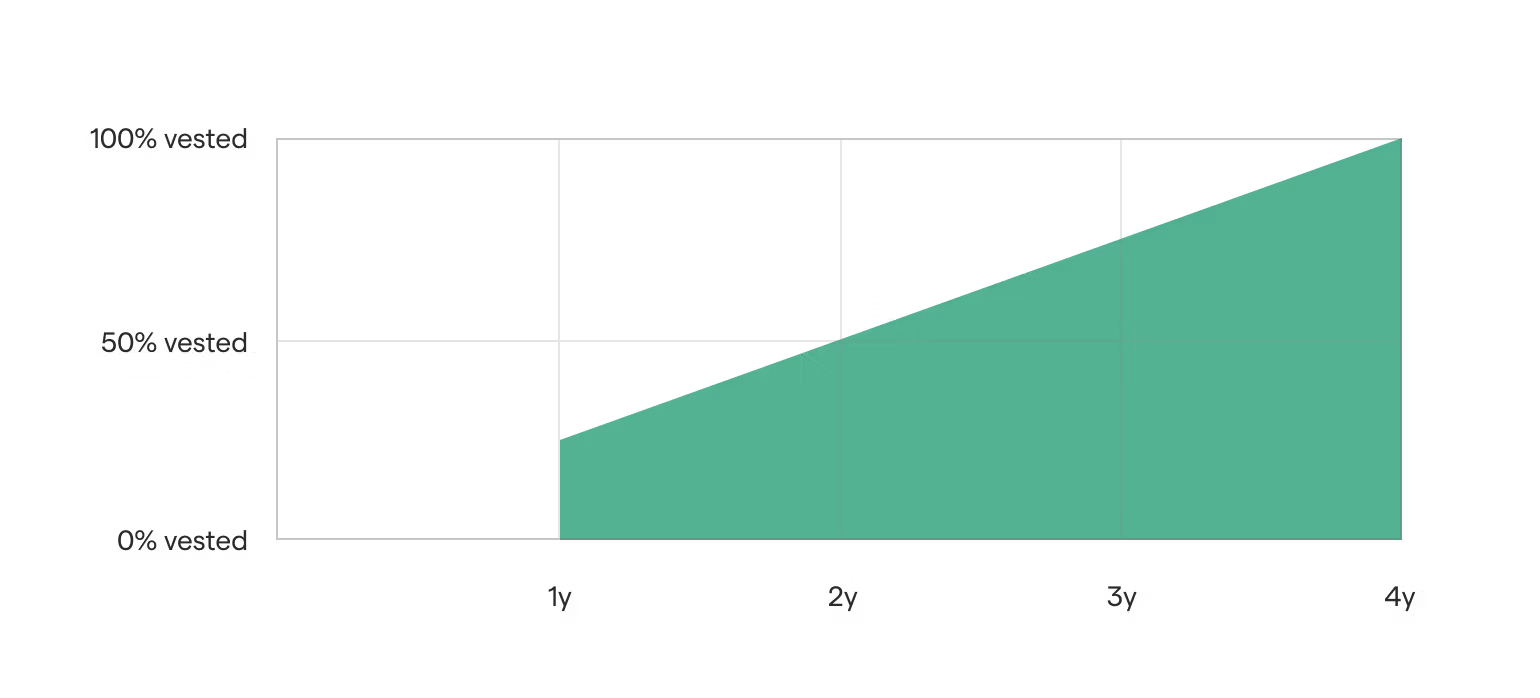
For illustrative purposes only. Actual results may vary, and there is no guarantee of any particular outcome.
There are some alternatives to this structure, but in most cases, your initial stock options grant will reflect this timeline. The main exception is if you get refresher grants, as these will probably have their own vesting schedule which may or may not include a cliff.
When it comes to initial equity grants, execs like cliff vesting because it acts as an incentive for new hires to stay at the company for at least a year. And if your equity is then granted bit by bit over multiple years, you're more likely to stick around for longer.
This is why stock and options grants are sometimes called golden handcuffs: you feel locked into your company by the promise of incoming equity.
Cliff or no cliff, leaving before all your equity has vested will result in whatever is unvested being forfeited. And if you do have the standard one-year cliff period and quit within 12 months of receiving your grant, you'll walk away with no equity at all.
With restricted stock units (RSUs), you'll get to keep any portion of your grant that has vested after leaving.
For stock options, it is a little less straightforward. Any unvested options will be lost, but if some of your incentive stock options (ISOs) or non-qualified stock options (NSOs) have vested, you typically will only have a 90-day window to exercise them after leaving. Miss this deadline, and you'll also forfeit your vested options.
This decision is a complicated topic in itself. You can read more about it in our guide on whether to exercise stock options after leaving your company.
Right off the bat, you should know that almost all companies use the same employee vesting schedule that we mentioned earlier in this article and will go into more detail on below. But that doesn't mean there aren't edge cases, especially for execs negotiating offers in real time.
These are the different cliff vesting schedules you might come across:
A four-year vest with a one-year cliff is the absolute most common cliff vesting schedule, and probably the one your grant is following.
In this grant structure, the cliff period is the first year of employment. So you don't receive any of your grant equity during this time. Then for every following year, you'll get another 25% of the grant.
For instance, maybe you were given 20,000 ISOs (incentive stock options) with a four-year vesting period and a one-year cliff when you joined your company. In the first year, none of those options will vest, meaning you aren't able to exercise anything.
After one year, 25% (the first 5,000 ISOs) of the options will vest. You'll then have the chance to exercise and hold/sell them. You don't have to do anything with your options, but the ability is there.
Every following year, 25% more options will vest until you reach all 20,000.
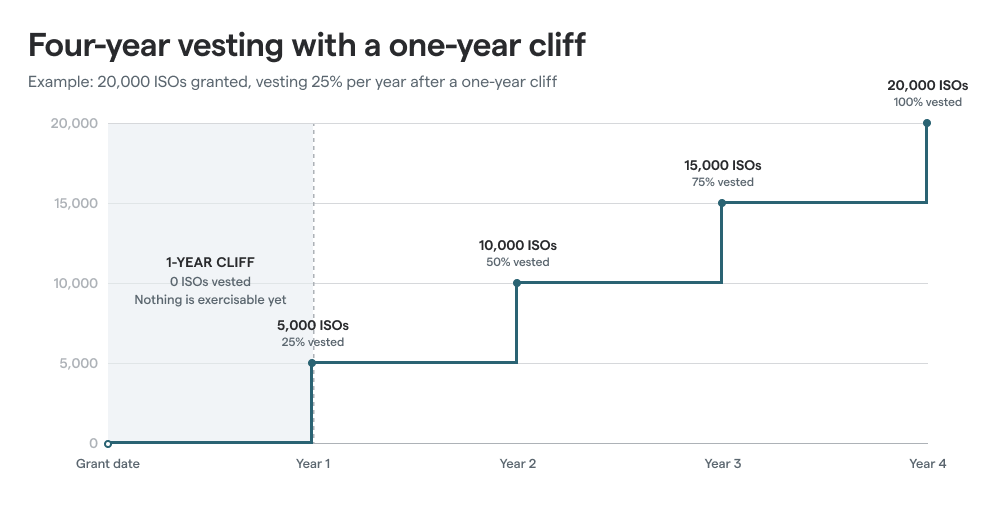
For illustrative purposes only. Actual results may vary, and there is no guarantee of any particular outcome.
A few things to know about four-year vesting with a one-year cliff are:
While most grants vest by time, some will use milestones instead. For example, if after your cliff period your company hits $100 million in revenue, an option package will be triggered and released to you.
You might have come across milestone vesting for the first time in 2025 with Tesla approving a $1 trillion milestone pay package to Elon Musk. The equity grant uses hybrid vesting and will be paid out over 10 tranches that are tied to Tesla's market valuation.
It states that if the company valuation rises in increments of $500 billion (and later $1trillion) up to $8.5 trillion, and Musk remains CEO for his vesting period of 7.5 years, then he'll receive almost $1 trillion worth of shares.
Although the size and value of this grant was unprecedented, milestone vesting is not a new concept. It is most commonly (but not solely) found in executive contracts, and is something that execs in mid-to-later stage careers might negotiate alongside their team of lawyers and wealth advisors.
Things to keep in mind with milestone vesting are:
Two-year cliffs are exactly what they sound like: employees must wait a full 24 months before being able to access any of their grant. And, even after this time, there is likely still a time element to the vesting schedule, e.g., a five-year vesting period with a two-year cliff.
Grants using this structure do exist, but in general are quite rare. In our experience, this is because it is off-putting to employees considering their offers. A one-year cliff is much more incentivising than having to wait two years to access any equity, regardless of whether the stock grant might be bigger overall.
The average company is not likely to offer these kinds of grants, but you might come across them with earlier-stage start-ups who are experimenting with offer structures. In even rarer cases you might come across other schedules such as 3-year cliff vesting.
If you are facing a two-year cliff vesting schedule, here's what to consider:
If you've received an RSU grant from a pre-IPO company, then there's a good chance it includes double-trigger vesting. This is where just the cliff period and multi-year vesting schedule are not enough for your stock to be released.
Double-trigger vesting consists of:
For instance, say you were given 50,000 RSUs with the standard one-year cliff and four-year vesting schedule. With double-trigger vesting, even after five years, your RSUs would not vest without an IPO. That means you cannot access or sell them.
What's worse is that if you leave the company, you may be forfeiting all that equity after multiple years of hard work. And this problem is becoming more and more prevalent as companies are staying private for longer.
Some of these companies are listening to the frustration of their employees and trying to retrospectively remove that second trigger. However, this drives an issue of its own: private companies need to raise a lot of capital to cover the withholding tax on those RSUs.
An example of this happened at Stripe in 2023. They had to raise around $6.5 million dollars in order to remove the second trigger, release the RSUs to their employees, and cover the large withholding tax bill at the same time.
If you have a double-trigger cliff vesting schedule, you'll want to know these things:
Being granted RSUs is a lot more straightforward than stock options. You automatically receive them as soon as they vest, with your company generally selling off (or retaining) some amount as withholding tax.
With ISOs and NSOs, you still have to decide if, when, and how you want to exercise your options, and your cliff vesting schedule will have an impact.
Here's what you need to know:
When you exercise stock options, the spread (the difference between how much you pay for the share and how much it is worth at the time) can be taxed. For NSOs this is at your ordinary income rate, but with ISOs you'll need to work out your Alternative Minimum Tax (AMT).
This is a separate tax system used to make sure the highest-income earners pay enough in taxes. And unlike the normal system, your stock exercise spread is taxable for AMT.
If you exercise any ISOs, you need to calculate your normal taxes and AMT, then pay whichever is higher. As the tax is dependent on the spread, the larger the difference between your strike price and the fair market value (FMV), the higher your tax bill will be.
And if you weren't already prepared, the AMT amount can be shocking. It's often multiple times higher than your cost to exercise, especially with a larger spread (e.g., exercising 100% of your options at once after an IPO).
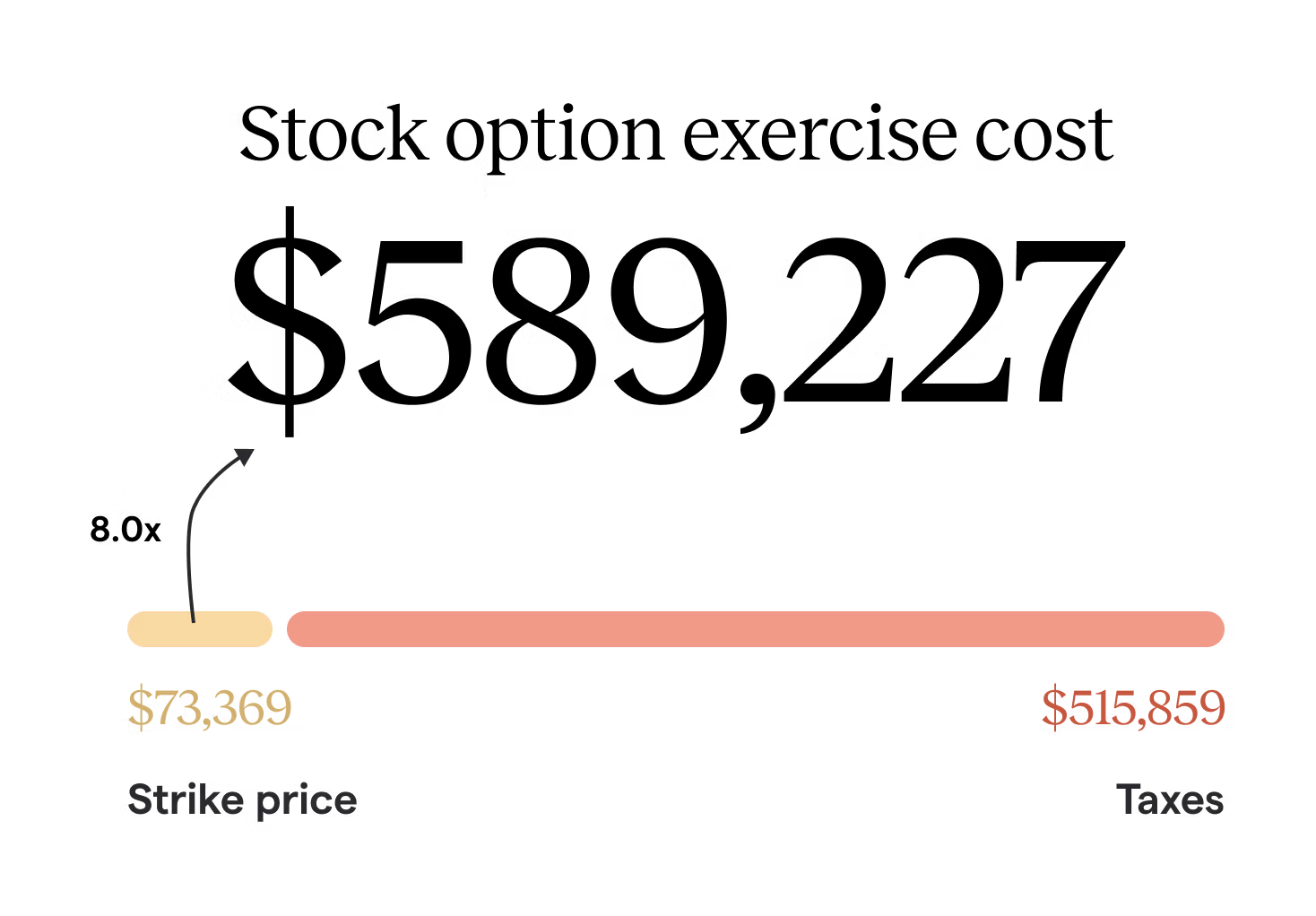
For illustrative purposes only. Actual results may vary and there is no guarantee of any particular outcome.
That's why the cost to exercise the same amount of options can be more expensive from one year to the next: if all goes to plan, your company will become more valuable, meaning your spread gets bigger, and so does your tax obligation.
In terms of a vesting schedule, this can be an incentive to exercise in a staged approach, as your options vest. E.g., every year, you exercise the 25% of your options that have just vested.
This can also be a savvy way to avoid triggering AMT altogether, as it usually happens when the taxable spread becomes large enough. Not exercising 100% of your options at once might keep your total spread per tranche under the AMT limit.
On top of paying a tax on the exercise spread of your options, you'll also be taxed when you sell your shares. Anything above the original strike price is considered taxable gains, but the final rate will depend on how long you have held the equity.
Hold your options for one year from exercise (and two years from grant for ISOs), and you'll access the long-term capital gains rate. This is usually in the range of 0-20%. Sell in under this time, and the gains will be taxed at your ordinary income rate instead. That can be up to 50%, depending on your state.
This plays into your vesting schedule, as the capital gains clock restarts for every tranche exercised.
To put this into a real-world situation, imagine you received 10,000 ISOs in January of 2022 with a one-year cliff and four-year vesting period. In January of 2023, 2,500 of those options would vest (25% of 10,000). Say you exercise them immediately, then the capital gains clock starts that same day.
One year later, another 2,500 options vest and you exercise them. You now hold 5,000 shares in your company.
Your original tranche has met the long-term capital gains holding period, but the second has not. So, if you were to sell all 5,000 that year, only half of them would get the more preferable long-term capital gains tax rate. The rest would face ordinary income tax.
You can see how complex modeling these scenarios can get, especially when you factor in refresher grants which may have entirely different cliff vesting schedules. Using tax calculators and equity planning tools to try and model how the vesting will play out can be helpful, or you could try our free AI equity assistant, Maeve, for instant personalized projections.
Early exercising is when a company allows you to exercise your stock options before they vest. Most grants don't allow for this, so make sure to check the exact wording of your own to know if it is a possibility.
If it is included in your grant structure, then you have the opportunity to exercise your unvested options during the cliff period. You still have to wait for them to vest in order to receive your equity, but there are some big potential advantages to an early exercise:
Of course, there are also some cons to consider:
To cover the cost of early exercise without personal risk, many execs seek approval for non-recourse financing. This covers the total cost to exercise while also taking on the liability should the company fail. Essentially, your shares are the collateral, and if they lose value, you don't owe anything.
On the other hand, if you have a successful exit, you'll pay a portion of the profit to the lender on top of the principal and interest.
In most cases, non-recourse financing is only available for later-stage companies, but you can learn more about it in our non-recourse financing guide.
Any RSU or stock options grant can be used to increase a potential new hire's total compensation package, without increasing their cash salary. This alone can make an offer more tempting, but the vesting schedule can also be used as a secondary incentive driver.
Not to join the company, but to stay.
Receiving equity, especially at a growing company, lets an employee or exec share in its success financially. And by spacing out the vesting period to happen over multiple years, it incentivises someone to stay longer in order to receive their full grant.
Plus, having equity in the company can make the employee feel not just financially invested, but emotionally invested in its success. As a result, they might stay there longer.
When negotiating with executives, being able to adjust the vesting period can make the payment package more appealing without changing any of the actual numbers. For example, removing the cliff period, or changing to a milestone schedule that gives them more agency in when their equity vests.
If you're currently negotiating your own grant structure, it may be helpful to use our AI equity assistant, Maeve, as a resource. It can quantify stock grant values, as well as project different scenarios so that you understand each potential outcome.
Trying to decode an equity grant is not easy, especially if it's your first time facing one. But that's exactly why we made Secfi. Our goal is to help you demystify stock options and be able to make the absolute most of your equity.
If you're tired of DIY equity planning, then here's how we can step in to help:
We built Maeve because we know how frustrating it can be to flick between a million different equity calculators and tax tools. Now, everything you need is in one place, with personalized responses that address your unique situation.
Maeve can review your grant offer and model real-world outcomes, including when your equity is actually going to vest. These projections will factor in tax obligations, cliff periods, and the likelihood of liquidity events so that you can have a comprehensive understanding of your offer's value before or after accepting.
And with Maeve, you never have to worry about missing something important. It knows the forms, tax liabilities, and grant small print without you even having to ask.
It's completely free to get started with Maeve, and uploading your details/connecting with Carta only takes a few minutes to complete.
Building an equity strategy is hard. But we know finding an expert who understands your specific situation can be even harder. Particularly as many advisors work with clients much further into their wealth journey.
At Secfi, our wealth team is experienced with clients at every step of the ladder, including those facing their first big financial decision.
We also work with executives who want to negotiate the cliff vesting schedule of their equity grant. Our advisors know how to evaluate an offer and can make suggestions on where additional value might be found.
You can ask them:
We've helped thousands of tech workers, have over $90 billion worth of equity registered on our platform, and provide you with combined decades of experience.
If you're trying to optimize your options strategy in line with a cliff vesting schedule, then you've probably realized that exercising stock options at the right time can be both a huge financial advantage and cost.
Being able to fund an early exercise or staged exercising approach can save you thousands (sometimes millions) in the long run. But only if you can access the capital first.
That is where non-recourse financing steps in. We will cover the entire cost to exercise your options in exchange for a portion of the gains if you have a successful exit. If the company fails, we're the only ones to take a loss.
What sets us apart from other lenders is that financing is just one part of the process. We also offer you scenario modeling, tax insights, and decision support along the way. As well as advising you on whether exercising even makes sense for your situation.
We're very particular with who we approve for non-recourse financing, and typically work with employees at later-stage companies. To learn more about our business model, check out: How Secfi financing works – our business model explained.
After deciding to leave his position at Confluent, Barry wanted to address the stock option grant he'd been given on joining. He realized that his options had vested, but that he only had 90-days to exercise them or they'd be lost.
He knew there was value in these options, and felt confident that Confluent was likely to IPO in the near future. Plus, after years of working for the company and vesting these options, he wanted to be able to fully benefit from them.
The issue was that he was not prepared for the very large tax liability. The total cost to exercise was significantly steeper than he had expected, and although he was confident in the equity's upside, he was not ready to take such a significant financial risk with his own capital.
He had heard about Secfi from a coworker and decided to reach out to one of our equity planners. After asking many questions and receiving an explanation on how Secfi could help, Barry decided to move forward with non-recourse financing.
We covered the cost of his exercise (including the sizable tax bill), allowing Barry to exercise his options within the 90-day window. Shortly after, Confluent had a successful IPO, and Barry was able to settle the financing costs.
Today, he has equity in a publicly traded company that has already grown substantially in worth since his pre-IPO exercise.
Read the whole story: Barry chose Secfi's equity financing because of the people, transparency, and reduced risk to own his options.
This case study is an illustration of our capabilities provided to an individual client. Client results may vary and there can be no guarantee of similar results. It is not known whether the client approves or disapproves of Secfi Advisory Limited or it affiliates as a whole.
Understanding your grant's structure is the first step to being able to strategize on it. And a cliff period is not only a part of this, but can also become an opportunity to learn and pre-plan for when your options do vest. Secfi is ready to support you in this journey, providing you with expert knowledge, comprehensive tools, and financing options so that you can feel confident in your ultimate equity decisions.
No. Vesting only gives you the right to exercise, but it doesn't create an obligation. You can exercise all, some, or none of your vested stock options whenever you choose, up until they expire (typically 10 years from the grant date, or much sooner if you leave the company).
Many people choose to exercise gradually rather than all at once, since exercising can trigger significant tax implications, including a large AMT liability owed to the IRS. In other cases, it may make sense to exercise all your options at once, with options for funding this such as doing a cashless exercise or using non-recourse financing. Working with a professional for equity management can help you navigate this decision.
Vesting simply converts a portion of your equity compensation from "promised" to "exercisable." Vesting milestones are often tied to your work anniversary, for instance the cliff vests on your first anniversary with the company, with additional options vesting each year after.
Once options vest, you gain the right to buy the underlying shares at your strike price, but nothing happens automatically to your taxes or bank account the way it might with RSUs because options generally aren't taxed at vesting.
You still have to actively exercise vested equity options to become a shareholder, and if you never exercise them, they simply sit as unexercised vested options until they expire under the terms of your grant.
Any options that haven't vested yet are typically forfeited the moment you leave, since vesting is designed to reward long-term commitment and is tied to continued employment. For the options that have already vested (but aren't exercised), most companies give you a 90-day window to decide whether you want to exercise them. If you miss this deadline, the options will also be forfeited.
Not usually, as the cliff (commonly a one-year cliff, as in the example above) and time-based vesting schedule are set by the company in your grant agreement, a standard feature of most employee stock option plans. Acceleration does happen on occasion, but only when it's been built into the agreement ahead of time.
The two common forms are single-trigger acceleration, where some or all unvested options vest automatically if the company is acquired, and double-trigger acceleration, where vesting speeds up only if an acquisition is combined with the employee being let go without cause.
These provisions are more common in executive offers or negotiated later-stage grants than in standard employee packages, so it's worth checking your own agreement rather than assuming it applies.