Strike price vs exercise price: What’s the difference for startup stock options?

17 min
0 result
John’s a Director at Secfi, helping founders, executives and employees navigate equity compensation and access to liquidity through his expertise in finance.
If you’re comparing strike price vs. exercise price, the simplest answer is that they generally mean the same thing. Both refer to the fixed price per share you pay when you exercise your stock options and buy shares in your company.
The confusing part is that your strike price is only one of several related numbers you may see in your equity documents. For example, how does it differ from the fair market value and your eventual exercise cost (which can end up being much higher than the exercise price)? And where do taxes fit into all of it?
Understanding how everything works together can help you work out if exercising stock options makes sense for your situation.
In this guide, we’ll cover:
Strike price vs. exercise price: Comparing related terms
What you need to know about your strike price before exercising
Ways your strike price affects taxes and the total cost to exercise
How Secfi can help you understand and act on your stock options
How Alex went from knowing her strike price to understanding how to use it for equity decisions
If you’re ready to go beyond your strike price vs exercise price and answer more equity questions, try our free AI equity assistant Maeve, or connect to it directly to ChatGPT with our MCP.
Private equity comes with a smorgasbord of terms you might hear that are related to your strike price.
| Term | What it means | Does it change? | Role it plays |
|---|---|---|---|
Strike price/exercise price | The fixed price per share you pay when you exercise your stock options. | Usually not after your option grant is issued. | It determines how much you pay your company for each share you exercise. |
409A valuation | An independent valuation used by private companies to help determine the fair market value of their common stock for tax purposes. | Yes. Companies generally update 409A valuations periodically and after certain material events. | It helps companies set compliant strike prices for new option grants and can affect the value used when calculating taxes on an exercise. |
Fair market value (FMV) | The value of a share for tax purposes at a particular point in time. For private-company common stock, a current 409A valuation is commonly used to establish FMV. | Yes. | The difference between FMV and your strike price can affect the tax consequences of exercising your options. |
Exercise cost | Your strike price multiplied by the number of options you exercise. | It depends on how many options you choose to exercise. | This is the amount you pay your company to buy the shares, before any applicable taxes. |
Total cost to exercise | Your exercise cost plus any taxes triggered by the exercise. | Yes. | This gives you a more complete estimate of how much cash you may need to exercise your options. |
Taxable spread | The difference between your strike price and the FMV of the shares when you exercise. | Yes. The spread can increase or decrease as the company’s FMV changes. | The spread may affect the taxes triggered by exercising. |
For example, say your strike price, or exercise price, is $2 and you exercise 10,000 options. Your exercise cost would be $20,000.
If a later 409A valuation establishes an FMV above $2 per share, the difference between your strike price and the FMV may also affect the taxes you owe, depending on the type of stock options you hold. Add any taxes triggered by the exercise to the $20,000 exercise cost, and you get your total cost to exercise.
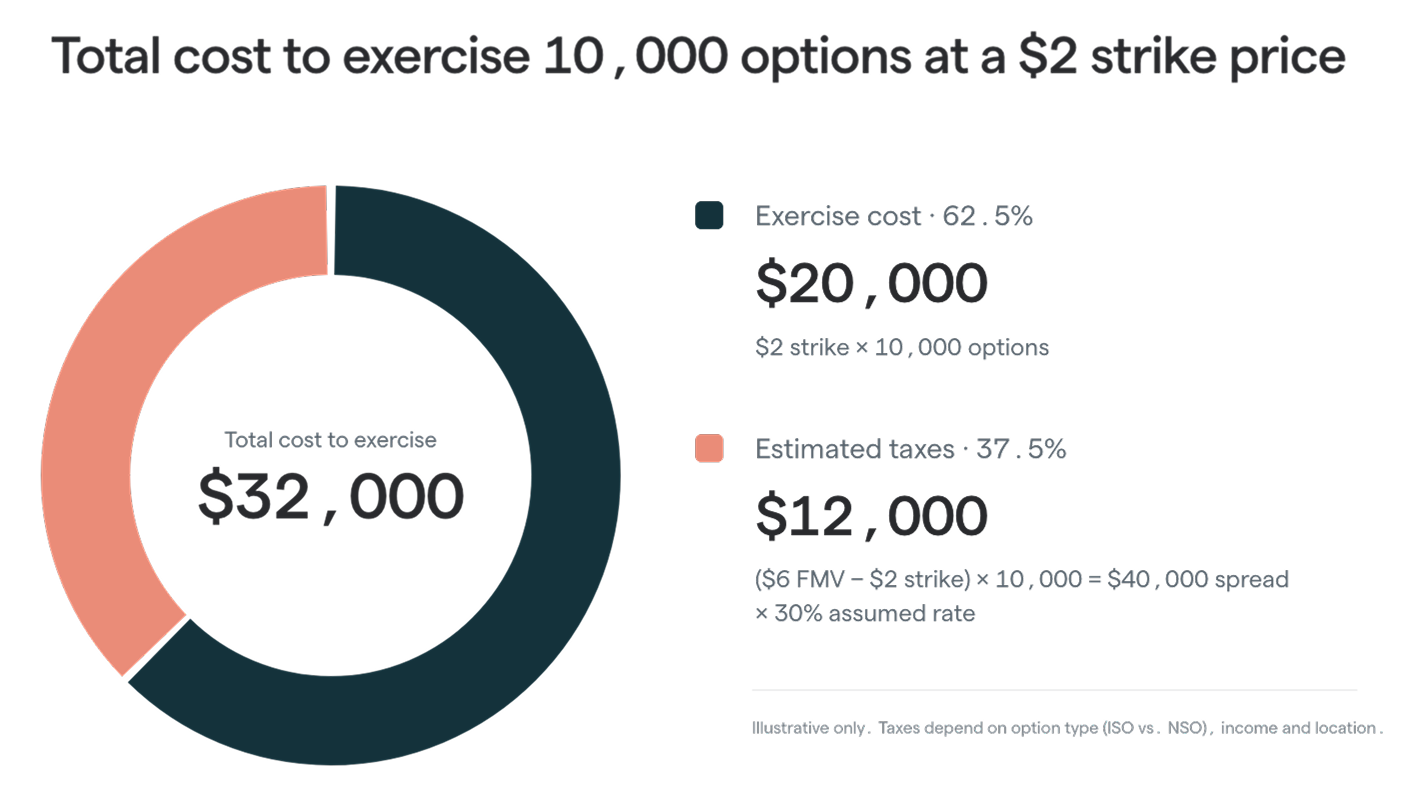
Illustrative example only. Actual outcomes depend on your circumstances. Check the calculations and any tax, legal, or financial decisions with your own advisor.
Your strike price will be on your initial stock option grant.
That might come in the form of paperwork, but these days, most companies manage their equity on a digital platform like Shareworks or Carta. If that’s the case, you can log in and find the details of your options, including the strike price.
You can often find your company’s current 409A valuation in the same equity management platform. If you can’t find it, ask someone in the finance or HR department, or whoever handles equity at your company.
If you have multiple stock option grants, check each one separately. Grants issued at different times may have different strike prices because the company’s fair market value may have changed between grant dates.
When you receive stock options, their strike price is generally set at or above the fair market value (FMV) of the underlying shares on the grant date. For private companies, that FMV is typically determined through a 409A valuation conducted by an independent third party.
The IRS requires any startup that issues stock options to perform these at least once a year, or whenever there is a major event such as a new funding round.
So if a company’s common shares are valued at $1 a share, new employees receiving option grants, as well as existing employees receiving additional grants, would generally have a strike price of at least $1 a share.
That may then remain the strike price for new stock options until the company gets a new valuation. Already existing stock options usually keep their original strike price.
Companies may also need to update their 409A valuation after a material event that could affect the company’s value, such as a new round of funding. Major events, like the pandemic, can also lead companies to reevaluate their 409A valuation. Basically, any time there's big news for a company, they’ll likely reevaluate their 409A valuation and thus their strike price.
The strike price amount really depends on a company’s stage and performance. Early on in many companies, you'll often see strike prices for under a dollar per share. But as a company grows and its fair market value increases, strike prices for new option grants will generally increase too.
We’ve seen strike prices anywhere from a few cents per share all the way up to hundreds of dollars per share.
The number of company shares also affects the per-share value. Two companies could have similar overall valuations but very different per-share values if they have different numbers of shares outstanding.
That’s why comparing strike prices between different companies is really comparing apples to oranges. A $1 strike price at one startup isn’t necessarily a better deal than a $10 strike price at another. You need more information about the company and the size of your equity grant to understand what your options could be worth.
A strike price usually isn't negotiable.
That’s because it’s generally a fixed number based on the fair market value of a company’s shares when the option is granted.
It is technically possible to grant options at a strike price different from the current fair market value. But it's not very common and can come with disadvantages. For example, granting options at a strike price below fair market value can create unfavorable tax consequences and may affect how the options are treated for tax purposes.
And if your strike price was higher than the current fair market value at grant, you’d be paying more per share when you exercise.
Your strike price stays fixed, but your company’s fair market value can change over time. As the gap between the two grows, exercising your stock options may become more expensive from a tax perspective.
Here’s another example, but make sure to check with a professional about your own situation.
If your strike price is $2 and the current FMV is $10, there’s an $8 spread per share. That spread can affect your taxes when you exercise, although the rules depend on the type of stock options you hold.
With incentive stock options (ISOs), exercising and holding the shares may create alternative minimum tax (AMT) income based partly on the spread between your strike price and FMV. AMT is a separate tax system designed to ensure high earners pay enough in taxes. When you exercise ISOs, you will need to work out both your regular taxes and AMT, then pay whichever is higher.
With non-qualified stock options (NSOs), the spread at exercise is generally treated as ordinary income.
That doesn’t mean you should always exercise as soon as possible. Exercising earlier may mean a smaller spread and lower taxes if your company continues to increase in value, but you’re also putting cash into private-company shares that may remain illiquid for years or ultimately lose value.
You also don’t necessarily have to choose between exercising everything and doing nothing. Depending on your grant and financial situation, you might exercise a portion of your vested options now and leave the rest unexercised. This is also a way to potentially reduce your AMT bill, or avoid triggering AMT altogether.
In some cases, you may qualify for non-recourse financing, so you don’t need to put your own cash or assets on the line to fund an exercise.
At Secfi, we help startup employees and executives understand and act on your equity. Secfi’s Maeve can help you model different scenarios using your own grant details, such as how much it could cost to exercise different numbers of options and how changes in FMV may affect the outcome. That can give you a clearer starting point before making a larger tax or financial decision.
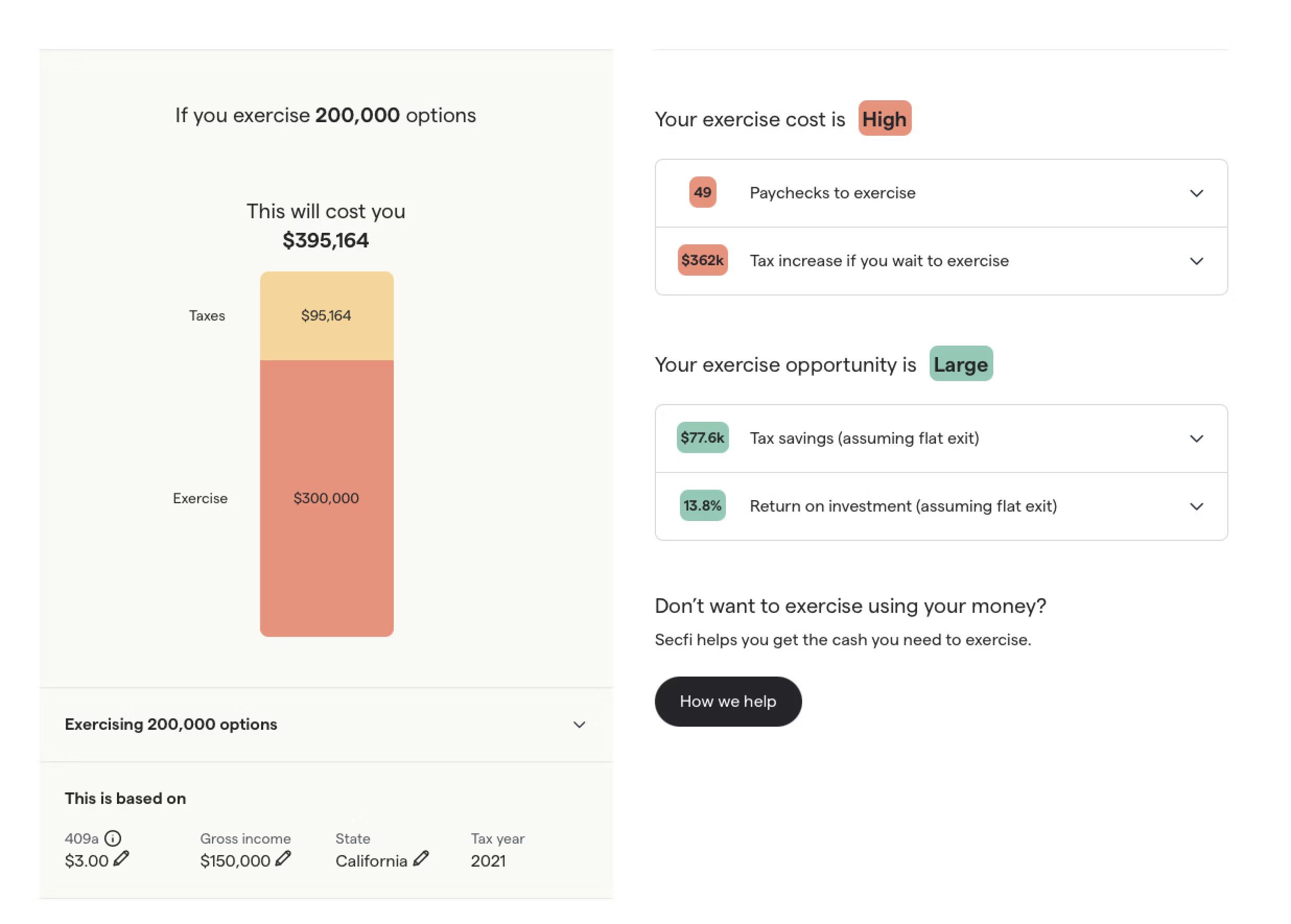
For illustrative purposes only. Actual results may vary, and there is no guarantee of any particular outcome.
Understanding your strike price is one part of managing stock options. Once you start thinking about whether and when to exercise, you may also need to calculate your exercise cost, estimate taxes, compare different timing strategies, and decide how much of your own cash you’re comfortable putting into private-company shares.
Secfi brings equity planning tools, financial advice, and financing into one place. As of July 2026, more than 62,000 startup employees and executives use Secfi to help make decisions about their stock options.
Here’s why employees and executives at companies such as Coinbase, Databricks, and Anthropic work with Secfi to understand and act on their equity.
A general-purpose AI tool can explain what a strike price is, but it won’t necessarily know your strike price, how many options you hold, your vesting schedule, current FMV, or tax situation.
Maeve is Secfi’s AI assistant built specifically for equity. You can connect your Carta account, upload grant documents, or enter your equity and tax details manually. Maeve can then use that information with Secfi’s calculation engines to help you explore questions such as:
How much would it cost to exercise 10,000 options at my strike price?
How does my current FMV compare with my strike price?
Could exercising my ISOs trigger AMT?
How would exercising a portion of my options compare with exercising all of them?
How might the cost change if I wait and my company’s FMV increases?
You can also connect your Secfi account directly to ChatGPT through Secfi’s MCP integration. That gives the AI assistant access to your Secfi equity data and calculation tools, so you can ask questions using your own numbers rather than repeatedly entering grant information into a general LLM.
For illustrative purposes only. Actual results may vary, and there is no guarantee of any particular outcome.
Even when your strike price looks relatively low, exercising a large number of options can require a significant amount of cash. Taxes can increase the total cost further.
For eligible companies, Secfi offers non-recourse financing that can help cover the cost of exercising stock options and associated taxes. You retain ownership of your shares and don’t put unrelated personal assets on the line.
If your company later has a successful liquidity event, such as an IPO or acquisition, you repay the financed amount according to the terms of your agreement, including applicable fees. If the company doesn’t have a successful exit, you generally don’t repay the financed amount.
This protection also means Secfi has to be selective about which companies and transactions it can finance. Eligibility and pricing depend on factors including the company, your equity, strike price, tax needs, and potential path to liquidity. Financing also comes with costs and may mean giving up some potential upside, so it’s worth comparing the outcome with using your own cash, exercising fewer options, or waiting.
Sometimes you want a person who is good at numbers and a specialist in the nuances of startup equity. Secfi Wealth’s financial advisors specialize in working with startup employees and executives whose finances include private-company stock options.
A traditional financial advisor may be very experienced in areas such as retirement planning and public-market investments without regularly dealing with private-company stock options. Secfi advisors can incorporate the details of your equity into the wider conversation, including whether exercising everything, exercising a portion, or waiting better fits your financial situation and risk tolerance.
Before joining Applied Intuition, Alex had spent years recruiting for technical roles and explaining compensation packages that included stock options. Her understanding of equity, she said, was mostly: “you are getting this many stock options at this strike price.”
But receiving stock options herself made her realize there was much more behind that number.
“I generally knew what a strike price was, but not to the degree that I do now,” Alex said.
She wanted to understand what exercising her options would actually mean for her finances and the potential tax implications.
Alex eventually started working with a Secfi financial advisor. Together, they looked at her vested options and modeled different strategies around whether and when to exercise and potential future liquidity opportunities.
At the end of the day, she found it helpful to have someone on her side who can help her navigate financial decisions. “The personable aspects of working with someone is always nice… I’ve enjoyed being very open and honest about where I am in my career, and [Secfi advisor] Chris has been very understanding about the ups and downs of working in these types of startup environments.”
Read the full case study: Why a tech recruiter wanted a financial advisor that understood private stock options.
This case study is an illustration of our capabilities provided to an individual client. Client results may vary, and there can be no guarantee of similar results. It is not known whether the client approves or disapproves of Secfi Advisory Limited or its affiliates as a whole.
Getting familiar with your strike price and related terminology is just the starting point when you have decisions to make about your equity.
If you want to see how those numbers work together for your own equity, you can use Secfi’s Maeve or MCP to ask questions and model different exercise scenarios using your grant details.
And if you want to talk through a bigger decision with a person, you can also speak with us about your stock options, taxes, exercise strategy, and available financing options.
Yes. For employee stock options, strike price and exercise price generally mean the same thing: the fixed price per share you pay your company when you exercise your options.
For example, if you have 5,000 options with a $10 strike price, it would cost $50,000 to exercise all of them before any applicable taxes.
Your strike price is different from the current stock price, fair market value (FMV), or private-company valuation. Those values can change over time, while the strike price on an existing grant generally stays fixed.
If you use Secfi’s Maeve, you can connect your Carta account or enter your grant details manually to see your strike price alongside the other numbers that affect your equity decision.
For illustrative purposes only. Actual results may vary, and there is no guarantee of any particular outcome.
A strike price of $120 means you have the right to buy each share covered by your stock option grant for $120 when you exercise.
So, if you exercise 1,000 options, the basic exercise cost would be $120,000 before taxes.
Whether a $120 strike price is attractive depends on what the shares are currently worth. If the current FMV or market price is above $120, your options have positive intrinsic value. If the stock is worth less than $120, exercising would mean paying more than the shares are currently worth.
For private-company employees, though, the decision isn’t based on the strike price alone. Taxes, liquidity, the company’s prospects, and how much cash you’re willing to put at risk also matter. Maeve can help model those factors using your own equity details.
The strike price is the fixed amount you pay per share when exercising your options. The market price is what a share is currently worth in the market.
For a public company, the market price is usually easy to see because the shares trade on the stock market. For a private startup, there may not be a continuously quoted market price, so employees often look at the company’s current FMV or 409A valuation instead.
The relationship between the two is sometimes described as an option’s moneyness. If the stock price is above the strike price, a call option is in the money (ITM). If they’re equal, it’s at the money. If the stock price is below the strike price, it’s out of the money (OTM).
Those terms are especially common in public options trading, but the same basic comparison can help startup employees understand whether their employee stock options currently have intrinsic value.
For startup employee stock options, you generally can’t simply sell the option itself the way an option holder might sell an options contract in public-market options trading.
Instead, you usually decide whether to exercise the option and buy the underlying shares, wait, or potentially exercise and sell shares when a liquidity opportunity is available.
Which path makes sense depends on your strike price, current FMV, taxes, cash available, risk tolerance, and whether you expect a future IPO, acquisition, or secondary sale.
A Secfi financial advisor who specializes in private-company equity can help you compare different exercise scenarios. And if exercising makes sense but the upfront exercise cost and taxes are difficult to cover, eligible employees may also be able to consider Secfi non-recourse financing rather than funding the entire exercise with personal cash.
These terms describe the relationship between an option’s strike price and the current stock price, known as its moneyness.
For a call option, which gives the option holder the right to buy shares, the option is in the money (ITM) when the stock price is above the strike price. It’s at the money when the two prices are roughly equal, and out of the money (OTM) when the stock price is below the strike price.
For example, an option with a $10 strike price has $15 of intrinsic value if the stock is worth $25 per share.
A put option works in the opposite direction because it gives the holder the right to sell shares at the strike price. Put options and call options are common in public-market options trading, while startup employee stock options are generally call-style rights to buy company shares.
For startup employees, being ITM doesn’t automatically mean you should exercise. You still need to consider exercise costs, taxes, liquidity, and the risk that a private company’s value could change before you’re able to sell.
The tool shown here uses artificial intelligence and is for illustrative purposes only and not necessarily indicative of future results, and there is no guarantee that similar results can be achieved. The information provided by the tool is not professional advice and is not intended by Secfi, Inc., its affiliates, and Secfi representatives, to be deemed as investment, legal, tax, or other professional advice or recommendations of any kind, or to form the basis of any decision to do or to refrain from doing anything. Secfi does not review the accuracy or completeness of the information provided to us within the tool.