Equity planning platforms like Secfi
At Secfi, we help growth-stage company employees navigate the complexity of tax-efficient exercising. Our platform, including our AI equity assistant Maeve, is built specifically to handle the nuances that generic financial tools miss.
Strategize in one platform
Maeve is designed to help bring your grant data, tax modeling, and scenario analysis together. You can upload your documents to see the long-term impact of your decisions. This helps you:
- Estimate your current AMT.
- Plan when and how many options to exercise to stay under certain tax thresholds.
- Understand how your equity fits into your broader financial planning.
Read more: How can a financial advisor help with your equity?
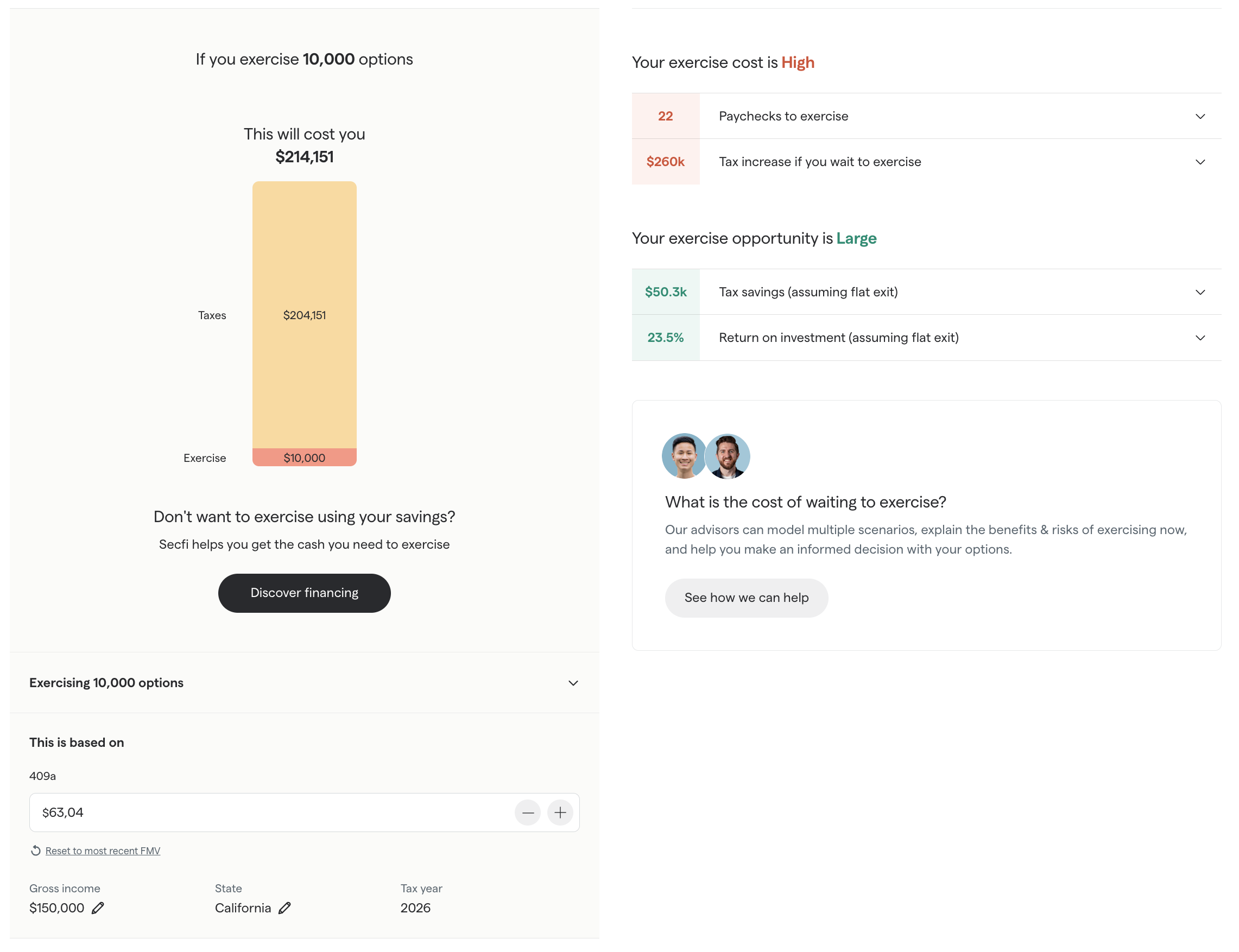
For illustrative purposes only. Actual results may vary and there is no guarantee of any particular outcome.
Access non-recourse financing for AMT bills
The biggest challenge with AMT is often the cash constraint. Many employees realize too late that the tax bill to own their shares is in the six figures. We provide non-recourse financing to cover both the exercise cost and the AMT bill.
Because the financing is non-recourse, you do not use your home or personal savings as collateral. Your shares serve as the security. If the company fails, you owe nothing. If it succeeds, you repay the amount plus a fee from the proceeds at exit.
This allows you to exercise early, start the capital gains clock, and limit further AMT exposure as the company valuation grows.
Point calculators like Carta
Point calculators are single-purpose tools helpful for isolated decisions. They are often free and do not require a full account setup.
Carta AMT calculator
Carta provides a dedicated calculator that specifically models the bargain element of ISOs. It is useful for estimating the immediate tax hit of a specific exercise.
- Standout feature. It links the exercise event to potential future capital gains.
- Ideal for. Employees who want a quick estimate before a specific exercise deadline.
Standard tax software like TurboTax
Standard software like TurboTax is necessary for the actual reporting of AMT. While it is not a tool for forward-looking equity planning, it is commonly used to calculate and report AMT during tax filing.
TurboTax and AMT reporting
TurboTax calculates your regular tax and your AMT simultaneously. If the AMT calculation is higher, it automatically accounts for the difference in your final return.
- Key feature: It pulls data from previous years to see if you qualify for an AMT credit.
- Ideal for: Filing returns and ensuring you don't miss out on claiming your carryforward credits.
IRS’ official AMT credit form
While not a digital dashboard, IRS Form 8801 (Credit for Prior Year Minimum Tax) is the actual ledger used to manage AMT over time.
How Form 8801 works
- Calculates credit usage. It determines how much of the AMT you paid in previous years can be used to lower your regular tax bill this year.
- Credit carryforward. If you cannot use the full credit this year, the remaining amount may carry forward to future tax years.
- Official recordkeeping. This form serves as the IRS mechanism for calculating and reporting AMT credits from prior years.
“The goal with AMT planning is understanding how exercising stock options today could affect your taxes both now and in the future. In some cases, employees may later recover part of what they paid through AMT credits, especially after a liquidity event.” – John Klingler, Equity Expert at Secfi
Read more: The AMT credit: Exercise now, save later
How to choose the right AMT tool
Choosing a tool depends on your current stage and the size of your potential tax bill. Consider these criteria:
- Data integration: Does the tool sync with your cap table provider like Carta to ensure accurate strike prices and FMVs?
- Scenario modeling: Can the tool help you compare different exercise, sale, or liquidity scenarios before making a decision?
- Financing capability: Does the platform offer a way to pay the tax bill it calculates?
- Specialist access: Does the tool come with access to licensed equity strategists who can verify the outputs?
FAQs: Managing Alternative Minimum Tax
1. What is the AMT credit?
The AMT credit is a tax credit generated when you pay Alternative Minimum Tax in a given year due to ISO exercises. It can be used in future tax years to lower your regular income tax bill when that bill is higher than your tentative minimum tax.
2. How long can I carry forward an AMT credit?
There is no expiration date for AMT credits. You can carry the credit forward indefinitely until it is fully exhausted against your regular tax liability.
3. Does every ISO exercise trigger AMT? Not necessarily.
You only owe AMT if the total value of your bargain element plus your other income exceeds the AMT exemption threshold set by the IRS for that tax year.
The tool shown here uses artificial intelligence and is for illustrative purposes only and not necessarily indicative of future results and there is no guarantee that similar results can be achieved. The information provided by the tool is not professional advice and is not intended by Secfi, Inc., its affiliates, and Secfi representatives, to be deemed as investment, legal, tax or other professional advice or recommendations of any kind, or to form the basis of any decision to do or to refrain from doing anything. Secfi does not review the accuracy or completeness of the information provided to us within the tool.
Sources
- https://site.pulley.com/
- https://site.pulley.com/managed-services/equity-managed-services
- https://carta.com/amt-calculator/
- https://carta.com/equity-management/cap-table/
- https://ttlc.intuit.com/turbotax-support/en-us/help-article/taxation/alternative-minimum-tax-amt-2021/L7dKAer4E_US_en_US
- https://turbotax.intuit.com/personal-taxes/online/live/full-service/