Early exercise stock options: When does it make sense to do it?

25 min
0 result
San Francisco native (yes, really). @uw and Lowell High alum. I like to nerd out on fintech, stock options and taxes.
Making decisions around exercising your stock options is complex enough without the phrase "early exercise" being thrown in. Especially when you're new to a company and still finding your feet.
And, as a result, the temptation to ignore the concept and just wait to deal with your options after they vest can be strong.
However, if your company is offering you early exercise stock options, the possible advantages are too important not to at least consider. Or, if you're an executive negotiating your stock option grant currently, you may want to think about adding in an early exercise clause at this point.
But first, you need to understand more about early exercising in order to decide if it makes sense for you.
That's where this article comes in. We're exploring:
Note: Secfi helps startup execs and employees understand, plan for, and make decisions around equity. If you're looking to better understand what you can do with your equity, sign up for our free platform here: Get Started.
Early exercising is when your company allows you to exercise your stock options before they vest.
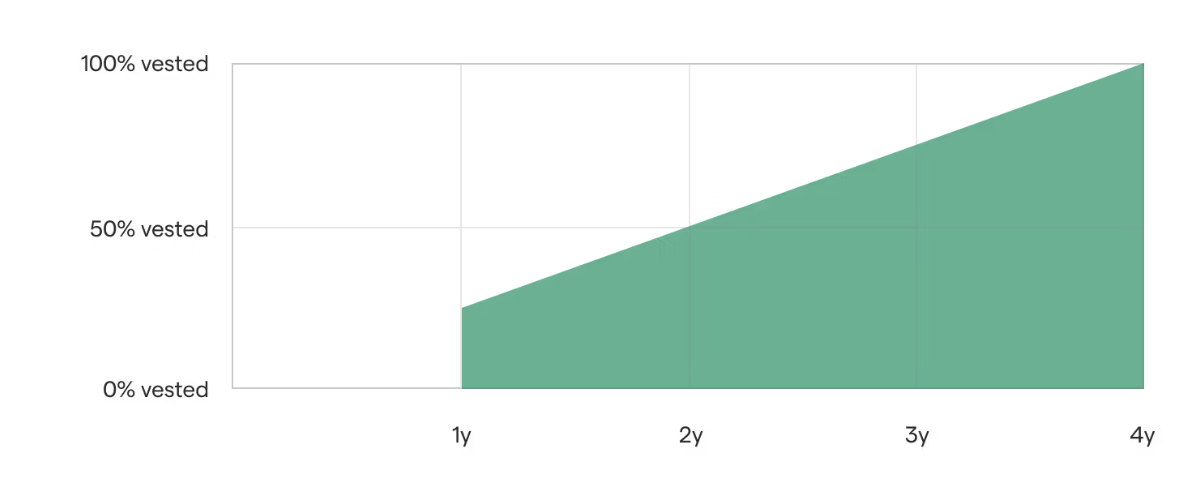
Most grants are structured using a one-year cliff and four-year vesting schedule. So, in most situations, you have to wait one year for any of the options to vest at all. After the cliff period, you'll receive 25% every year for four years until all have vested.
For illustrative purposes only. Actual results may vary, and there is no guarantee of any particular outcome.
Usually, you can only exercise a stock option if it is vested, but early exercising is a bit different. It's when your grant allows you to exercise your options before vesting, regardless of the cliff or vesting schedule.
For instance, if you have been granted 10,000 options with a normal cliff vesting schedule, you would have to wait 12 months to exercise just the first 2,500 options.
With early exercise stock options, you could exercise all 10,000 within weeks of receiving the grant. For reasons we'll explain below, this can save you a lot of money in taxes, plus start the long-term capital gains clock as early as possible.
Of course, you'll still have to wait for those options to vest before you own the equity, and early exercise alone is not enough to qualify you for all the possible tax benefits. Below are the other major factors that you need to know about.
The section 83(b) election is potentially the most important factor when it comes to early exercise. It is a provision of the Internal Revenue Code (IRC) that lets you elect to pay taxes on all your stock options at the time of exercise, instead of when they vest.
You don't have to file an 83(b) if you exercise early, but without one, you are likely missing out on some significant tax savings. To understand why, you first need to understand how stock options are taxed.
Regardless of whether you have NSOs or ISOs, your stock options are taxed on the spread. This is the difference between the strike price (the price you pay per share) and the fair market value (FMV) at the time of exercise.
The strike price is always set when the grant is given, and it never changes. Because it is determined by your company's most recent 409A valuation, there should be no to very little difference between the strike price and FMV when you first get your grant.
Then, over time, your company's valuation hopefully increases. As a result, so does the difference between your strike price and FMV. With each year, and each new options tranche, your spread grows, and so does your tax bill.
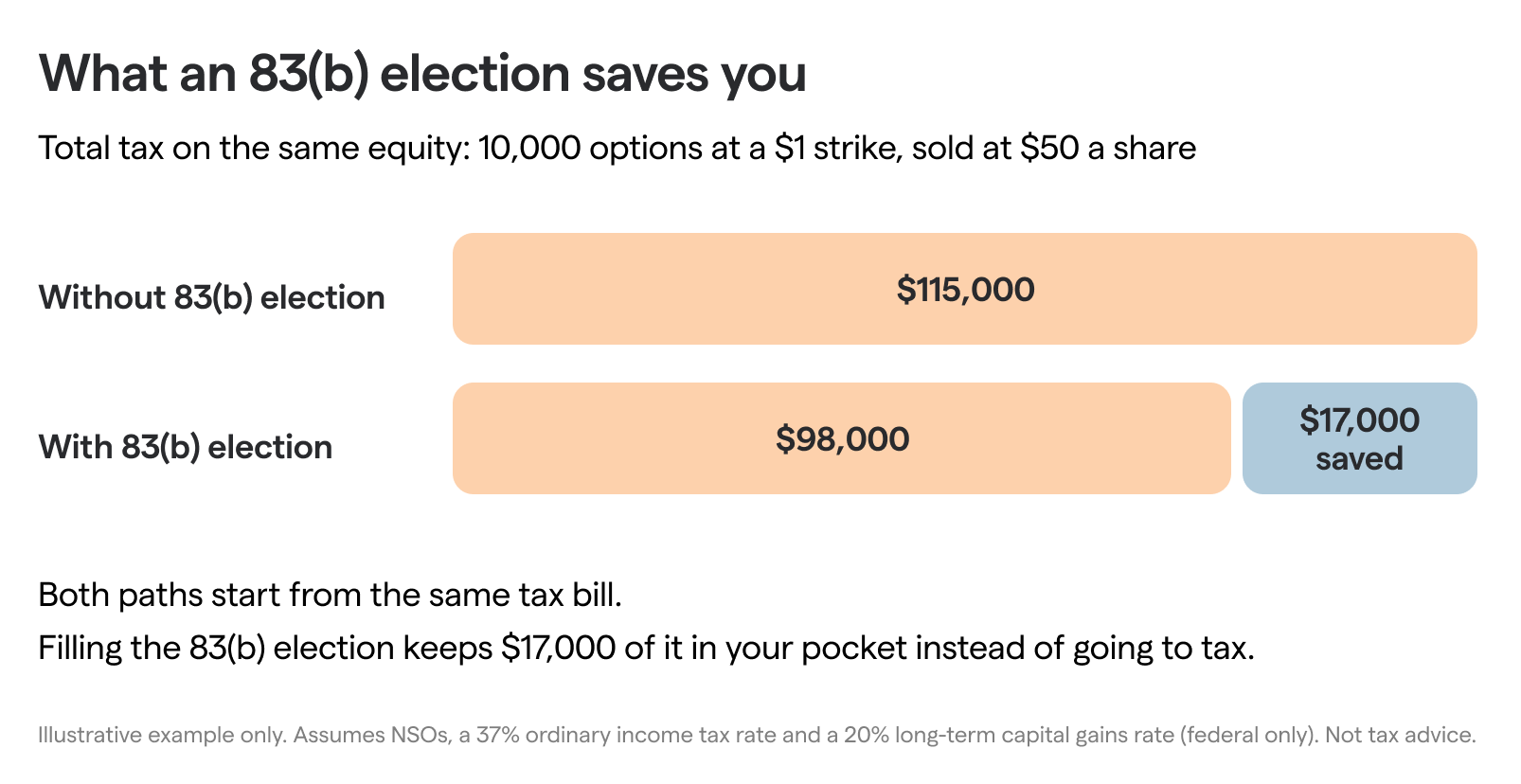
Without an 83(b), you'll have to pay tax on the spread at the time of vest.
But with early exercise and an 83(b) election, you can lock in that taxable spread at as low an amount as possible.
For illustrative purposes only. Actual results may vary, and there is no guarantee of any particular outcome.
This is why the stakes are so high for correctly filing your 83(b) form. Here are the things you should know before early exercise to ensure there aren't any mistakes down the road:
You might have come across these two terms and be a little confused about the differences. In essence, both incentive stock options (ISOs) and nonqualified stock options (NSOs) work similarly. They're given to employees in grants, who then have the option to exercise them and get equity in the company.
The main difference comes in the way that they are taxed.
For NSOs, the spread is taxed at your ordinary income rate. If you're in California, that can be as high as 50%. ISOs, on the other hand, deal with the Alternative Minimum Tax (AMT), which has two tax rates (26% and 28%).
AMT is a tax system designed to ensure that the ultra-wealthy are taxed appropriately, meaning it has its own deductions and exemptions. When you exercise ISOs, you have to work out both your AMT and normal tax, then pay whichever is higher.
When it comes to early exercise, the spread is usually very low (or $0), so there isn't too much of a difference between the tax obligations for NSOs and ISOs.
The notable differences for early exercise stock options are in how the gains are taxed.
When you sell your equity, you'll pay tax on anything above the strike price. For NSOs, if you hold your stock for over one year from exercise, you'll get taxed at the long-term capital gains rate (generally between 0-20%). Sell it before this date, and the upside will be treated as short-term capital gains (matching your ordinary income tax rate).
With ISOs, it is more nuanced.
Exercising ISOs early can result in them no longer qualifying for ISO tax treatment, effectively turning them into NSOs for tax purposes. In other cases, they remain as ISOs, which you'll need to hold for two years from grant and one year from exercise in order to qualify for the long-term capital gains rate. If you don't meet this holding criteria, the gains will be taxed as ordinary income.
We know it's a complicated topic, so the best thing to do might be to speak to a professional first who can best advise on your options strategy. Or you can learn more in our guide to how ISOs are taxed.
Qualified Small Business Stock (QSBS) is a special category of equity that qualifies for certain tax benefits. The biggest advantage is that some or all of your QSBS-status stock can be excluded from capital gains tax on a federal level when you sell.
QSBS was designed to encourage employees at early-stage businesses to invest in their companies. But to qualify, your company must meet the following rules:
If your company qualifies, then you can exclude up to $10 million ($15 million if issued after July 4, 2025) or 10x your exercise price (strike price x number of shares) from federal capital gains tax, whichever is higher. This is a lifetime exclusion cap, and you don't have to sell all your shares at once to use it.
All stock must be originally granted (options or shares bought on the secondary market won't qualify), and you have to hold the stock for a certain amount of time to get the capital gains exemption.
A new tiered system was introduced in 2025 to outline these holding periods:
This is why early exercising can be extremely advantageous if you are holding QSBS: under Section 1202, the holding period for QSBS starts from the moment you early exercise, instead of when the options vest. That means five years after early exercise, you will be able to exclude 100% of your stock from federal capital gains tax (up to the lifetime cap).
Another important reason is that if you wait until your company's valuation increases, you're risking its assets exceeding the $75 million mark. The moment that happens, your stock will no longer qualify as QSBS, and you'll lose the capital gains exemption.
As we've started to outline, early exercise can offer you a lot of benefits when carried out correctly. Here are the ones you need to know:
The total cost to exercise your employee stock options is the buying price (strike price x number of shares) and the tax bill that accompanies it.
No matter when you exercise, the strike price never changes. It's set from the grant.
But there are ways of lowering the tax bill, including early exercise with an 83(b) election. And in many cases, those tax savings can be significant.
That's because you'll be able to lock in an incredibly low spread between the strike price and FMV. That can mean little to no tax obligations, and for ISOs, you'll likely avoid triggering AMT altogether.
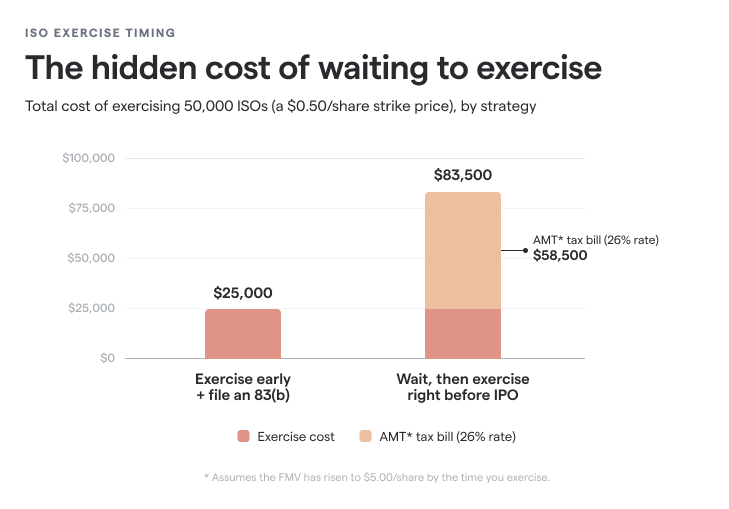
Imagine, for example, that you receive 50,000 ISOs at a strike price of $0.50/share. If you early exercise all 50,000 after three months at the company (and before its next 409A valuation) with an 83(b) election, your spread is $0, and so is your tax bill. Your entire cost to exercise is just the $25,000 buying cost.
Now, let's consider the alternative. Maybe you wait until all your options have vested, and decide to exercise right before IPO when the FMV is now $5.00/share. The spread is now $4.50 per share, or a total of $225,000. With an AMT tax rate of 26%, you would be facing a tax bill of $58,500 on top of the $25,000 exercise cost.
If you don't have access to $83,500, you won't be able to exercise at all.
For illustrative purposes only. Actual results may vary, and there is no guarantee of any particular outcome.
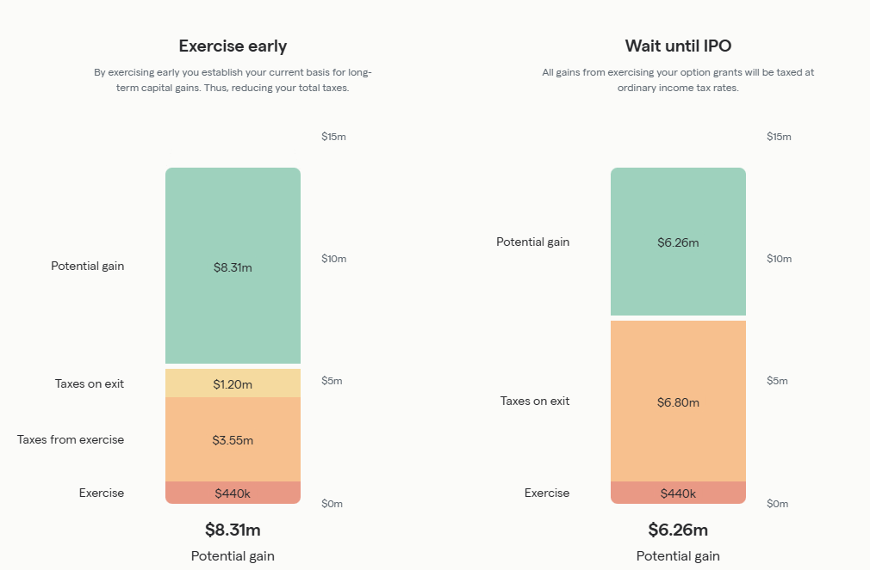
The recent SpaceX IPO is a great example of the advantages of early exercise. The same California-based employee with the same 100,000 ISO grant at a $4.40 strike price would have paid $1,364,200 to exercise in 2024, but $3,989,200 if they waited to exercise until pre-IPO in 2026. That's a difference of over $2 million.
For illustrative purposes only. Actual results may vary, and there is no guarantee of any particular outcome.
The second big potential tax advantage to early exercise only materializes when you want to sell your equity.
If you exercised NSOs, you only have to wait one year from exercise before your gains qualify for the more preferable long-term capital gains rate. ISOs must be held for one year from exercise and two years from grant. Sell either earlier, and the gains will be taxed at your ordinary income rate.
When it comes to QSBS, this only becomes more important as the holding period allows you to pay zero capital gains tax on some or all of your equity. As you have to wait a full five years to get the exemption on 100% of the stock, you want to start that clock as soon as possible.
The long-term capital gains clock for all stock option matters even more when you remember that a liquidity event like an IPO or acquisition can come at any time. You have no control over these factors, and if an exit event happens before you're prepared for it, you might lose out on those capital gains tax savings.
We want to be clear: early exercise is not for everyone. There are many factors to consider before making a decision, including the potential drawbacks. The most important cons to early exercise are:
The first thing to understand is that the money-saving scenarios outlined in this article so far only make sense if your company increases in value and has a successful exit. In reality, there is no guarantee of this happening.
Plenty of growing businesses end up failing, and if that happens, your equity will become worthless. And the risk of an early-stage company failing is higher than one about to IPO.
On the other hand, if you invest early and your startup does end up being successful, you'll be in a much better financial situation because of that early exercise.
Many executives manage this risk through non-recourse financing. These loans cover the cost to exercise, but remove all personal risk, as you only have to repay the loan if your company has a successful exit. If the company fails, you are not personally liable for the loss.
You should also know that if you exercise early but end up leaving your company before your options vest, they have the right to buy those shares back at the exercise cost or FMV, whichever is lower. That means you could be making a loss. Plus, if you did have to pay tax during the early exercise, you won't be able to claim it back.
Exercising your stock options is often the first big investment someone makes. And if you're using your own savings, that is a huge undertaking. An early exercise should be thought of as a long-term investment where your money is locked into illiquid equity for years.
You won't be able to cash out until an exit opportunity like an IPO comes along, but with companies like Anduril and Stripe staying private for longer, this could take a lot longer than you first thought.
And in that time, other investment opportunities or life events are going to arise. But because you exercised early, you might not have the capital to access them. So, the question is: if you have a lump sum of money to invest in anything, is your company truly the first choice?
Before you actually decide on whether or not to exercise your options early, you first need to consider how and if it can be done at all. These are the steps that you need to be aware of and plan for:
This is a lot of information, and there is a lot to consider. Whether you exercise early or not, there is risk involved. So, understanding your personal risk and situation is the key.
These are the questions to ask yourself:
Knowing when to exercise your stock options will ultimately depend on your unique situation. There is no one-size-fits-all answer. We've found that the best course of action is to start modeling the potential outcomes and comparing them against your personal financial timeline to see which is the best fit.
If you decide an early exercise is right for you, the next decision is how you want to fund the exercise. There are three main ways to consider:
1. Cash:
If you have personal savings or access to enough capital to pay the cost to exercise, you can cover the whole cost yourself.
Of course, this does come with some drawbacks:
2. Traditional financing: These loans can be a good option to provide you with upfront capital for exercising your options early.
But it doesn't come without risks worth considering:
3. Non-recourse financing: Unlike traditional loans, a non-recourse financing lender assumes most of the downside risk. You do not have to pay them back unless your company has a successful exit, meaning very little personal risk. This also frees up your personal capital to be spent elsewhere.
The things to consider are:
You've probably learned by now that early exercising is not a straightforward process. Many factors can trip you up along the way, with considerable risk whether you exercise now or later.
Just understanding your situation is a challenge before you can even start to consider if early exercising is right for you.
The founders of Secfi experienced this pain firsthand, and knew there had to be another way to navigate stock options decisions. Now, the Secfi platform does just that: assisting tech workers to better handle their exercises through targeted tools, expert advice, and access to non-recourse financing.
Here's how we can help you understand your early exercise stock options:
Even with reading articles like this, putting the concepts into practice to understand your own stock options situation is still hard.
So, we built Maeve to solve the problem. It's our AI equity assistant that helps you to understand your existing grant situation and model how it might look in the future. Maeve is target-trained on stock options, but its answers are personalized to your situation.
You can upload your grant and employment documents straight to the platform, connect to Carta in seconds, or manually input all of the relevant details. You can then ask Maeve specific questions like:
Or you can use it for more in-depth and personalized financial models. For instance, Maeve can project multiple exit scenarios to show you the potential exercise cost, tax bill, and profit, including creating timelines and quantifying risk.
Plus, you can continue to use Maeve as a resource even after exercising, and all the way through liquidity events and exit opportunities!
Even if you understand your stock option choices, making a decision can still be overwhelming. Without experience with these kinds of scenarios, any choice can feel uncertain, or like taking a blind leap of faith.
So, while Maeve can model outcomes, sometimes the best source of support is through a licensed advisor who is familiar with stock options and early exercising.
For instance, Secfi's wealth team has decades of combined experience and is ready to help you strategize on the decision to exercise early. They've worked with people at every step of the stock option experience, in companies of every size, and have truly seen it all.
Working with a member of the team means accessing advice on how to spot the signs that early exercise is (or isn't) a great investment, as well as recommendations around funding the exercise and handling the shares once they vest.
We believe a lot of people don't know how large a role tax plays in equity planning. So, our wealth team also provides you with a plan to potentially reduce your tax obligations. This can help ensure you're optimizing all your tax advantages during both exercise and sale.
If cash is the only thing holding you back from exercising, then non-recourse financing with Secfi could be a solution. We will cover the cost to exercise your stock options (including any taxes), and assume the risk if your company fails.
In most cases, we work with later-stage companies closer to IPO, but in certain situations non-recourse financing can make sense with early exercising.
It could be a fit for you if:
Non-recourse financing makes sense for tech workers who want access to the upside of their company equity, but without using their own savings. Hopefully, within a few years you'll have a successful exit opportunity, and be able to sell your shares at a profit. You'll then pay us back plus interest and a portion of those gains.
This trade-off means you get to exercise earlier and with less personal financial risk.
If non-recourse financing isn't a fit, we may be able to help you later on with liquidity by selling your shares on our secondary market.
We've helped clients from leading companies like Palantir, Anduril, and Databricks. To learn more about our business model, check out: How Secfi financing works – our business model explained.
Instead of facing the decision to exercise early alone, Secfi is ready to help you through personalized advice and custom strategic planning. Not only that, but as exercising is just the beginning of your wealth journey, we're also here to offer ongoing support as your options vest. We can help you navigate liquidity events like IPOs and understand how to walk away with the largest possible amount.
The final decision doesn't just come down to the financial, but also the personal. Even if early exercising makes sense from a monetary point of view, it doesn't mean it is the best investment for you right now. That's where working with a professional can really count.
Early exercise of stock options means buying them before they've vested, rather than waiting until you've fully earned them based on your vesting schedule, which typically runs from your date of grant. Just note that not every company allows this, and it has to be specifically permitted in your equity plan. So, it's worth checking your grant agreement or asking your equity team before assuming it's an option for you.
The appeal is usually timing: early on, the gap between your strike price and the company's fair market value (FMV) tends to be small, which can mean little or no tax due at exercise and a lower overall cost to acquire the shares. The tradeoff is that you're paying for shares you don't fully own yet, and the company can typically buy them back at your strike price (or lower in some cases) if you leave before they vest.
It depends on your company's stage, your finances, and how much risk you're comfortable taking on. Early exercise tends to make the most sense when your strike price and FMV are still close together, you're confident enough in the company to stay through vesting, and you can afford the exercise cost (and any resulting tax bill) without derailing other financial goals.
If your FMV has already climbed well above your strike price, the tax advantage shrinks, and the exercise cost goes up. That can make the decision less clear-cut.
The best course of action is to make sure you have a firm grasp on the current situation, as well as modeling multiple future outcomes. Running your specific numbers with a tool like Maeve, or talking with a tax professional or equity strategist, are great places to start.
Not automatically. It depends on several factors, including your stock option type and whether you file an 83(b) election. By default, the IRS doesn't start your capital gains holding period until your shares actually vest, even if you've already paid for them.
Filing an 83(b) election within 30 days of early exercising changes that: it tells the IRS to tax you now, at today's FMV, and in exchange, your capital gains clock starts immediately from the date of exercise for NSOs. This brings you closer to qualifying for long-term capital gains tax rates once you sell.
ISOs are a bit more complicated, as early exercise can result in them losing the ISO tax advantages. The best thing to do is speak to a professional who can advise on your specific situation.
Stock options are a valuable piece of your equity compensation, so before exercising, there are a few key tax implications and other factors worth considering: