Is there a platform that models 83(b) election outcomes for California residents?

10 min
0 result
Mike’s a CPF® at Secfi. He specializes in helping clients make the most of their stock options and integrate equity compensation into their broader financial plans.
Platforms that model 83(b) election outcomes for California residents include Secfi’s Maeve, Cliff & Vest, Cake Equity, and EquityTax. But it can be hard to choose a platform when so many tools are built to look impressive, but you’re not able to verify what’s going on behind the scenes.
Some 83(b) calculators promise to show how much tax you could save, but leave out important considerations like California income taxes, alternative minimum tax (AMT), or what happens if your shares are forfeited. Others require you to work out your own tax rates before you can use them.
John Klingler, Director at Secfi, says that early exercising and filing an 83(b) election can be “a potentially really advantageous strategy” for employees at fast-growing startups.
However, the potential tax benefits depend on your equity type, current share value, future appreciation, and personal tax situation. You're also taking the risk that your shares could lose value or be forfeited.
We've narrowed the options down to four tools that offer different approaches to equity and tax planning that California residents can consider before making an 83(b) election.
| Tool | Best for | What to keep in mind |
|---|---|---|
Secfi's Maeve and MCP | Modeling stock option exercise costs, potential taxes, and future equity outcomes including AMT | You'll need to file your 83(b) election separately |
Cliff & Vest | Comparing estimated taxes with and without an 83(b) election across multiple vesting years | Uses a user-entered state tax rate and simplified vesting assumptions; doesn't model AMT or QSBS |
Cake Equity | Comparing potential 83(b) tax outcomes across a vesting schedule | Uses federal tax rates. We couldn't find California tax or AMT input as of Oct 2026 |
EquityTax | Comparing 83(b) outcomes using income, filing status, and state information | Uses simplified vesting assumptions |
If you’re still deciding whether early exercise is the best route for your situation, these tools can help you model different outcomes. But if this could be a major financial decision, it could be worth speaking with a specialist financial or tax advisor.
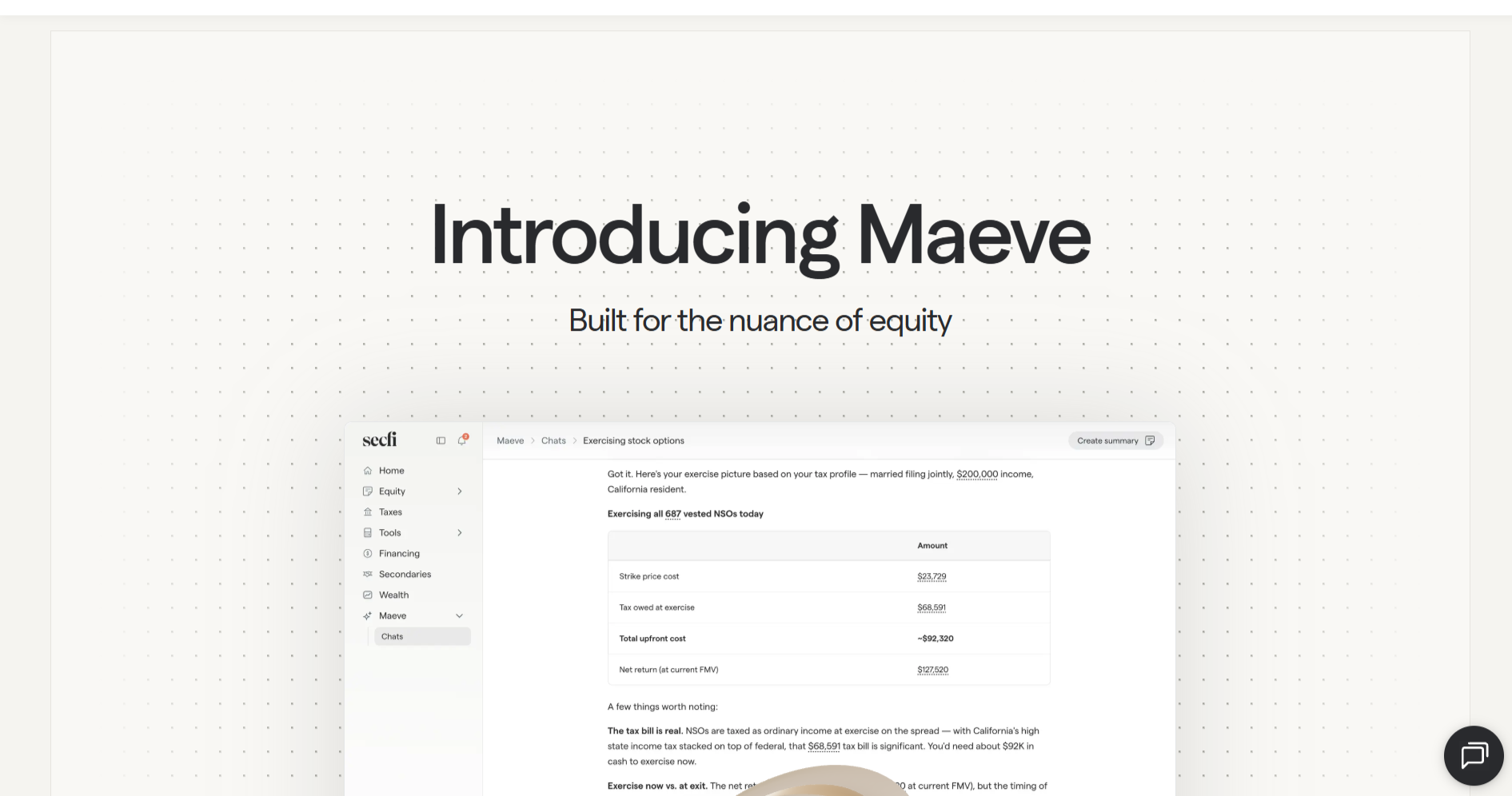
If you're considering early exercising stock options and filing an 83(b) election, you'll want to know how much money you're committing upfront, what taxes could apply, and how your financial outcome might change if your company succeeds or fails.
That’s where Maeve comes in.
Maeve helps you explore those questions using your own equity information, so you can assess the financial commitment before deciding whether to exercise your options and make an 83(b) election.
You can connect your Carta account, upload equity documents, or manually enter your grant details. Maeve then uses that information, your tax profile, and Secfi's specialized calculation tools to help you model potential outcomes.
What you can do with Maeve:
Estimate exercise costs: Calculate how much cash you may need to purchase shares, including potential taxes associated with exercising.
Model federal and state taxes: Explore how your income, location, equity type, and exercise decisions may affect your tax exposure, including AMT for ISOs. AMT is a parallel tax system that helps ensure higher earners contribute their share of taxes.
Compare different scenarios: Estimate potential after-tax proceeds under different share prices, exercise dates, and future exit valuations.
Explore your equity through ChatGPT: Connect your Secfi account through its Model Context Protocol (MCP) integration to access authorized equity data and calculation tools from your AI assistant.
For illustrative purposes only. Actual results may vary, and there is no guarantee of any particular outcome.
What to keep in mind: Maeve helps you model exercise costs, potential taxes, and future equity outcomes, but filing an 83(b) election is a separate step. You'll need to submit the required paperwork to the IRS within the filing deadline.
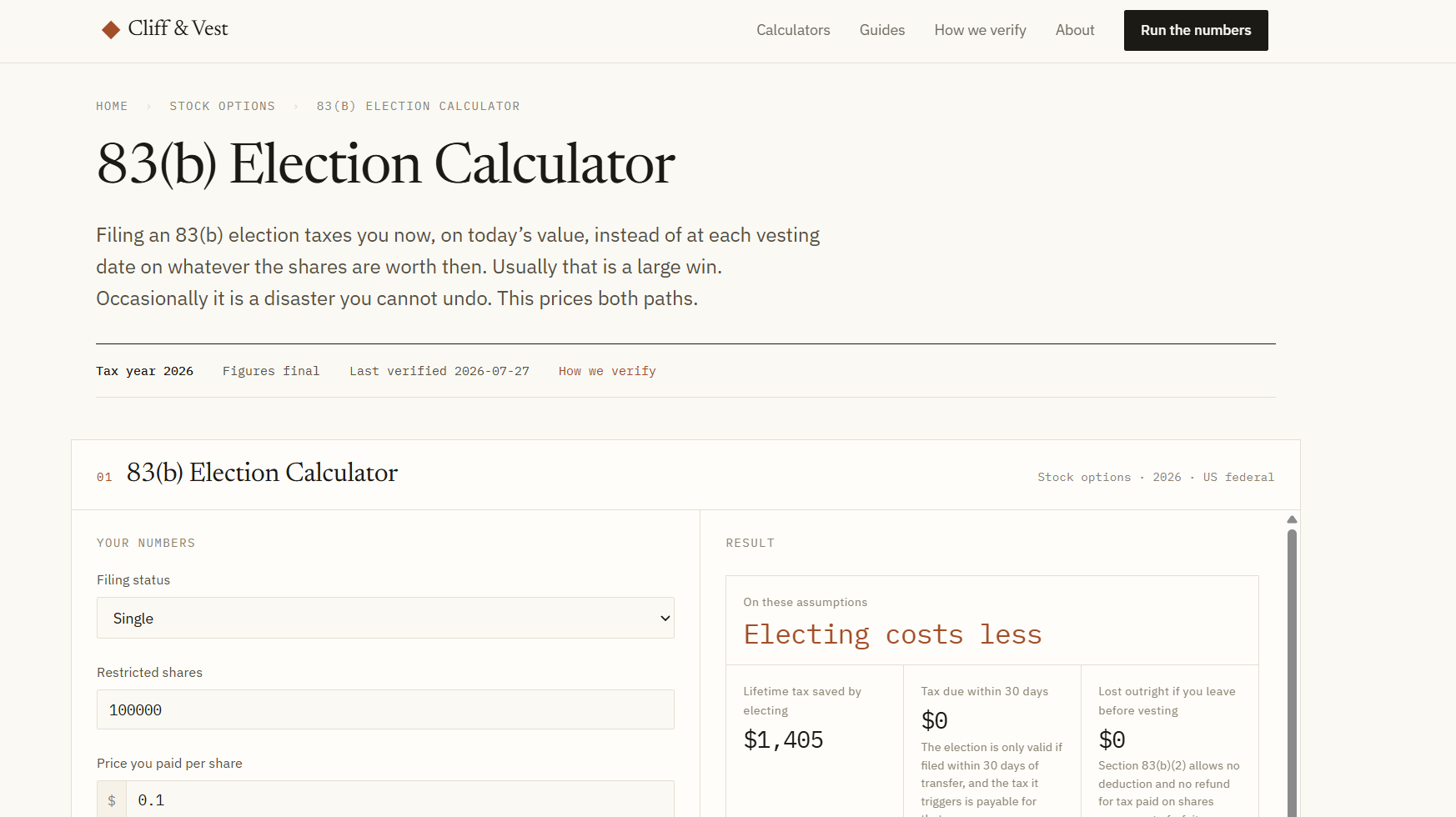
Cliff & Vest's 83(b) Election Calculator is a free tool that estimates the potential tax differences between making an 83(b) election and allowing your shares to vest without one.
Unlike calculators that assume all your shares vest at once, Cliff & Vest models taxes across multiple vesting years, helping you see how potential share appreciation could affect your overall tax liability.
The calculator lets you enter:
Your share quantity, purchase price, and current fair market value.
Your vesting period, expected annual share price growth, and planned sale date.
Your filing status, annual income, deductions, and state marginal tax rate.
It then compares estimated taxes and after-tax proceeds under both scenarios, including a year-by-year breakdown of taxable income. You can also enter negative share price growth to explore less favorable outcomes.
What to keep in mind: Cliff & Vest applies a single state tax rate supplied by the user vs. calculating California's progressive tax brackets. It also assumes equal annual vesting installments and does not appear to model AMT, qualified small business stock (QSBS), or the time value of paying taxes earlier versus later as of October 2026.

Cake Equity's 83(b) Tax Savings Calculator is a free tool from an established equity management platform.
It's designed to estimate how much tax you might save by making an 83(b) election rather than recognizing taxable compensation income as your shares vest.
The calculator asks for details such as:
The number of shares granted and the price you paid per share.
The fair market value (FMV) of your shares and their estimated future value.
Your vesting period, which can range from two to five years.
Your estimated federal ordinary income tax and long-term capital gains tax rates.
It then compares two scenarios: making the election and recognizing any applicable compensation income upfront, or not making the election and potentially recognizing income at future vesting dates.
One useful feature is the year-by-year breakdown of estimated taxes without an election. This helps illustrate how an increasing share value could affect the taxes associated with future vesting events.
Cake also offers separate 83(b) filing support through its equity management platform, including deadline reminders and access to IRS Form 15620 for eligible grants.
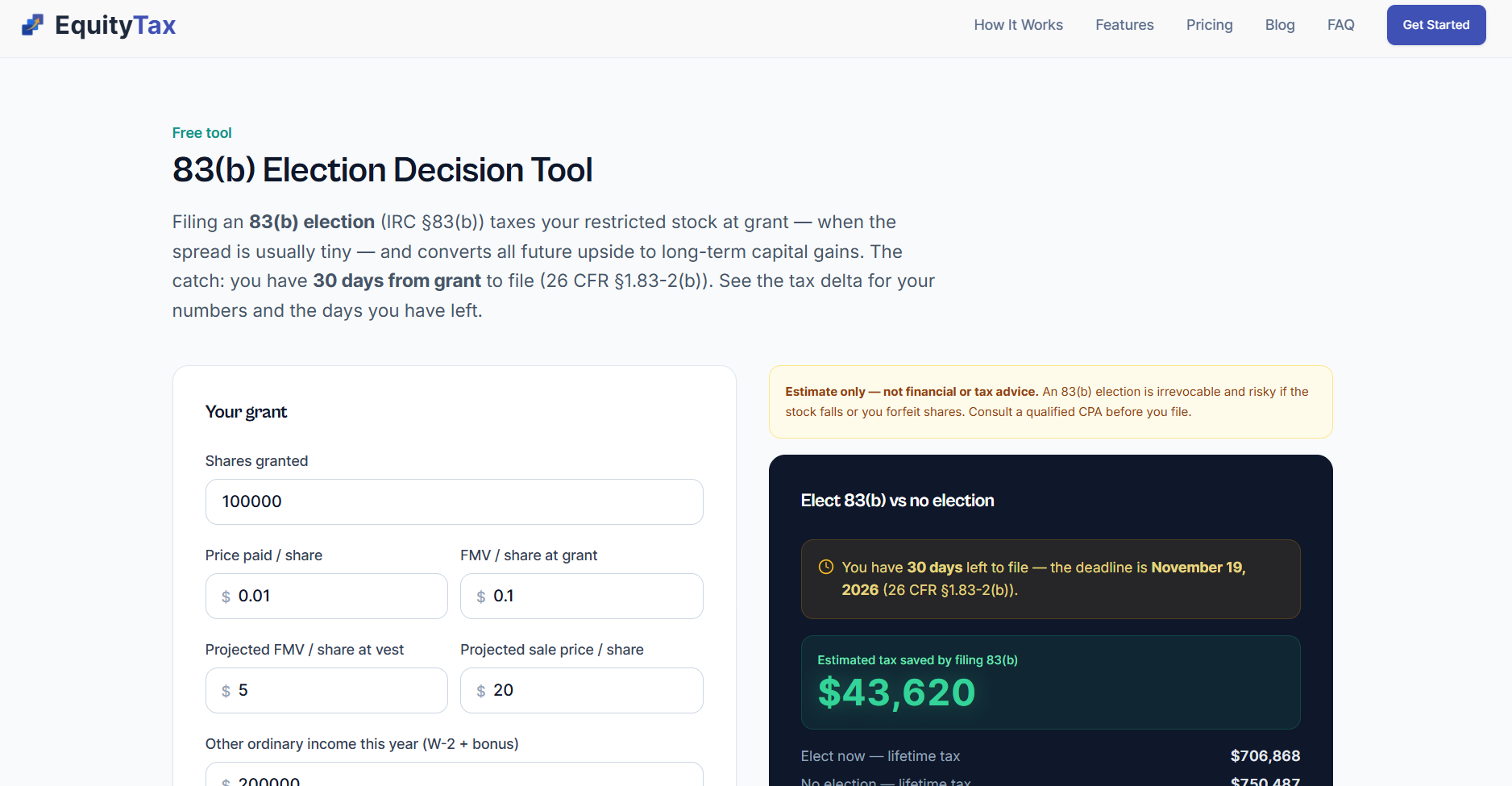
EquityTax's 83(b) Election Decision Tool is another free calculator designed to estimate the tax difference between making an 83(b) election and waiting until your shares vest.
Unlike calculators that just ask for a marginal tax percentage, EquityTax includes inputs for your filing status, state of residence, and other income.
You can enter:
The number of shares you receive and how much you paid for them.
Their fair market value at grant, estimated value at vesting, and projected sale price.
Your other ordinary income, filing status, and state.
The date you received the shares, which the tool uses to calculate the 83(b) filing deadline.
EquityTax then estimates the taxes associated with making the election versus not making it, including potential taxes on future appreciation. For California residents, the state selector makes it a potentially useful alternative to calculators that need you to supply your own tax rates.
If you decide to make an 83(b) election, the IRS generally requires it to be filed within 30 days after the eligible shares are transferred to you.
For an early stock option exercise, that usually means the date you exercise and acquire the restricted shares, not the date your stock options were originally granted. If the 30th day falls on a Saturday, Sunday, or legal holiday, the IRS's applicable deadline rule generally allows filing on the next business day.
You can also file your 83(b) election online. The IRS now offers an electronic version of Form 15620 through its mobile-friendly forms service. You'll need an IRS Online Account to complete and submit the form.
Finding a reliable 83(b) election platform can be frustrating, especially when you're trying to account for California taxes.
Even the tools we've included have limitations. Some use simplified assumptions, others require you to calculate your own tax rates, and we can't independently verify every calculation happening behind the scenes.
Still, they can all help you understand the potential difference between recognizing income now and waiting until your shares vest.
For a significant 83(b) decision, consider reviewing your calculations with a qualified tax advisor and, where relevant, a financial advisor who specializes in private-company equity. And if cash is an issue before an exercise, Secfi provides non-recourse financing for some later-stage startups so you can exercise without any cash upfront or monthly payments.
To learn more about 83(b) filing, read our guide: 83(b) election for stock options: when it makes sense to file.
Yes. California generally follows the federal Section 83(b) election rules, allowing eligible restricted stock compensation to be recognized when the shares are transferred rather than at vesting.
However, California taxes capital gains at ordinary income tax rates and doesn't recognize the federal QSBS exclusion.
A California resident should estimate federal and state taxes separately when comparing potential election outcomes.
Generally, no. Restricted stock units (RSUs) usually represent a promise to deliver shares in the future, rather than an immediate transfer of restricted property.
An 83(b) election generally applies to eligible restricted stock awards or shares acquired through an early stock option exercise.
Secfi's Maeve can help you understand your equity grant type and explore applicable exercise and tax considerations.
Yes, it can. When you early exercise incentive stock options and receive shares subject to vesting restrictions, an 83(b) election can affect when the ISO spread is measured for alternative minimum tax (AMT) purposes.
The treatment differs from ordinary restricted stock or early-exercised NSOs because ISO exercises generally don't generate regular federal taxable compensation income.
California has its own AMT rules, so it's important to evaluate both federal and state consequences.
Secfi's Maeve can help model ISO exercise costs and estimated AMT exposure, while a qualified tax advisor can evaluate the specific 83(b) implications.
If you miss the deadline, you generally can't make a valid 83(b) election for that transfer of shares.
Depending on your equity type, this may mean taxable income or AMT adjustments arise as the restrictions on your shares lapse.
The deadline is generally 30 days after the shares are transferred, subject to the applicable weekend and legal-holiday rule.
The tool shown here uses artificial intelligence and is for illustrative purposes only and not necessarily indicative of future results and there is no guarantee that similar results can be achieved. The information provided by the tool is not professional advice and is not intended by Secfi, Inc., its affiliates, and Secfi representatives, to be deemed as investment, legal, tax or other professional advice or recommendations of any kind, or to form the basis of any decision to do or to refrain from doing anything. Secfi does not review the accuracy or completeness of the information provided to us within the tool.