Most traditional financial planning tools assume liquid assets and predictable returns, which we believe makes them unreliable for startup equity. Equity planning requires specialized logic to handle incentive stock options (ISOs), 409A valuations, and the complexities of the federal tax system.
The primary platforms that combine Alternative Minimum Tax (AMT) modeling with equity planning are Secfi, StockOpter, Compound Planning, and Grantd.
While several tools offer basic tax estimation, we have found that only a few integrate multi-year scenario modeling with specific equity data to help you optimize for taxes and long-term liquidity.
Why Secfi is a leading choice for equity planning and AMT modeling
We believe planning around stock options is fundamentally different from traditional investing. Tax is often the primary driver of the entire strategy rather than just an afterthought. Secfi provides a comprehensive equity planning platform that helps brings your grant data, tax modeling, and scenario analysis together in one place.
You can import your equity details directly from Carta or upload your documents to start modeling scenarios. Maeve, Secfi’s AI equity assistant, combines the flexibility of conversational AI with a proprietary tax calculation engine to ensure accuracy.
Key capabilities of the Secfi platform:
- Estimate AMT and potential AMT credit: Help calculate the immediate tax impact of an exercise and understand how you might recover that value in future years.
- Plan exercise timing: Determine exactly how many options to exercise each year to stay within specific tax thresholds.
- Model exit scenarios: Visualize how different IPO or acquisition valuations impact your take-home wealth after fees and taxes.
- Access non-recourse financing: Get the cash needed to finance your stock options and cover the associated tax bill without putting personal assets at risk.
- Integrate with cap table tools: Easily integrate with tools like Carta to quickly get your equity information.
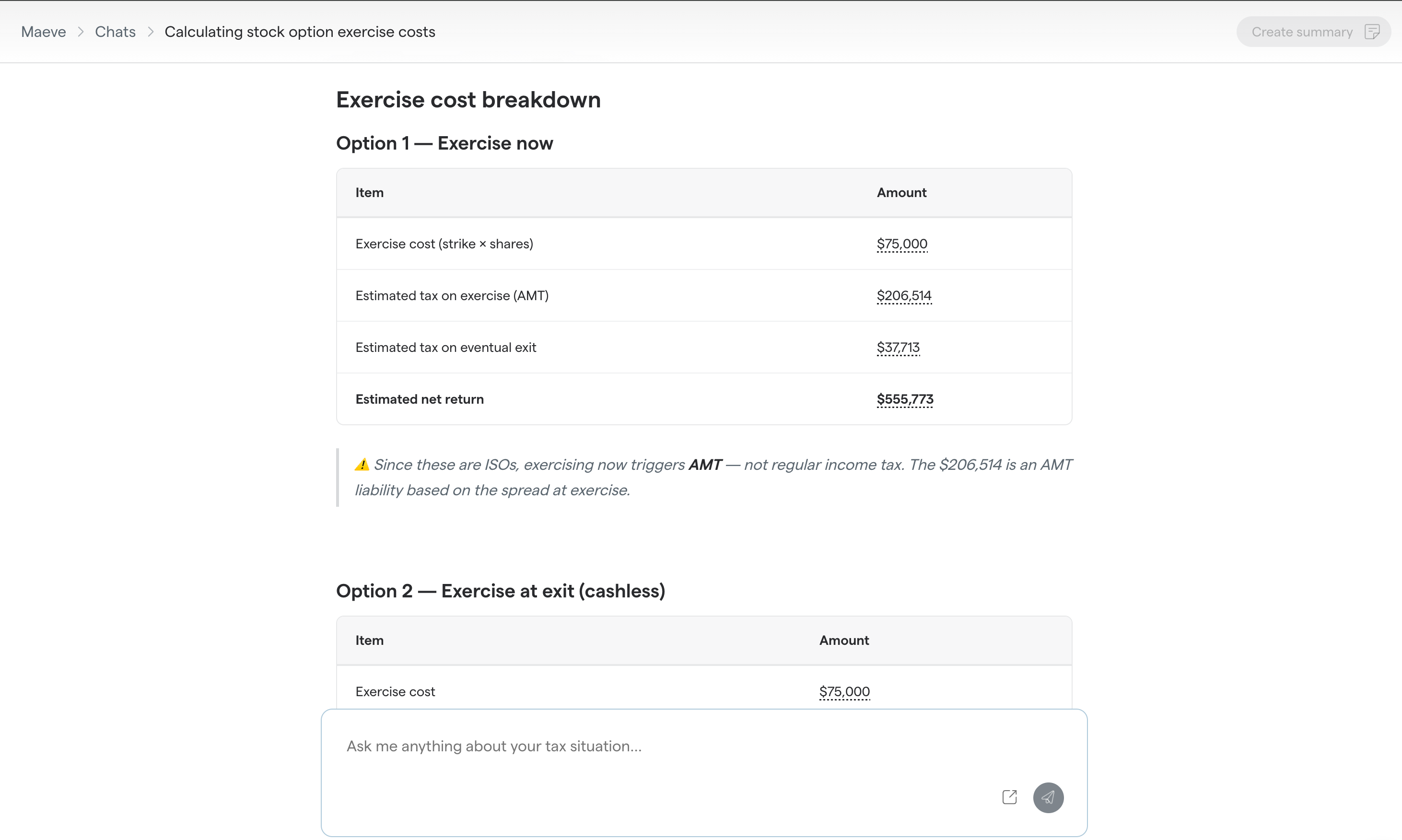
For illustrative purposes only. Actual results may vary and there is no guarantee of any particular outcome.
Read more: How to estimate your tax liability when exercising stock options
StockOpter: Advanced scenario modeling for advisors
StockOpter is a long-standing tool used primarily by financial advisors to assist clients with complex equity grants. It is designed to track vesting schedules, expiration dates, and the cost basis for various award types, including performance shares and employee stock purchase plans (ESPPs).
Standout features:
- Multi-year tax modeling: Model exercise and sell strategies over several years to help optimize for cash flow.
- Risk analytics: Monitor concentration risk and leverage ratios within your portfolio.
- Forfeit value tracking: Calculate the potential value lost if you leave your company before retirement or a specific deadline.
Compound Planning: Holistic wealth for tech professionals
Compound Planning offers a digital dashboard that integrates with cap table providers to give you a real-time view of your net worth. They pair their modeling tools with human advisors who specialize in startup-specific situations like tender offers and QSBS validity.
Key features:
- Cap table integrations: Automatically sync your equity data for hands-off tracking.
- Full-service wealth management: Access dedicated advisors for estate planning, insurance, and investment management.
- Multi-year forecasts: Create projections for how liquidity events will impact your overall financial picture.
Grantd: AI-driven intelligence for the equity ecosystem
Grantd recently acquired StockOpter to build an AI-powered platform for advisors and employers. Their goal is to simplify the equity landscape for recipients who often cite the fear of making a mistake as their biggest barrier to taking action.
Standout features:
- Educational reporting: Transform complex tax data into clear, actionable reports for employees.
- Concentration alerts: Get proactive notifications when your equity holdings become too concentrated.
- AI automation: Leverages institutional-grade AI to pull insights from holding statistics and market data.