What happens to employees when a company goes public?

17 min
0 result
John is the Chief Investment Officer (CIO) at Secfi. An expert in portfolio construction and investments, he helps individuals maximize returns and control risks unique to their situation.
If rumors that your company is going public are going around, congratulations! When you hold equity, this could be a life-changing financial opportunity. But despite the excitement around an IPO, it’s normal to feel nervous or confused about what happens to employees when their company goes public.
The dream is that you and your coworkers are showered with cash, and you buy a gorgeous villa overlooking the Mediterranean (or at least a sensible starter home).
But there are quite a few steps between IPO rumors and potential wealth from your equity. And more importantly, you might still need to exercise your stock options to take part in that potential upside.
While you can't control what happens to your company's stock price, you do have control over a number of decisions about your equity at this stage.
This article will cover what to look out for, including:
Wondering what happens to you as an employee when your company goes public? Share questions specific to your equity in Maeve, our free AI equity assistant.
When a company goes public, its shares become available for investors to buy and sell on the public stock market. If you're an employee or executive with equity compensation, this can create an opportunity to turn your stock options or shares into cash.
However, an IPO doesn't automatically mean an immediate payday. You may face restrictions on selling your shares, commonly through a lock-up period of around 180 days. Your workplace may also change as the company adjusts to additional reporting and regulatory requirements, although an IPO doesn't automatically affect your salary, benefits, or employment status.
Here's what happens to your equity.
Unlike stock options, RSUs generally don't require you to pay an exercise price to receive shares.
Some private-company RSUs have a double-trigger vesting requirement. That means employees must satisfy two conditions, typically a time-based vesting schedule and a liquidity event, such as an IPO.
If the IPO satisfies the second condition, eligible RSUs may vest or settle into shares, depending on your award agreement. Other RSUs may continue vesting according to their original schedules.
You'll typically keep your existing stock options, exercise prices, and vesting schedules after your company goes public. But you'll generally need to exercise your options to acquire shares before you can sell them. It’s important to take into account that timing impacts your taxes, and you should plan your exercising schedule carefully.
For example, selling ISO shares more than one year after exercising and more than two years after the grant date can qualify for favorable federal tax treatment. But exercising before an IPO also means committing money before you can sell your shares, potentially putting your savings at risk.
At Secfi, we help tech workers manage their equity, including through Maeve, our free AI assistant. Maeve can help you draft multiple exercise scenarios, so that you can strike the right balance between optimizing taxes and managing personal risk.
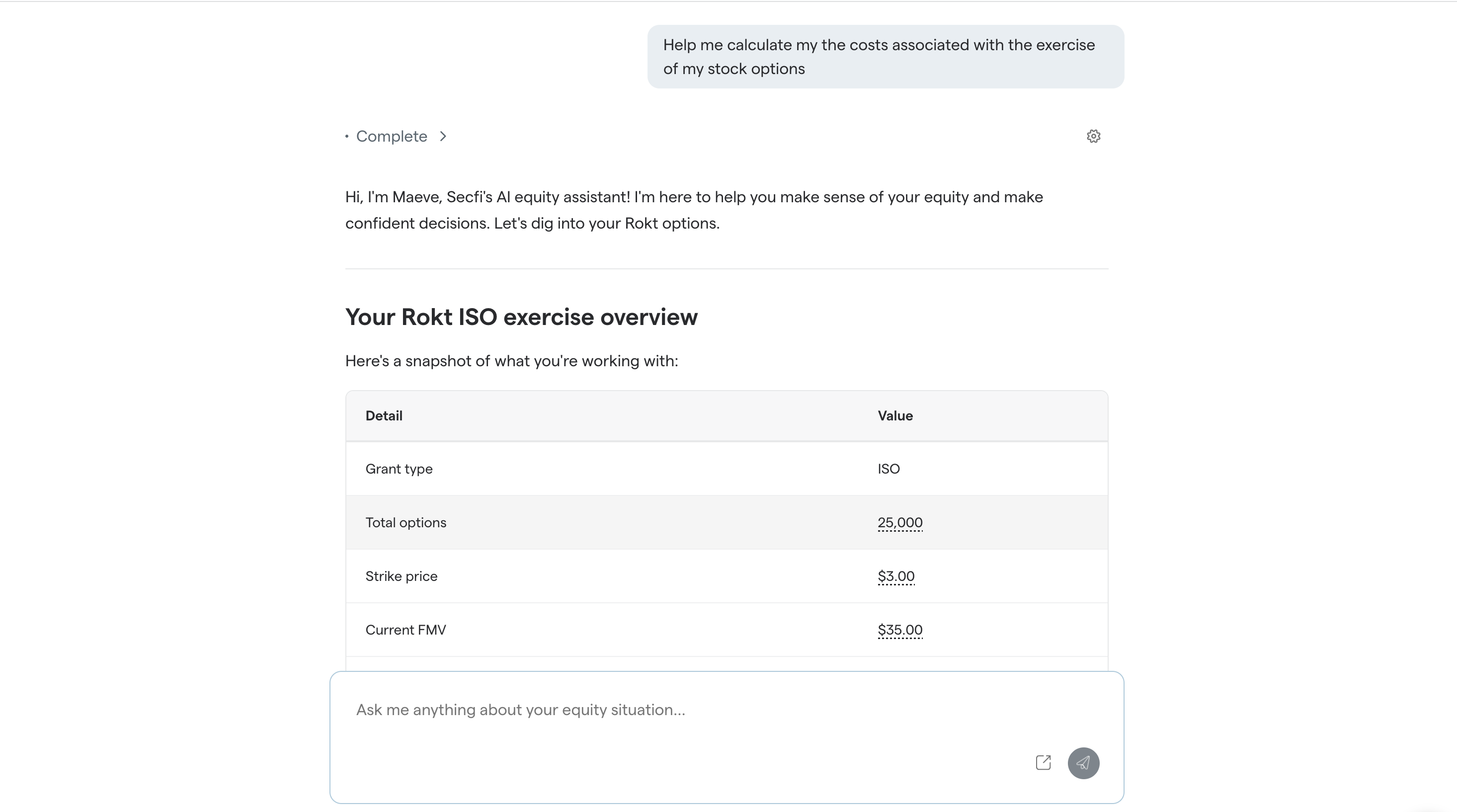
For illustrative purposes only. Actual results may vary, and there is no guarantee of any particular outcome.
An IPO can bring several potential tax obligations, depending on the type of equity you hold and the decisions you make.
For example, exercising nonqualified stock options (NSOs) typically triggers ordinary income tax on the difference between your exercise price and the shares' fair market value. Exercising ISOs may trigger alternative minimum tax (AMT), a parallel tax calculation that can increase your tax bill even if you haven't sold your shares.
If you have RSUs that vest with an IPO, their value is generally taxed as ordinary income. That means you could owe taxes even if lock-up restrictions prevent you from selling the shares immediately.
Your employer may withhold shares or cash to cover those taxes, commonly at a flat federal rate of 22%, or 37% on annual supplemental wages exceeding $1 million. However, the amount withheld may be less than your actual tax liability, so you might need to set aside additional money.
Selling shares can also create capital gains taxes, with the amount depending on your cost basis, holding period, and other circumstances.
These taxes can add up quickly, particularly if you've accumulated a large amount of equity over several years. Understanding your tax obligations before exercising or selling can help you avoid unpleasant tax surprises.
A lot of startup employees put off making decisions about their equity because it can feel confusing and stressful, and an IPO often feels like something that's always a few years away.
In fact, according to research from Carta, roughly two-thirds of stock options issued to startup employees are never exercised. Sometimes that's because the options aren't worth exercising, but employees can also miss out because they don't understand or can't afford their equity.
Waiting is a decision, too, and it can limit your options. For example, if you leave your company, you'll commonly have just 90 days to exercise your vested options. Even if your company gives you longer, ISOs generally lose their favorable tax treatment if you exercise them more than three months after leaving.
At every point in your equity journey, keep taxes at the front (not back!) of your mind. Many of our clients’ costs to exercise end up being eight to ten times more than expected, and taxes often play a role in that.
Here are the decisions you need to make before your company's IPO.
Exercising your stock options means purchasing your company's shares at the exercise price specified in your equity grant.
Exercising before your company's IPO may offer tax advantages, depending on the type of options you hold, the company's valuation, and how long you keep the shares. For example, exercising ISOs earlier can start the clock on certain holding-period requirements for potentially favorable tax treatment.
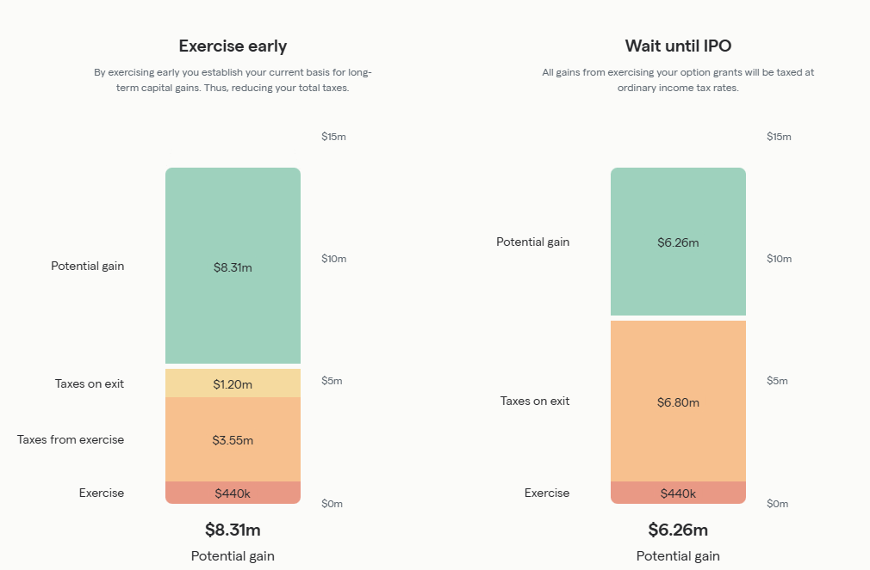
For illustrative purposes only. Actual results may vary, and there is no guarantee of any particular outcome.
But there's a trade-off. Exercising before an IPO means paying for shares you may not be able to sell until the lock-up period ends. If the stock price falls during that time, your shares could be worth considerably less than you expected. On the other hand, waiting until your company's value increases could mean a higher tax bill when you exercise.
You may also be able to exercise your options during the IPO lock-up period, even if you're not yet allowed to sell your shares. Check your company's equity plan to see what's permitted.
Exercising your stock options can be expensive, especially if you have a decent number of shares or your company's valuation has increased significantly.
If you're funding the exercise yourself, consider what you'll need to give up or put at risk to access that cash. Tapping retirement savings, for example, could have tax consequences and affect your long-term financial security. Taking out a private loan could mean repayments even if the shares don’t perform well.
For eligible employees at later-stage companies approaching an IPO, non-recourse financing could provide another way to cover exercise costs. Unlike a traditional loan, repayment generally depends on a successful liquidity event, so your other personal assets aren't at risk if your company doesn't exit.
Once your company officially announces its IPO, things can move quickly. You may have opportunities to sell shares, exercise options, or make decisions that affect your future tax bill.
Here are the decisions to think through as your company makes the transition from private to public.
Some employees and existing shareholders may be given an opportunity to sell a portion of their shares as part of the IPO or through an early lock-up release.
It can be tempting to hold out for an IPO "pop," when a company's share price jumps on its first day of trading. But prices can fall just as quickly.
If selling some shares would help you reach an important financial milestone or provide greater financial security, that may be worth more than the possibility of additional gains. But stock prices can also fall, and there's no guarantee that waiting will lead to a better outcome.
A Rule 10b5-1 trading plan allows company insiders, particularly executives and directors, to schedule stock sales in advance. Trades are then executed according to the plan, helping eligible insiders manage trading restrictions while complying with securities laws.
These plans have specific requirements, including mandatory cooling-off periods for certain insiders. If you regularly have access to material nonpublic information or expect to sell substantial amounts of stock, ask your company's legal team about this option.
It's easy to think of an IPO as the finish line. You've worked hard, your company goes public, and now it's time to enjoy the rewards.
But going public is also the beginning of another set of decisions.
When your lock-up expires, we believe one of the biggest factors to consider is how much of your net worth is tied to company stock.
If most of your wealth is tied to your employer, your investments and employment income depend heavily on the same company's success. Selling some shares can help reduce that concentration and diversify your portfolio.
There's no perfect percentage to sell. Think about how much company stock you're comfortable holding and what you want the proceeds to accomplish.
Selling a large number of shares through a market order, which executes at the best available price, can potentially result in a worse price than expected, particularly when trading volume is low or prices are volatile.
Think of it like a grocery store trying to sell millions of boxes of Cap'n Crunch. If there aren't enough buyers at the current price, the store may need to lower prices to generate demand.
You could also spread larger sales over time rather than selling everything at once, although this leaves you exposed to potential stock price changes between sales.
Ooooh, think of all the possibilities! A house? An early retirement fund? The trip of a lifetime you've been talking about for years?
Before making any major purchases or investments, think about what you want this money to accomplish over the long term.
You can consider this investing principle: Don't risk what you have and need for what you don't have and don't need.
If your company's IPO gives you an opportunity to establish lasting financial security, it may make sense to protect some of that wealth rather than taking unnecessary risks. That often means diversifying your investments instead of continuing to hold most of your wealth in company stock.
An IPO can create exciting financial opportunities, but figuring out what to do with your equity isn't always straightforward. At Secfi, we help startup employees and executives understand and act on their equity.
Here are the features that can help you navigate your company’s IPO:
Wondering whether you should exercise now or wait until after your company's IPO? Or how much you could owe in taxes under different scenarios?
Try Maeve, Secfi’s free AI equity assistant. Unlike text-prediction LLMs such as Claude and ChatGPT, which can give confident but incorrect answers, Maeve is run on our equity and tax calculation engines. Your relevant data gets run through our purpose-built calculators, instead of getting answers that sound right but could be missing important details.
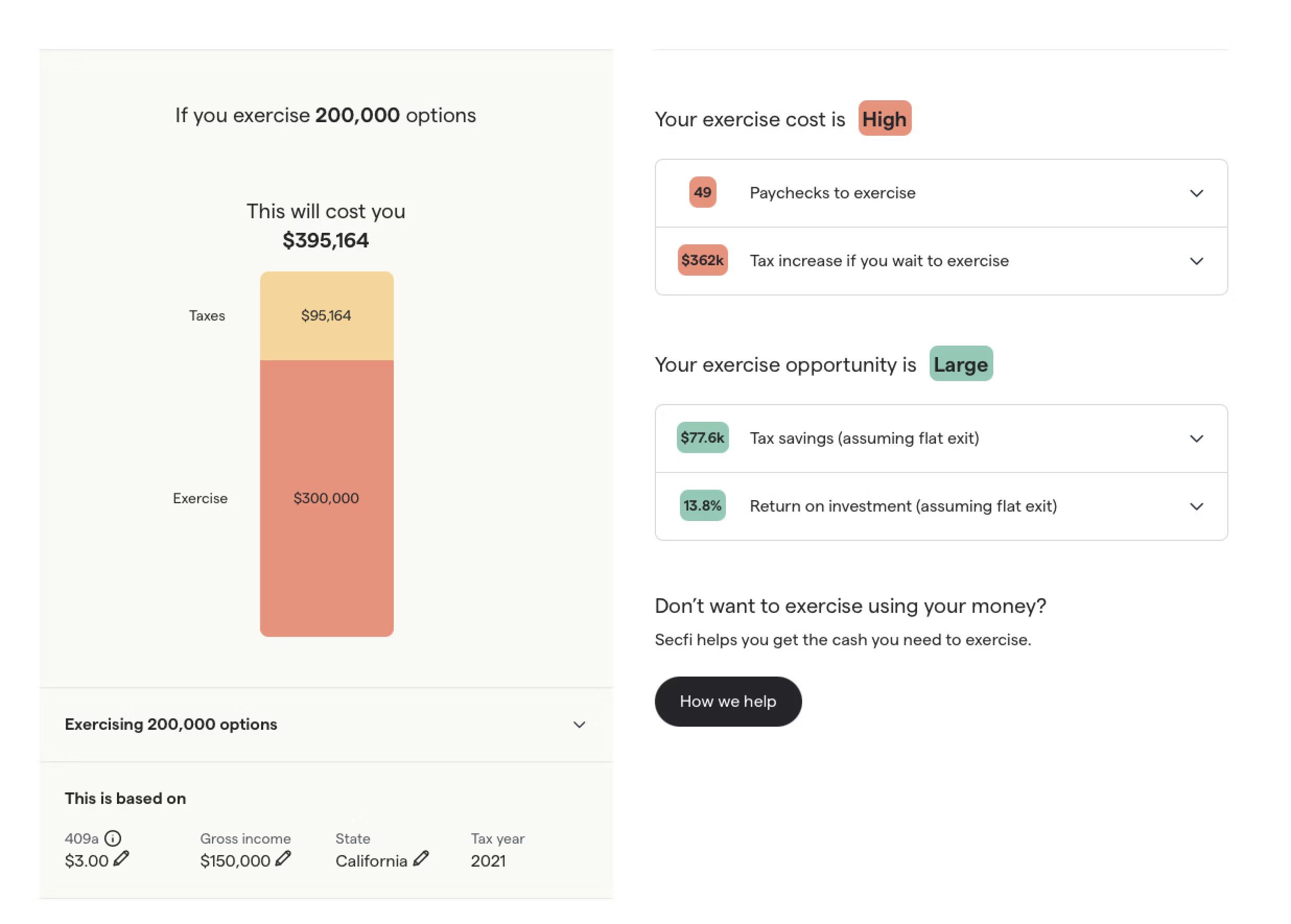
For illustrative purposes only. Actual results may vary, and there is no guarantee of any particular outcome.
Connect your grants and other equity information automatically through Carta, or upload relevant documents so Maeve can give personalized answers. You can model different IPO scenarios, comparing how changes in your company's share price, exercise timing, and potential taxes could affect what you ultimately walk away with.
Maeve can also show you its assumptions so you can double-check anything you're not sure about.
For illustrative purposes only. Actual results may vary, and there is no guarantee of any particular outcome.
If you have a preferred LLM, Secfi’s MCP lets you connect to our calculators in ChatGPT and potentially other LLMs. You’ll have the context and training you’ve already given your AI, but can access the advantages of Maeve in your familiar AI.
Traditional financial advisors may have plenty of experience with retirement planning and investment management, but not necessarily with private-company stock options, RSUs, IPO lock-up periods, or AMT.
Our financial planners regularly support employees when their companies go public. They can help you compare exercise strategies, understand potential tax implications, and plan when and how to sell your shares. And they'll consider how these decisions fit into your wider financial picture, from buying a home to building a diversified investment portfolio.
Secfi's Wealth advisors also have a fiduciary duty to act in your best interests. They don't earn commissions or kickbacks for recommending financing or other financial products, so their advice is focused on finding the right approach for your circumstances, even if that means waiting to exercise or deciding against financing altogether.
Exercising stock options before an IPO can require a substantial amount of cash, particularly when you factor in potential taxes. And even if you have the money saved, you might not feel comfortable tying up a large chunk of your savings in shares you can't yet sell.
That's where Secfi's non-recourse stock option financing can help.
Unlike a traditional loan, which you're personally responsible for repaying regardless of what happens to your company's stock, Secfi's financing is backed by your shares alone. That means you can get funding to cover your exercise costs and potentially associated taxes, while keeping your savings, home, and other personal assets protected.
You also won't have monthly repayments. Instead, you'll repay the financing and agreed fees when your company has a qualifying liquidity event, such as an IPO or acquisition. If your company never has a successful exit, you won't have to repay the advance.
Meanwhile, you retain ownership of your shares and their potential upside. Exercising earlier may also help you qualify for more favorable tax treatment when you eventually sell.
Of course, non-recourse financing isn't available to everyone. Secfi carefully evaluates the companies and employees it finances, generally focusing on businesses with strong growth prospects and a credible path to an exit. However, if you’re at a later-stage company close to IPO, you might be a great fit for this service.
Like many startup employees, John knew he had some equity but put it on the back burner. As his company moved closer to an IPO, he realized it was time to look at his options more closely. But he struggled to understand the tax implications and how to pay for exercising his shares.
"I'd been thinking about how to finance for a few months, but I was just kind of frozen," he said. "I didn't know what to do about it, and I thought I was screwed, to be honest."
John considered personal loans and lines of credit, but he'd heard stories of startup employees borrowing hundreds of thousands of dollars to exercise their options, only to see their company's share value decline. He didn't want to risk ending up in the same situation.
After speaking with Secfi's team and exploring his options, John chose non-recourse financing to help cover his exercise costs and potential taxes without putting his personal assets at risk.
"I felt that what Secfi offered was so unique," he said. "They were willing to write off the loss, and that was it for me."
John's experience shows why preparing ahead of an IPO can be so valuable. Understanding your exercise costs and potential tax obligations can help you make informed decisions before time pressures or rising valuations limit your flexibility.
Read the full case study: Why a senior startup leader facing a high tax bill used equity financing.
This case study is an illustration of our capabilities provided to an individual client. Client results may vary, and there can be no guarantee of similar results. It is not known whether the client approves or disapproves of Secfi Advisory Limited or its affiliates as a whole. Unless otherwise indicated, Clients offering a Testimonial do not receive compensation, and their statement does not present a conflict of interest.
Your company going public could be a major financial milestone. That Mediterranean villa might even be within reach someday. But how much you walk away with depends partly on your company's stock performance and partly on the decisions you make along the way.
Luckily, you don't have to figure it all out on your own.
Talk to our team about making the most of your equity if your company might go public.
There's no fixed payout for employees when a company goes public. How much you could make depends on the number and type of shares or stock options you hold, the IPO share price, exercise costs, and taxes. You can estimate your potential equity proceeds and plan for the financial decisions that come with an IPO with Secfi’s free AI equity assistant Maeve.
Employees often have to wait around 180 days after an IPO to sell their shares due to a lock-up period. However, some companies allow earlier sales, while trading windows and insider trading restrictions may apply afterward. Secfi Wealth’s financial advisors work with equity decisions every day and can help you plan when and how to sell your shares while considering potential taxes.
Some employees make life-changing amounts of money after an IPO, but substantial payouts aren't guaranteed. Your potential gains depend on your equity holdings, the company's stock performance, exercise costs, and taxes. Secfi helps startup employees understand their equity's potential value and make informed decisions before and after an IPO.
Yes, a publicly traded company can become private again through a buyout, merger, or other going-private transaction. Shareholders typically receive cash or other consideration under the transaction terms, although outcomes vary.
The tool shown here uses artificial intelligence and is for illustrative purposes only and not necessarily indicative of future results, and there is no guarantee that similar results can be achieved. The information provided by the tool is not professional advice and is not intended by Secfi, Inc., its affiliates, and Secfi representatives, to be deemed as investment, legal, tax, or other professional advice or recommendations of any kind, or to form the basis of any decision to do or to refrain from doing anything. Secfi does not review the accuracy or completeness of the information provided to us within the tool.