How to choose a financial advisor for stock options

23 min
0 result
Mike’s a CPF® at Secfi. He specializes in helping clients make the most of their stock options and integrate equity compensation into their broader financial plans.
Having a specialized financial advisor for stock options can make financial planning less intimidating if you have startup equity.
Stock options can put you in a strange financial position: they could one day become wealth, but you're still trying to figure out if it's even worth it to exercise. Meanwhile, you're trying to decide if you can buy your dream home anytime soon and still have enough cash to live a comfortable life.
Some specialized advisors are better qualified to help make this happen. While a generalized advisor knows how to invest in public stocks and save for retirement, an equity-focused financial advisor knows the nuances of specifics like AMT and early exercise.
More than the technical expertise, we believe a good financial advisor needs to be able to help you:
Many advisors talk about "maximizing your equity", but that's not always the goal when you have daycare bills to pay or want mortgage approval. So how do you find the right person for the job?
In this guide, we'll cover:
Want a second set of eyes on your finances? Secfi's financial advisors for stock options can help you plan for your financial goals. Talk to our team.
Some advisors specialize in financial planning (e.g., tax, insurance, education, retirement, and legacy planning), while others focus more on investing (e.g., asset allocation, portfolios, funds, and returns).
Ideally, you want a financial planner who understands both the planning and investing side, especially in the context of startup equity.
Someone who doesn't work with these daily might inadvertently cause you to leave some life-changing money on the table. On the other hand, they might over-enthusiastically advise an expensive exercise that leaves you with a painful tax bill, and not enough cash flow to meet your current needs.
For example, exercising incentive stock options (ISOs) can increase your alternative minimum tax (AMT) exposure. AMT is a separate way of calculating federal income tax that can apply when certain adjustments push your tax liability above what you would owe under the regular tax system. With ISOs, one of those adjustments is generally the difference between your strike price and the fair market value of the shares when you exercise.
A specialist advisor can model different exercise amounts to show how much you may be able to exercise before triggering AMT in a given year. Later in the article, we'll show how this can create a potential six-figure exercise cost.
Working with a specialized financial advisor for stock options can increase your confidence in any equity decisions you need to make, and could save you money down the road.
Making financial decisions with equity can be overwhelming. Exercising in particular can feel like there's a long list of considerations that need days of research to fully grasp. How will it impact your ability to pay for your child's education, set aside for retirement, or finally pay off your own student debt?
Exercising stock options might be the first time you've had to make a six-figure financial decision about an illiquid investment. It's also often one of the largest expenses anyone will have in their lifetime.
Unlike buying a house or contributing to retirement, the potential value is also highly uncertain, which can make it difficult to judge how much cash and risk you're comfortable taking on.
That's one reason specialist advice can be useful early, before the decision becomes urgent or significantly more expensive. Plus, having someone to ask your questions can make it easier to move forward with your next steps, so you don't keep kicking the can down the road.
Working with a financial advisor who doesn't work on commissions comes with an upfront cost. But we feel it can pay for itself many times over, especially when dealing with the potential (and complexity!) of equity.
At Secfi, we help startup employees and executives understand and act on your equity. Here's an anecdotal example from one of our clients, but always check with an advisor about your own situation.
A member of our financial advisor team met with a client who worked at a startup that recently raised a funding round. It would cost the client about $170,000 to exercise all of his vested stock options, triggering a massive alternative minimum tax bill.
Using Secfi's AMT calculator, which now powers our AI equity assistant Maeve, we found the client could exercise $3,500 worth of his vested stock options without triggering AMT.
The client was skeptical. $3,500 in stock options seemed like a drop in the bucket, so why bother? But it gave him a way to start owning some of his shares without taking on the full $170,000 cost.
The important detail was what that $3,500 actually bought him. His strike price was $1.26 per share, while investors in the company's latest funding round had valued the shares at $36 each. So he could spend about $3,500 to exercise stock that, based on that latest round, had an implied value of roughly $100,000.
Exercising a smaller portion now gave him a way to make progress without committing $170,000 all at once. Because the options were ISOs, it also started the clock on the holding period. That meant that if he later sold the shares after meeting the requirements, some of the gain could potentially qualify for long-term capital gains treatment, instead of ordinary income tax rates.
Some people are able to take on more risk, or find financing for their stock options. But you may also just want a chance to participate in potential upside without jeopardizing your finances. A financial advisor for stock options can help you figure out a comfortable balance.
This case study is an illustration of our capabilities provided to an individual client. Client results may vary, and there can be no guarantee of similar results. It is not known whether the client approves or disapproves of Secfi Advisory Limited or its affiliates as a whole.
When thinking about the right time to hire a financial advisor for stock options, consider the context of hiring an accountant.
There was probably a time in your life when your taxes were simple, and you filed them on your own. Then if you enter a marriage or long-term partnership, you might hire a tax preparer to handle the added complexity of a two-income tax return. Then when you're trying to figure out a major home purchase or investment, you'll often bring in a CPA to advise you on how to be more tax-efficient.
The same goes for working with a financial advisor. At certain inflection points, it makes sense to bring in outside help.
If the equity you're given is relatively small compared to your net worth, you can certainly experiment by yourself or with the help of a general advisor.
But if you're granted equity at a company that could make a material difference in your life, then it may be time to consult with a financial advisor for stock options.
If you've never worked with a financial advisor, you may think the only time to hire one is when you already have money. But with stock options, waiting until they're clearly "worth something" can make them much more expensive to exercise, particularly as your company's valuation and potential tax bill increase.
You also run the risk of backing yourself into a corner.
For example, if you choose to move to a new job or happen to get laid off, you often only have 90 days to figure out what to do with your equity (known as your post-termination stock option exercise window). Even if you hired a financial advisor immediately after leaving the company, you might not be able to risk the cash to exercise.
But if you had hired the advisor last year, they would have already helped you plan for a scenario where you get laid off or choose to leave the company.
If you're on the fence about whether an advisor is worth it right now, you can use our free AI equity assistant Maeve. Plug in your details or connect directly if you have a Carta account, and it can help you model scenarios and determine if a financial advisor could be a good fit.
For illustrative purposes only. Actual results may vary and there is no guarantee of any particular outcome.
A financial advisor for stock options can help you make decisions with context that you might miss if you tried to figure it out yourself or with a generalized advisor.
Here are some of the areas where that specialist knowledge matters.
At the end of the day, stock options are an investment. Deciding how much you want to put into one company, compared to using that money for other investments or opportunities, is worth considering in context.
Your financial advisor should be coaching you through questions that are nuanced when it comes to your investments.
For example, "Can I afford to exercise all of my options?" is usually too simple a question.
"How much am I comfortable putting into this investment without compromising the rest of my financial plans?" is something you need to work through with your advisor.
That answer is extremely personal and may change as your circumstances do. It might look very different if you're expecting large expenses like school fees or major medical costs in the next few years.
Even if you know in theory taxes can come into play when exercising stock options, it can get expensive extremely quickly. A financial advisor who works with startup stock options sees this regularly and can help you plan for it.
We call this the "surprise factor": the difference between what you think exercising will cost based on your strike price and what it actually costs once taxes are included. In the example below, that turned a seemingly manageable exercise into a total cost that was 8x higher than the strike-price cost alone.
The culprit is often a growing difference between the strike price and the company's 409A valuation, which can increase the tax due at exercise.
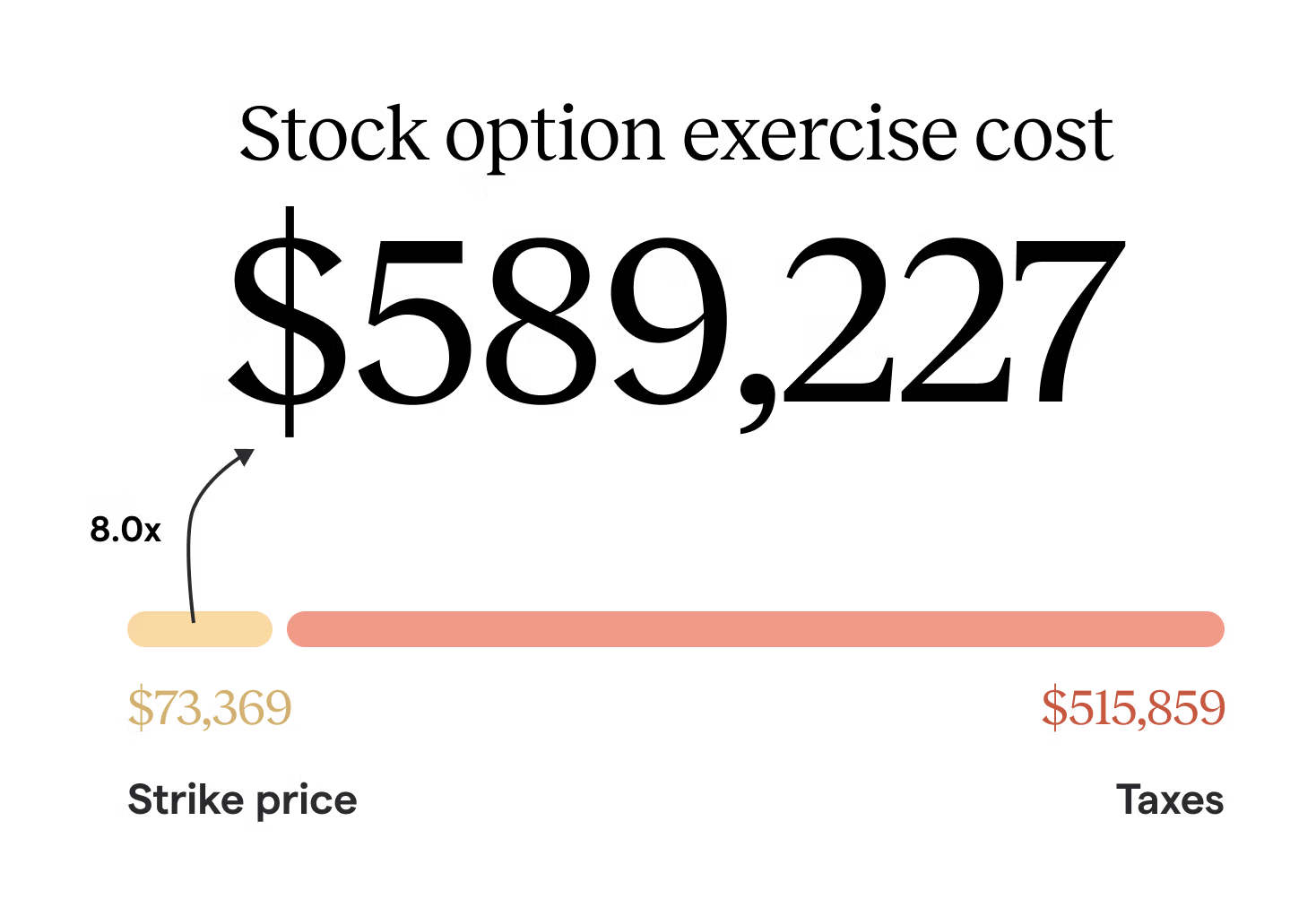
For illustrative purposes only. Actual results may vary and there is no guarantee of any particular outcome. Check with a financial advisor before making decisions about your equity.
Beyond the surprise factor, there are plenty of other tax rules a specialist advisor should understand and be able to explain in the context of your situation, from ISO vs. NSO treatment and the $100,000 ISO rule to AMT credits.
Even when exercising sounds good in theory, you still need to decide how to pay for it.
You could use personal savings, or explore traditional and non-recourse financing.
If you already hold shares, a secondary sale or tender offer could create liquidity that may help fund an exercise or preserve more of your personal cash.
Each option comes with trade-offs that your financial advisor should be able to map out and advise based on your situation.
Leaving a startup can turn a decision you've been thinking about for years into one you need to make quickly.
Depending on your grant and company rules, you may have a limited post-termination exercise window, often around 90 days, to exercise vested options before they expire or their tax treatment changes.
That creates several questions at once: how much can you afford to exercise, what tax could be triggered, whether keeping the shares is worth the risk, and how exercising would affect the rest of your cash.
Your advisor should be able to help you model those decisions before you hand in your notice or while you still have time to act, which is better than discovering the implications after the clock has started.
An exercise or liquidity event can change your financial picture very quickly. Suddenly, you may be dealing with a large tax bill, a concentrated public-stock position, or more cash than you've ever had to manage.
A specialist advisor can help you manage risk and taxes over time, including deciding when and how much stock to sell, planning for capital gains tax, and figuring out what to do with newly liquid cash. That can be especially useful if you stay in the startup ecosystem and find yourself with more private equity opportunities later.
We've worked with clients who went through an IPO, looked back on what they could have done differently, and came to Secfi the next time around so they could make more informed decisions earlier.
If you have an existing financial advisor you trust, it can also make managing this next stage easier. And potentially even fun, after all, this is what you've been working towards!
It might feel awkward to ask so many questions to someone you've just met, but how a potential financial advisor responds will also give you important information.
Here are three categories and example questions to ask your new potential financial advisor.
This is the big one we keep hammering home in this article.
They need to be able to understand what matters most to you, and that it could change in the coming years.
In an ideal situation, you and your financial advisor are building a long-term relationship where you both make a lot of money and lead happier lives because of it.
You may end up talking to your advisor about your salary, marriage, kids, career plans, fears about money, aging parents... even if you go into it thinking you're just planning for some stocks and figuring out your mortgage.
Make sure to check:
You should feel comfortable disagreeing with them and admitting when you're uncertain. And most importantly, you should ask yourself: Do I actually like and trust this person?
Secfi was built specifically for startup employees and executives trying to understand and act on their equity. One of our founders realized he had to pay a $1.8 million tax bill to exercise his shares, and he didn't want anyone else to go through the same situation.
As of July 2026, more than 62,000 startup employees and executives trust Secfi to help make decisions about their stock options. We've also provided more than $800 million in non-recourse financing, more than any other company of this kind.
Secfi can help leadership and HR teams give employees the information they need to make informed decisions about their equity. As a third party, employees can feel comfortable bringing us their questions and getting help with planning.
Here's why employees from companies including Reddit, DoorDash, and Canva choose Secfi.
Finding a financial advisor who can holistically answer your questions about startup equity is a challenge. But at Secfi, it's our focus. Secfi Wealth advisors regularly work with people whose finances include private-company stock options, concentrated equity positions, upcoming liquidity events, and complicated tax decisions.
You'll never have to spend half the meeting explaining what a 409A valuation is or why an exercise deadline matters before getting to your actual question.
For clients who need broader financial planning, we can look at your equity alongside the rest of your financial life, including investments, cash flow, retirement, housing, and family goals.
Our financial advisors work on a fee-only basis, so they don't make any commissions or kickbacks. They have fiduciary duties to only make suggestions in your best interests.
If you already have a tax expert or accountant you want to keep working with, we can work with your existing team members and provide the equity angle of expertise.
Learn more about Secfi Wealth, including our free initial consultation call.
Sometimes before you want to meet with a person, you just want to run the math yourself.
We purpose-built Maeve to help you model different scenarios using your actual data and risk profile. Unlike regular LLMs that work on predictive text, Maeve is powered by nearly a decade of our tax and equity calculators. You can check the assumptions and outputs, which you'll find are more consistent and thorough for equity compared to regular AI.
You can ask Maeve any questions you currently feel too awkward to ask someone in person, and Maeve will help you figure it out. Maeve works best when you give full context, so you can upload documents directly or connect with Carta, and it will extract the needed information. But if you just want rough estimates or to figure out the basic concepts, it can help with that too.
For illustrative purposes only. Actual results may vary and there is no guarantee of any particular outcome.
If exercising looks promising but the upfront cost is too high, Secfi can help eligible clients explore non-recourse financing. Even if you get hit with a large tax bill during your calculations, our financing can often cover the exercise cost and taxes for eligible employees.
You don't owe any cash upfront or monthly interest payments. If your company has a successful exit, we share in the upside. Non-recourse financing gets its name because there's a lack of recourse if your company doesn't do well. If there's no successful exit, your personal assets and cash are all safe.
Non-recourse financing also doesn't typically negatively impact your debt-to-income ratio, compared to financing your exercise with traditional financing like a loan. Keeping your ratio at a good level can make it easier to qualify for mortgages and lines of credit.
That said, usually only later-stage companies with high valuations qualify for non-recourse financing. It might also not be the right fit for you. A good financial advisor for stock options can help you weigh the decisions and advise based on your situation.
Sam was an early Stripe employee trying to decide whether to participate in a tender offer. She and her husband were also thinking about buying their first home, starting a family, and building a longer-term financial plan.
"Honestly, I went back and forth. I thought I wasn't going to do it, and then I did. And then I logged onto Shareworks and I had actually missed the window," she said.
That's when she realized she wanted to be prepared, and that meant having a specialist help her think through the decisions. She remembered using one of Secfi's free tools online and decided to get in touch.
"[Our Secfi advisor] didn't pressure us in any particular way. He knew what questions to ask."
Instead of treating the decision as "sell everything or hold everything," Secfi helped them decide to sell 33% of her Stripe stock. The proceeds helped cover taxes, build cash reserves, and diversify, while she kept the remaining equity for potential future upside and made a plan for exercising her remaining NSOs later.
Read the full case study: Why a Stripe employee hired a financial advisor and decided to sell in a tender offer.
Testimonials are specific to an individual Client's experience and may not be representative of all Clients. Unless otherwise indicated, Clients offering a Testimonial do not receive compensation, and their statement does not present a conflict of interest.
Without the right help, you could read hundreds of articles and still end up with a strategy that doesn't quite fit your needs.
Even if you and your colleagues could theoretically be millionaires one day from your equity, an advisor can help you build a comfortable life and plan for that possibility.
And whether or not the equity does eventually turn into wealth, you'll already have a plan for what comes next.
Want to explore your options first? Use Maeve to model different equity scenarios, or talk to Secfi's team about building a plan around your stock options and broader financial goals.
Yes. You don't need to be a millionaire before working with a financial advisor, even if a large part of your potential wealth comes from equity compensation. Someone with $200,000 in savings, investments, stock options, RSUs, or other assets may already have decisions to make around tax planning, investment management, retirement planning, and concentration risk.
For startup employees, the more useful question is often whether your financial situation has become complex enough to benefit from advice. A specialist advisor or CFP who understands equity compensation planning can help you think through incentive stock options, non-qualified stock options, restricted stock units, ESPPs, your vesting schedule, and how much risk you are comfortable taking with one company.
Look for a financial advisor who regularly works with incentive stock options (ISOs) and understands alternative minimum tax (AMT) planning. They should be comfortable modeling how your strike price, 409A valuation, income, filing status, and number of options exercised could affect your potential AMT bill.
Secfi's advisors specialize in startup equity, and Maeve, Secfi's AI equity planning assistant, can model different exercise scenarios and estimate how many ISOs you may be able to exercise before reaching your AMT crossover point. A tax professional should still be involved for tax filing and advice specific to your return.
There is no single best answer. The right choice depends on your cash reserves, risk tolerance, tax considerations, confidence in the company, and what else you need your money to do.
Using cash avoids financing costs but puts more of your personal savings at risk. Non-recourse financing may let eligible employees exercise without using as much personal cash, while a secondary sale can create liquidity by selling some shares if your company permits it and buyers are available. Selling also means giving up the future upside on those shares. Secfi can help eligible employees compare financing and secondary-sale options, while Maeve can help model the exercise costs, taxes, and potential outcomes before you decide.
The $100,000 rule applies to incentive stock options. Under the rule, only up to $100,000 worth of ISOs can first become exercisable in a calendar year and retain ISO tax treatment. The calculation is based on the fair market value of the shares when the options were granted, not what the shares are worth when you exercise them.
Any amount above the limit is generally treated as non-qualified stock options (NSOs) for tax purposes. This can affect your equity compensation planning because ISOs and NSOs have different tax treatment, so it is worth understanding the split before exercising.
Stock options are only one part of your financial picture. A financial advisor who understands equity compensation should consider them alongside your cash flow, other investments, retirement planning, risk management, and longer-term wealth management goals.
That becomes especially important if your company is going public or a large portion of your potential net worth is tied to one employer. Your advisor can help you think about concentration risk, future liquidity, tax planning, and how your equity should affect the rest of your investment strategy. Estate planning may also become more relevant as your wealth grows.
The tool shown here uses artificial intelligence and is for illustrative purposes only and not necessarily indicative of future results and there is no guarantee that similar results can be achieved. The information provided by the tool is not professional advice and is not intended by Secfi, Inc., its affiliates, and Secfi representatives, to be deemed as investment, legal, tax or other professional advice or recommendations of any kind, or to form the basis of any decision to do or to refrain from doing anything. Secfi does not review the accuracy or completeness of the information provided to us within the tool.