Whether it is better to use a CPA or a dedicated platform depends on the complexity of your stock options and your need for a multi year strategy.
For most tech employees with significant incentive stock options (ISOs), we believe the most effective approach is a hybrid model that combines a dedicated equity platform for real time modeling with consulting a specialized CPA for final strategic validation.
Effective Alternative Minimum Tax (AMT) planning is more than just a calculation task. It is a forward looking strategy that involves timing your income, managing Incentive Stock Option (ISO) tax treatment, and tracking tax credits across multiple years.
Dedicated platforms like Secfi provide the knowledge and scenario modeling required for regular decision making, while a CPA offers the human judgment needed for complex filings and edge cases.
What dedicated equity platforms offer for AMT strategy
Dedicated platforms are purpose built to handle the dense data models associated with startup equity. Unlike generic tax software, these tools are designed to factor in strike prices, 409A valuations, and specific stock option vesting schedules that determine tax liability.
Key potential benefits of using a platform
- Run instant what-if scenarios: You can immediately see how exercising 5,000 shares versus 15,000 shares affects your tax bill.
- Visualize AMT thresholds: High quality tools show you the exact crossover point where you begin to trigger AMT.
- Automated data connections: Platforms can often sync directly with tools like Carta or allow you to upload your equity option information to ensure your grant details are accurate.
- Tell you how many options you can exercise before triggering AMT: Platforms can help you understand how much AMT you will owe in a given scenario, and how many options you can exercise to minimize tax.
Read more: A comprehensive guide to employee stock option taxes
Why a CPA remains essential for complex planning
A CPA provides value when your financial picture extends beyond a single grant. Software can be a helpful tool in decision making, but human experts can interpret the subtleties of the tax code that a rigid algorithm might miss. It is always important to consult your tax professional regarding your particular circumstance.
Situations where a CPA can help
- Multi state tax complexity: If you worked for a company in California but moved to Texas, the interplay between state credits and federal AMT is notoriously difficult to model without human help.
- Business income and depreciation: High earners with K-1 income or rental properties have specific adjustments that can impact the Alternative Minimum Tax calculation in ways software might misinterpret.
- Strategic credit recovery: A CPA can help you strategically pull back your AMT credit in future years by adjusting your regular tax income to be higher than your AMT.
- Holistic goals: An advisor can weigh your tax bill against other life goals, such as buying a home or diversifying a concentrated stock position.
Maintaining your professional leverage
Managing your AMT exposure is not just about the final dollar amount; it is about optionality. If you have a massive, unfunded tax bill tied to your options, you lose your ability to leave for a new challenge or negotiate a higher salary.
We view AMT planning as a way to ensure you always remain a 'credible threat' in the market, giving you the freedom to move when the time is right, rather than when your tax bill allows it.
Why Secfi is a leading choice for AMT and equity planning
We believe Secfi is a leading choice because it looks to bridge the gap between a DIY software tool and a traditional advisor. The platform was built by founders who personally experienced the frustration of high AMT bills and limited cash to cover them.
Maeve, Secfi's assistant for equity, uses a proprietary tax calculation engine rather than simple pattern matching. This ensures that the numbers you see are grounded in real math.
How Secfi supports your AMT strategy
- Scenario modeling: Use the platform to model exit scenarios and understand how your equity fits into your broader financial picture.
- Specialist access: If you are pursuing financing or want to work with a financial advisor, you can talk to our specialists who understand private company valuations and tax timing.
- Non-recourse financing: If your modeling reveals a massive AMT bill you cannot afford, Secfi provides non-recourse financing. This allows you to exercise your options without risking personal assets.
- Fiduciary wealth management: For those who need more than software, Secfi Wealth offers fiduciary planning specifically for tech professionals.
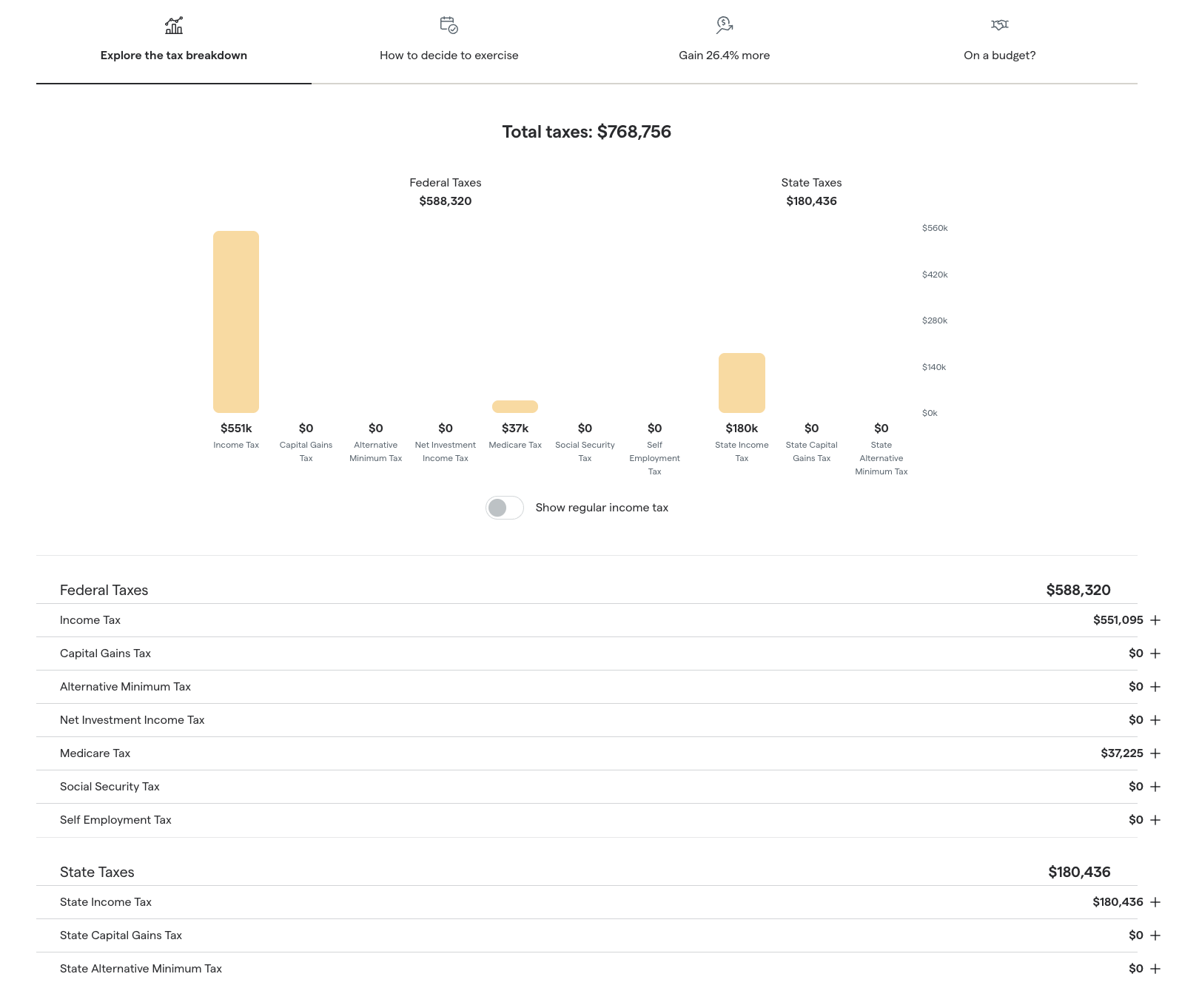
For illustrative purposes only. Actual results may vary and there is no guarantee of any particular outcome.
How to choose the right approach for your situation
When deciding how to manage your AMT planning, consider the current scale of your potential tax liability and the complexity of your holdings.
- Use a platform if: You primarily want to estimate your exposure, understand your stock option strike price, or model different exercise dates throughout the year.
- Use a CPA if: You have a large AMT risk, you are dealing with multiple tax jurisdictions, or you need to manage complex deductions.
- Use both if: You are a high earner looking to optimize your wealth over several years. Use the platform for year round tracking and bring the reports to a CPA for a final pre-tax season strategy session.
Read more: When should you hire a financial advisor for your equity
FAQs: AMT planning and stock options
1. What is the biggest advantage of using a dedicated platform for AMT?
We believe The primary advantage is speed and the ability to run unlimited what-if scenarios. You can instantly see the tax impact of various exercise amounts based on your real grant data.
2. Can generic tax software handle complex ISO exercises?
Based on our experience, generic tools often lack the specific nuance of private company valuations and exercise calculations. They are useful for filing after a transaction but are limited for forward looking planning.
3. When does an ISO exercise trigger the Alternative Minimum Tax?
AMT is triggered when the spread between your strike price and the fair market value at the time of exercise is large enough to push your taxable income above the AMT exemption.
4. How does the AMT credit work in later years?
If you pay AMT in one year, you usually generate a tax credit. This credit can be used in future years to lower your bill when your regular income tax exceeds your tentative minimum tax.
5. Is a financial advisor different from a CPA?
A financial advisor specializes in the nuances of startup compensation and liquidity, while a CPA is generally focused on broader tax compliance and filing. Many people benefit from having both perspectives.
Sources
- https://www.irs.gov/taxtopics/tc556
- https://www.irs.gov/forms-pubs/about-form-6251
- https://www.mgocpa.com/perspective/should-you-automate-multistate-tax-compliance/
- https://www.taxfyle.com/blog/comparing-diy-tax-software-vs-professional-accountants