RSUs vs stock options: What’s the difference and which is better for you?

18 min
0 result
Frederik is the CEO and Co-Founder of Secfi. The leading online platform where we help founders, executives and employees of fast growing technology companies better manage their equity through Wealth Management, Equity Planning and Equity Financing. In addition, he runs Secfi Capital, Secfi's institutional investment arm focused on investing in late stage private companies.
For a while, RSUs were seen as a simpler alternative to stock options. With RSUs, employees don't need to pay an exercise price or even decide when to exercise.
But it's no longer as clear-cut that RSUs are the answer because:
Private companies are staying private longer, while employees increasingly expect access to liquidity before an IPO.
When years of RSUs settle at once, tax and withholding obligations can create major financial challenges for both employees and the company.
If a company previously offered stock options, employees with only RSUs may feel discriminated against when the company holds a tender offer.
These consequences often emerge years after an equity plan is introduced, so they're easy to underestimate at the outset. We've seen the frustration this can create for both leadership teams and employees.
In our view, stock options often give employees more control, a clearer path to ownership, and better access to liquidity before an exit, especially when exercise affordability can be addressed through education and financing.
This article brings the trade-offs together so you can assess which structure is more suitable for your company, and communicate the decision clearly to employees. As always, the tax information present here is for general purposes, always speak with a tax professional regarding your particular circumstance.
We'll cover:
The difference between RSUs vs stock options
How double-trigger RSUs work at private companies
Why private companies switch from stock options to RSUs
The risks of double-trigger RSUs at private companies
RSUs vs stock options: Which is better for your situation?
Whatever you choose, help employees understand their equity
If you want to offer your team education on RSUs vs stock options and other equity considerations, get in touch with our team. And if you're an employee trying to figure out your next steps, try our free AI equity assistant Maeve.
Stock options and restricted stock units (RSUs) can both allow employees to benefit if your company grows. But they provide that opportunity in different ways.
A stock option gives you, as an employee, the right to buy a company share at a fixed exercise price, also known as the strike price. Once an option has vested, you can usually choose whether to exercise it. If you do, you pay the strike price and receive the underlying share, subject to the terms of your grant.
An RSU is a promise from your company to deliver a share, or sometimes its cash equivalent, after certain conditions have been met. You don't exercise an RSU or pay a strike price to receive the underlying share.
Here are the basic differences between RSUs vs stock options:
| Differences | Stock options | RSUs |
|---|---|---|
What you (as the employee) receive | The right to buy company shares at a fixed strike price | A right to receive shares or their cash value once the award's conditions are met |
What you pay | The strike price, plus any applicable taxes | Usually no purchase price |
Personal financial risk | You may spend your own money exercising options for shares that later lose value or remain illiquid. Eligible employees may be able to help reduce this risk through non-recourse financing | You generally don't pay a strike price to receive the shares, so you're not risking exercise funds upfront. You may still face tax and concentration risk once the RSUs settle. |
Potential upside | An option can become highly valuable if the share price rises well above its fixed strike price. | Value rises and falls with the value of the underlying share. Because RSUs have no strike price, they can still retain some value as long as the shares remain worth something |
Employee decision required | You generally decide whether and when to exercise vested options before they expire | You generally don't choose when the award settles |
Where they're commonly offered | Earlier-stage and growth-stage startups | Later-stage private companies and public companies |
Tax treatment | Depends on whether you hold ISOs or NSOs, when you exercise, and when you sell | Generally taxed as compensation when the shares or cash are delivered, although the exact timing depends on the award |
The simplest distinction is that stock options give employees the choice to purchase shares, while RSUs provide a conditional right to receive shares or value later.
As an employer, the trade-off is that each award solves a different problem. Stock options can give employees more control and potential upside, but the exercise cost may become unaffordable when the company grows. RSUs remove that upfront cost, but at a private company, they can delay when employees actually receive shares and create complications around liquidity and tax.
Exercise affordability doesn't always require replacing options with RSUs. Tools such as non-recourse financing can help eligible employees cover the exercise price and associated taxes, without putting their other personal assets on the line.
The distinction is relatively straightforward at a public company. But at a private company, RSUs often include an additional condition that can delay when employees receive their shares.
At a public company, RSUs often settle after the employee completes a time period set out in the award, such as working at the company for one year or reaching a specific date (called the vesting date). Because the shares trade publicly, the employee may be able to sell some shares to cover the resulting tax.
A private company can't usually offer that same liquidity because its shares don't trade on a public market. Employees may have no practical way to sell the shares until the company runs a tender offer, goes public, or is acquired. If the company delivered shares whenever part of the award met its time-based service condition, the employee could owe tax before they had a way to sell shares and cover the bill.
Here's an example, but always check with a tax professional about your own situation.
Imagine, as an employee, you receive 1 million RSUs with a four-year vesting period and a time-based vesting schedule. Assuming the award vests evenly, 25% becomes time-vested after each year you remain employed. After your first year, that means 250,000 RSUs have met the service condition.
If the shares are worth $1 each and the company delivers 250,000 shares at that point, the IRS may treat the $250,000 value of those shares as ordinary income. In other words, your taxable income for that year could increase by $250,000, even though you haven't received any cash. Which therefore means that your tax bill will also increase.
To avoid this problem, many private companies use double-trigger RSUs. These are RSUs where two conditions generally need to be met before the award settles:
A time-based service condition
A liquidity-related condition, such as an IPO or acquisition (this allows employees to cover the cost of taxes)
In some cases, an employee could complete the time-based requirement years before the second trigger happens. In other words, they could work at the above company for more than 4 years and get all their RSUs. But because no acquisition or IPO happens, they're not able to sell those shares and therefore access the cash. In this article, we'll refer to these as time-vested but unsettled RSUs.
Double-trigger RSUs address a real problem: employees generally shouldn't face tax on private shares they can't sell.
Once we account for the double-trigger structure, the practical differences of RSUs vs stock options for employees become more significant:
| Differences | Stock options | Private-company double-trigger RSUs |
|---|---|---|
When do you own the shares? | After you exercise the options and the company issues the shares | After both triggers are met and the RSUs settle into shares |
What is your control over timing? | You may be able to choose when to exercise vested options before they expire, potentially giving some control over tax treatment | The award terms and company events generally determine when settlement occurs |
What is your access to liquidity before an exit? | After exercising, you may be able to participate in a tender offer or approved secondary sale | Time-vested but unsettled RSUs may be excluded from liquidity opportunities because you don't yet own the underlying shares |
What is the risk if the company's value falls? | Exercised shares may become worth less than you paid. Unexercised options can become underwater if the share value falls below the strike price | The RSUs may lose value, but you haven't paid a strike price to acquire them |
What happens if you leave or don't act in time? | Options have an expiration date. After employment ends, vested options often remain exercisable only for a limited period. If you don't exercise before the deadline, they may expire. | RSUs don't have an exercise deadline, but time-vested or unsettled awards may be retained, cancelled, or subject to another deadline under the award agreement and company plan. |
For employers, RSUs can look simpler because employees don't need to pay an exercise price. But if the company stays private, those awards may remain unsettled for years, and changing the structure later can create significant tax and liquidity costs.
The issue with stock options is that they can become much more expensive for employees to exercise in a growing startup. The employee may need to pay both the strike price and any taxes triggered by the exercise, often before there's a market where they can sell the shares.
At Secfi, we help startup employees and executives understand and finance their equity. One pattern we see repeatedly is the gap between what employees expect exercising to cost and the actual total once taxes are included.
We call this the "surprise factor." In a sample of 25 recent Secfi users, the average total exercise cost was 3.5 times the strike-price cost once taxes were included. Some employees faced costs close to 10 times higher than expected.
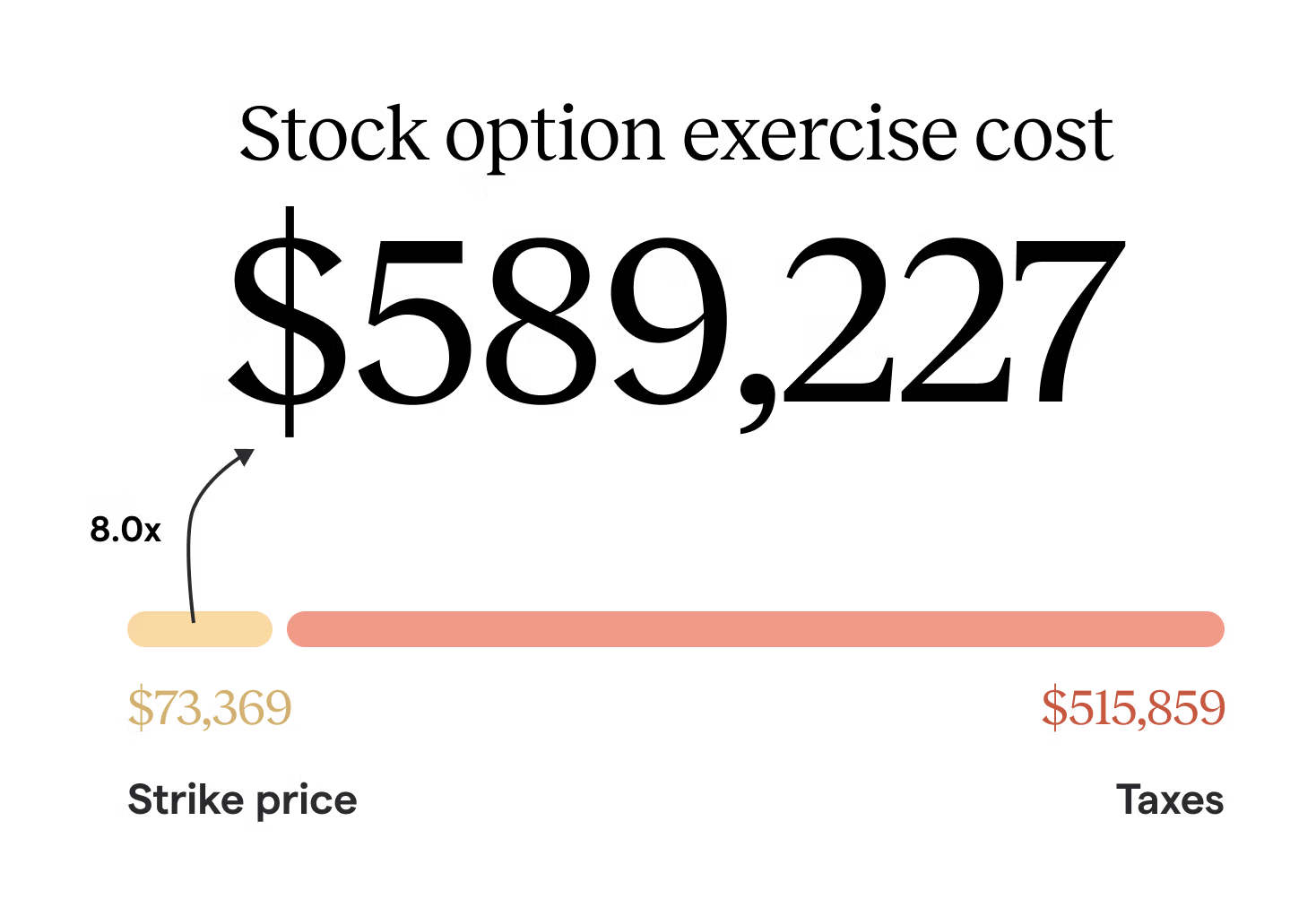
For illustrative purposes only. Actual results may vary, and there is no guarantee of any particular outcome.
For example, imagine an employee has 100,000 options with a $1 strike price. Exercising would cost $100,000 before any potential tax is added. If the company's 409A valuation rises well above the strike price, the tax bill could significantly increase the total cost.
For many employees, that puts exercising out of reach. It's one of the biggest reasons later-stage companies consider moving from stock options to RSUs.
RSUs can help companies:
Potentially reduce the affordability problem for employees. Employees don't need to pay a strike price to receive RSUs, which can make the equity package feel more usable when exercise costs and taxes have climbed beyond what most employees can comfortably fund.
Offer competitive equity with fewer units. Because an RSU generally has more value than an option at the time of grant, a company may be able to issue fewer units while maintaining a competitive compensation package.
Avoid granting options that may go underwater. If the share price falls below an option's strike price, the grant may lose its practical value. RSUs can still retain value as long as the underlying shares are worth something, which may help companies preserve the motivational value of equity during a downturn.
Align settlement with an expected liquidity event. Double-trigger RSUs can delay settlement and tax until an IPO, acquisition, or similar event makes it easier for employees to cover the resulting tax.
Despite these potential advantages, we've seen several risks surface when years of awards accumulate, or a company begins offering liquidity before an IPO.
An employee may complete the time-based portion of their RSU award years before the second trigger happens. During that period, the RSUs are time-vested but unsettled, which means the employee has met the service condition but still hasn't received the shares.
They generally can't:
Vote as a shareholder
Sell the shares
Participate in transactions limited to existing shareholders
This can be frustrating for long-standing employees. They may have built meaningful value for the startup and themselves, but have nothing they can sell to buy a home, start a family, or meet other financial goals.
Double-trigger RSUs delay settlement until both the time-based and liquidity conditions are met. If the liquidity trigger happens after years of awards have accumulated, a large number of RSUs may settle at the same time.
For employees, those awards generally become taxable as ordinary compensation income when they settle. That can significantly increase taxable income and withholding in a single year.
For your company, it can create a substantial withholding obligation across the workforce. You may need to withhold shares, use cash, or arrange another way to cover the taxes due.
A clear example came in 2023, when Stripe raised more than $6.5 billion at a $50 billion valuation to provide employee liquidity and address tax obligations linked to employee equity awards.
Stripe's situation was unusually large, but the structural issue applies more broadly. Double-trigger RSUs protect employees from owing tax before liquidity exists, but they can also concentrate years of tax and withholding obligations into the eventual liquidity event.
Tender offers give eligible shareholders the chance to sell some of their private-company shares before an IPO or acquisition.
Employees with exercised stock options are able to participate because they already own shares. Even employees with unexercised but vested stock options are almost always allowed to participate in a cashless exercise. Employees with time-vested but unsettled RSUs may be excluded because the company hasn't delivered their shares yet.
Some people refer to this as "liquidity discrimination." Two employees may have worked at the company for a similar amount of time, but only one can access cash from their equity during the same company-sponsored liquidity event.
This difference usually isn't deliberate; it's an unintended difference created by the equity structure. Even so, it can still become a fairness, retention, and employee-relations problem for leadership teams. The exact outcome depends on the tender terms and the company's equity plan. But it's something to consider before introducing RSUs.
Stock options can give employees more control over when they become shareholders, when they trigger tax, and whether they participate in future liquidity events. But that doesn't make them the best choice in every situation.
RSUs may work better when:
The company's valuation is already high. A high strike price and 409A valuation can make stock options prohibitively expensive to exercise.
Employees are unlikely to exercise options. An option may offer more control in theory, but that control has limited value if most employees can't afford the exercise price and associated taxes.
The company wants employees to receive value without paying a purchase price. RSUs don't require employees to pay a strike price and can retain value even if the share price falls.
The company is closer to an IPO or acquisition. Double-trigger RSUs may be less problematic when there's a credible path to liquidity within a relatively short period.
The company can manage settlement and withholding. RSUs may be more practical when leadership has modelled the tax obligation and has a clear plan for covering it.
Stock options may work better when:
Employees value becoming shareholders before an exit. Once options are exercised, employees own shares and may be able to participate in eligible tender offers.
The company is earlier-stage. Lower strike prices and 409A valuations can make exercising more affordable and increase the potential tax benefits of exercising early.
Employees want more control over timing. They may be able to decide when to exercise based on their taxes, career plans, and financial circumstances.
The company wants employees to retain more potential upside. Options can become highly valuable if the share price rises substantially above the strike price.
Exercise affordability can be addressed another way. Education, planning tools, and financing may help employees exercise without requiring the company to replace options with RSUs.
The company is open to supporting non-recourse financing. Employees apply for financing individually, but the company may still need to approve the transaction or be comfortable with the arrangement under its equity plan and transfer restrictions.
Whichever equity structure your company chooses, employees still need help understanding what they've been granted and what decisions they may face.
In a Secfi survey, 88% of startup employees wanted equity education, and 90% said it was a reason they joined their company.
Many employees don't even understand the implications of exercising until they're facing a major decision, such as preparing for a tender offer or approaching a deadline.
Providing ongoing and upfront education means there is less pressure around taxes and deadlines, and more intentional planning around their goals.
Company-wide equity education can help employees understand:
What they've been granted and when it vests
How exercising turns options into owned shares
What exercising could cost, including potential tax implications
What happens to their options if they leave
Which questions require personal tax or financial advice
If non-recourse financing or secondary sales are available for their shares
There may be restrictions around what type of financial guidance you can offer employees, which is why companies like Secfi can provide equity education on your behalf.
We provide planning resources and access to equity strategists and financial planners who understand private-company equity. This can also increase the trust factor for employees, who may be more comfortable asking a third-party sensitive questions about their finances.
Even employees who understand their options may be unable or unwilling to use their savings to exercise them.
Non-recourse financing can provide the money needed to cover the strike price and associated taxes. The employee exercises the options and retains ownership of the resulting shares, then repays the financing after a qualifying liquidity event.
If your company doesn't successfully exit, the financer's recovery is generally limited to the equity covered by the agreement, rather than the employee's other personal assets.
Secfi uses this model to help startup employees exercise their options without funding the entire cost personally. We've provided over $790 million for employees to exercise their startup options, more than any other provider of this nature. Our equity strategists walk employees through their proposal, including the applicable fees, repayment terms and potential outcomes, before they decide whether to proceed.
Financing won't be the right solution for every employee. The next useful step depends on what they hold, what decision they're facing, and what they want their equity to do.
Secfi supports startup employees at different stages with:
Maeve, a purpose-built AI equity assistant that helps employees explore their equity and model potential decisions
Secfi Wealth, certified financial planners for employees and executives who want their equity decisions connected to their wider financial and tax planning
Secondary-market support, for eligible shareholders who want to explore selling private shares rather than holding everything until an exit
RSUs and stock options each solve (and create) different problems.
In either case, employees should understand what their grant means in practice. Ask when you'll actually own shares, what happens if you leave, when tax may become due, and whether you'll be eligible for a tender offer before an IPO.
Meanwhile, company leaders should look beyond the immediate exercise-cost problem before replacing stock options with RSUs, and consider thorough employee education in either scenario.
Secfi helps private companies educate their employees about equity and gives eligible employees access to planning support and non-recourse financing. Speak with Secfi about supporting your company's equity programme, or try our free AI equity assistant Maeve to better understand your own equity.
It depends on the company's stage, the terms of the grant and what matters most to you.
RSUs may be more attractive if you don't want to pay an exercise price and prefer equity that can retain value even if the share price falls. Stock options may offer more potential upside and more control over when you become a shareholder, but exercising can require a significant amount of cash and may trigger taxes.
The tax implications also differ. Exercising incentive stock options can trigger the alternative minimum tax (AMT), while exercising and holding qualifying shares may create an opportunity for long-term capital gains treatment if the relevant holding requirements are met. RSUs are generally taxed as ordinary income when they settle.
At a private company, also check whether the RSUs are double-trigger. You may complete the time-based service requirement years before the company delivers the shares.
Secfi's AI equity assistant, Maeve, can help employees review their grant details and compare how RSUs or stock options may work under different company and liquidity scenarios.
RSUs can be valuable because you generally don't need to pay a strike price to receive the shares. Their value usually rises and falls with the value of the underlying company stock, so they can still be worth something even if the share price declines.
However, private-company RSUs may remain unsettled until an IPO, acquisition or another trigger occurs. That can limit your ability to sell the shares, participate in a tender offer or use the equity for a financial goal while the company remains private.
Whether RSUs are worth it depends on the number of units, the company's value, the settlement terms, what happens if you leave and how likely the company is to offer future liquidity. Maeve can help you organise those details and understand which questions to ask before making assumptions about the value of your award.
The $100,000 rule applies to incentive stock options, or ISOs. It limits the value of ISOs that can first become exercisable in a calendar year to $100,000, based on the shares' fair market value when the options were granted.
Any amount above that limit is generally treated as non-qualified stock options for tax purposes.
This rule can become complicated when you have multiple grants or overlapping vesting schedules. Secfi's equity planning tools and Maeve can help you organise your grants, although you should confirm the tax treatment with a qualified tax professional.
A stock option gives you the right to buy company shares at a fixed strike price. You generally become a shareholder after the option has vested and you exercise it.
An RSU is a promise to deliver a share, or sometimes its cash value, after the award's conditions have been met. You don't pay a strike price or exercise an RSU.
The key differences involve:
Cost: Stock options require an exercise price, while RSUs generally don't.
Ownership: Exercising options can make you a shareholder before an exit. With double-trigger RSUs, you may meet the service condition without receiving the shares yet.
Tax: The timing and treatment depend on the award. RSUs are generally taxed as compensation when they settle, while option taxation depends on whether you hold ISOs or NSOs and when you exercise and sell.
Liquidity: Exercised shareholders may be able to participate in eligible tender offers, while employees with unsettled RSUs may not.
Secfi helps startup employees understand these differences through equity education, Maeve, planning tools, and personalized guidance.