Cashless exercise options: How to exercise stock options without paying cash upfront

10 min
0 result
Mike’s a CPF® at Secfi. He specializes in helping clients make the most of their stock options and integrate equity compensation into their broader financial plans.
You’ve probably heard about cashless exercise, and wonder if it’s the best way to get cash from your employee stock options.
The answer is, like most things in equity: it depends!
A cashless exercise usually happens after an IPO or another liquidity event such as an acquisition or tender offer. Which means it might not help if you’re leaving your company, facing a 90-day exercise window, or trying to exercise before a potential exit.
That’s why it’s worth understanding cashless exercise options, alternatives such as non-recourse financing, and how to make a choice that aligns with your situation.
Because something we still hear way too often from startup employees is: “I wish I had known all of this years before the IPO..."
Luckily, you’re now reading this article.
In it, we’ll cover:
Note: Secfi helps startup employees understand, plan for, and finance major equity decisions, including whether to exercise stock options before an IPO, wait for a cashless exercise, sell shares on the secondary market, or use non-recourse financing to cover exercise costs. Model your specific situation with our free AI equity assistant Maeve.
A cashless exercise of options is when you exercise your stock options, and then immediately sell some or all of the resulting shares.

Normally, you’d need cash to pay for your option exercise. But that can be expensive. It includes paying the exercise price for every share you want to buy, plus any taxes triggered by the exercise.
For startup employees at later-stage private companies, the total cost may be tens of thousands, hundreds of thousands, or even more, depending on how many options you have, your exercise price, the company’s current 409A valuation, and your tax situation.
With a cashless exercise, you’re able to use the proceeds of the sale to cover the cost of exercising stock options.
With a cashless exercise, you still exercise your stock options first. The difference is that you don’t have to bring your own cash to the transaction.
After your company has an IPO or another liquidity event, a brokerage firm typically facilitates the cashless exercise. On your end, it feels like a single transaction. But here’s how it usually works:
The shares are usually sold on the public market after an IPO, or through the specific liquidity process your company has approved.
Waiting for a cashless exercise is often the default because it doesn’t require you to take action while your company is still private. You don’t need to come up with cash, estimate taxes, or decide whether exercising before an exit is worth the risk. But just because it feels easier, doesn’t mean it’s always the right choice for you.
To understand why some employees still choose this route, let’s look at the main benefits of a cashless exercise.
Cashless exercise can be useful if you don’t want to risk putting your own money into private company stock before you know whether the company will exit. If you exercise before an IPO or acquisition, you could spend tens or hundreds of thousands of dollars on exercise costs and taxes, and still end up with shares that are difficult to sell or eventually worth less than you hoped.
Here are the main reasons to consider this post-IPO strategy:
One thing to note about #2 and #3: there is also a low-risk, cashless option to exercise your options before an IPO (so you can avoid the high taxation) — but not many people know about it. It’s called non-recourse financing — more on what that is below.
However, there are a few reasons why a cashless exercise might not always be the best option:
1. You’ll be taxed at the highest rate (up to 53% vs. up to 37%).
Even though you don’t need cash to do a cashless exercise, it’s still not free. You’re just deferring the payment until you actually make money. The money you make will be taxed at ordinary income rates. These can be as high as 52.65% (for federal + state taxes in California).
If you exercise before your company exits and sell your shares at least 1 year later, you’ll get the lower long-term capital gains rate. This maxes out at 37.1% (for federal + state taxes in California). So you could take home money by doing so.
2. You have to stick around at the company until the exit.
At the majority of startups, when you leave, you have to exercise your stock options (or they expire). So if you leave before an IPO or acquisition, you won’t be able to wait for a cashless exercise. Given how long startups take to go public, this cancels out the possibility of a cashless exercise for a large group of employees.
Whether you’re exercising incentive stock options (ISOs) or non-qualified stock options (NSOs or NQSOs), a cashless exercise is usually taxed at ordinary income tax rates. You’ll typically owe tax on the difference between your exercise price (strike price) and the price you sell your shares for.
That’s the same tax rate as your salary, and can be as high as 52.65% for federal + state taxes if you live in California.
Your actual tax rate depends on your situation. You can use our free AI equity assistant Maeve to get a personalized figure.
Below is a generalized example, it’s important that you speak to a tax professional regarding your particular circumstance.
Let’s assume:
Since you’re doing a cashless exercise, you didn’t exercise your stock options before the IPO, and are now exercising and selling them all in one go.
Your net gain is $1,212,750.
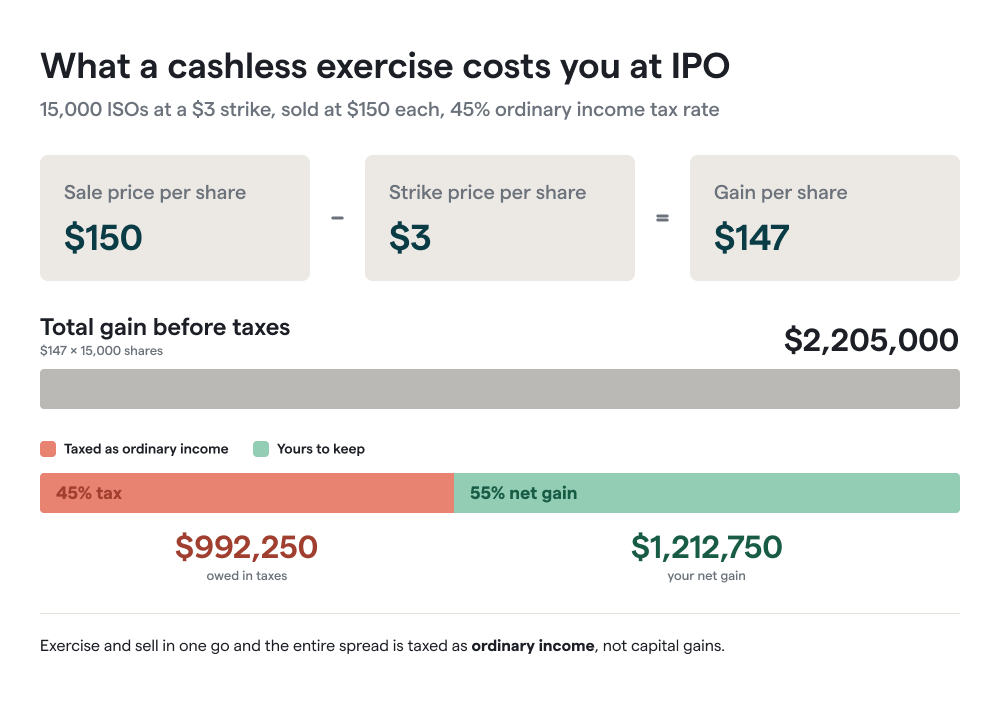
For illustrative purposes only. Actual results may vary and there is no guarantee of any particular outcome.
Now assume you didn’t wait for a cashless exercise, but exercised your ISOs in advance.
You’d have to pay the company $45,000 ($3 strike price * 15,000).
In addition, you’d owe tax. The amount of tax depends on the 409A valuation (also known as fair market value) at the time of your exercise.
Let’s assume the 409A is $35, and you owe $161,000.
So including taxes, you’d need to come up with $206,000 in order to exercise.
Assuming you sell your shares at least 12 months later, your proceeds now get taxed at long-term capital gains rates.
Let’s say the effective rate, in your situation, is 30%. (Again, that’s around what we often see for our California clients.)
Now:
This time around, your net potential gain is $1,543,500.
The difference is $330,750. That’s a 27.3% potential gain because you exercised pre-IPO instead of doing a cashless exercise.
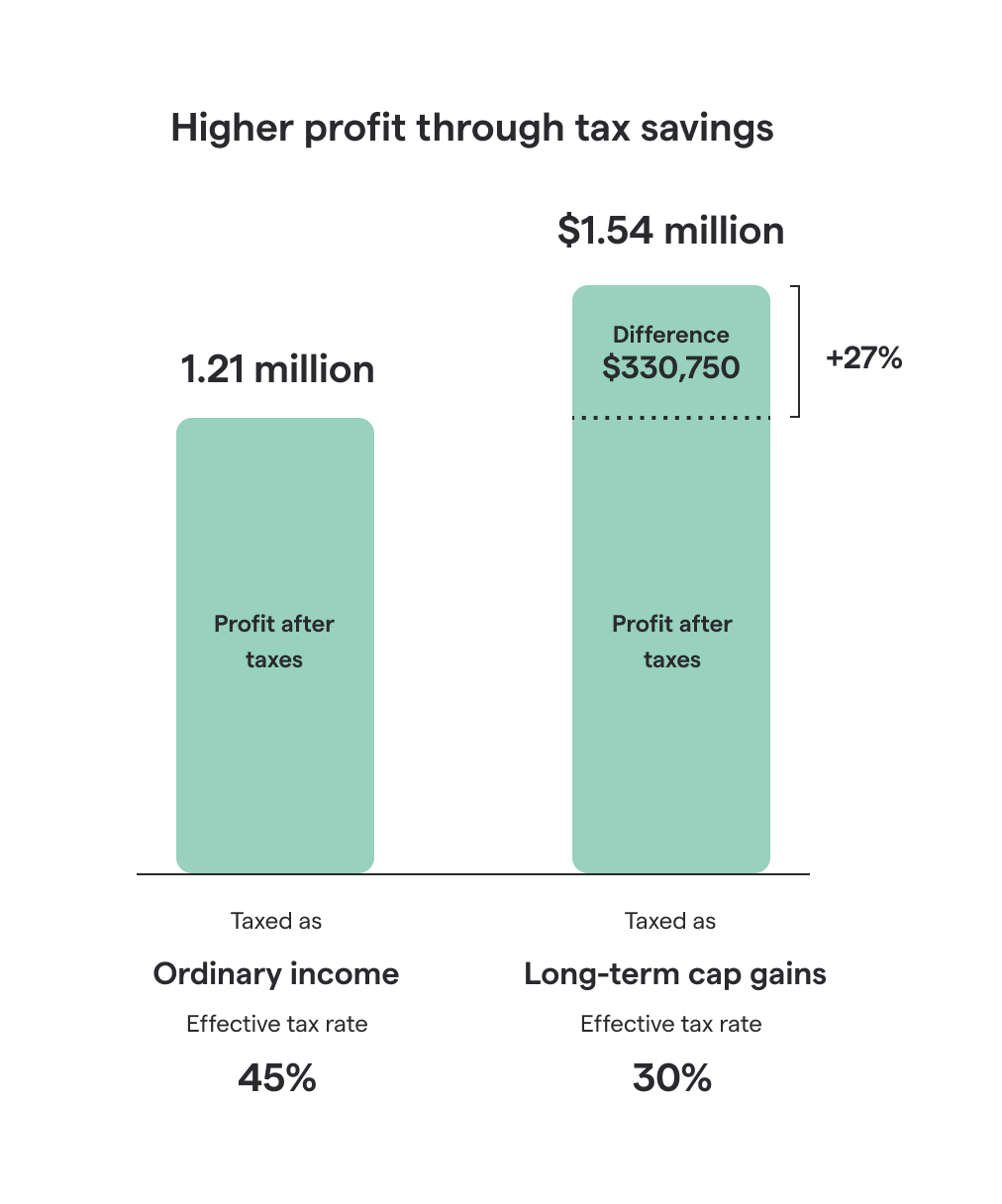
For illustrative purposes only. Actual results may vary and there is no guarantee of any particular outcome.
We built our AI equity assistant Maeve to help you make this choice.
It takes in your equity and tax situation, and allows you to compare both scenarios. Use it to figure out whether it’s worth it to exercise in advance of the IPO, or if it’s better to wait.
In the below scenario, exercising early results in $12.2 million in profit, compared with $9.14 million from waiting until IPO. That’s a difference of about $3.06 million which you probably don’t want to ignore.
The reason is the tax treatment. By exercising early, the employee starts the holding period sooner and may be able to have more of their gains taxed at long-term capital gains rates. By waiting until IPO, the gains from exercising are taxed at ordinary income rates, which can materially reduce the final outcome.
This won’t be true in every situation. Exercising early can still require significant upfront cash, create tax liability before you can sell your shares, and expose you to the risk that your company never exits. But the example shows why it’s worth comparing the numbers before defaulting to a cashless exercise.
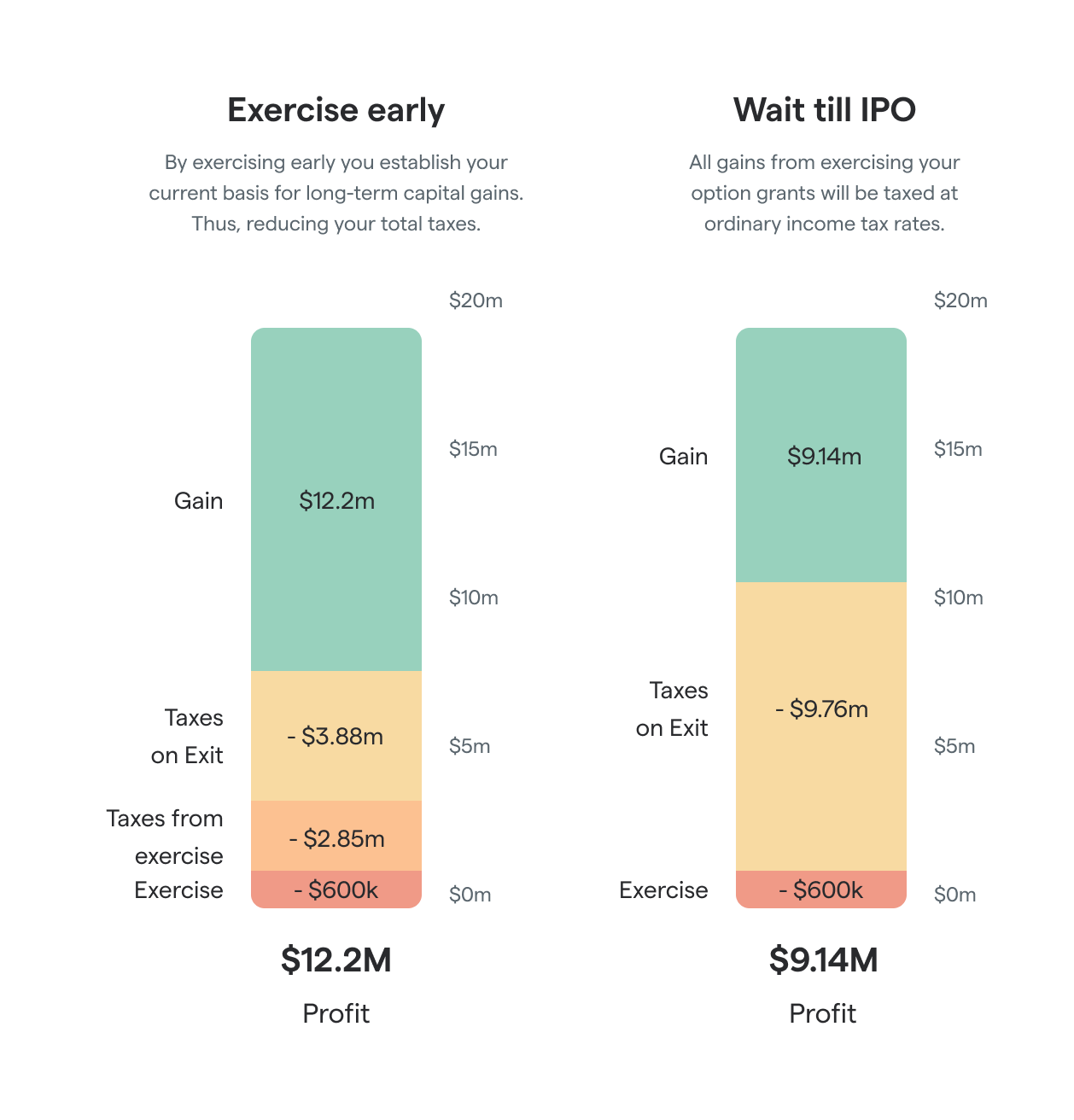
For illustrative purposes only. Actual results may vary and there is no guarantee of any particular outcome.
If your company has IPO’d, a cashless exercise is facilitated by a brokerage firm.
When you’re ready to exercise your options, the firm covers the share cost, transaction fees, and taxes with a short-term loan.
Then, they turn around and sell at least a portion of your new shares to pay back the loan.
From your perspective, it will feel like one seamless transaction that leaves you with cash, shares or a combination of both.
If your company doesn’t IPO but is instead acquired for cash, cashless exercises are often simply handled by your employer.
In the above scenarios, we’ve talked about using a cashless exercise to exercise your options, immediately selling all the shares, and cashing out completely.
This strategy is called ‘exercise and sell.' As discussed, it means being taxed at the highest tax rate.
Alternatively (if you didn’t exercise prior to the IPO) you can also do a cashless exercise to ‘exercise and hold.'
Also known as ‘sell to cover,' it means you sell just the right amount of shares to be able to cover the costs, holding the rest for another 12 months.
This way, you still get the tax benefits — although partly.
After a successful IPO, you may have life-changing wealth locked up in your employee equity.
If you keep that locked up in the form of company shares for a year, the stock might go down by much more than what the tax benefits make up for.
If you decide you don’t want to wait for a cashless exercise, your next step is to figure the costs of exercising your stock options using your own money, including the tax liability.
You can do that using our purpose-built AI equity assistant Maeve.
Unfortunately, for many people, the cost will be so high it’s unaffordable. Luckily, there are alternative ways to cover the costs.
Secfi offers non-recourse financing to employees of select companies.
If you’re eligible, our financing allows you to purchase your options prior to an IPO without spending your own money.
We provide the funds to help cover the cost of exercising, related taxes, and sometimes additional cash to use at your own discretion. You still own your shares, which means you can potentially participate in the future upside if your company exits successfully.
The “non-recourse” part is what makes this different from a traditional loan. If your company has a successful liquidity event, such as an IPO or acquisition, you repay the amount financed plus a fee at that time. But if your company doesn’t exit or the shares become worthless, you don’t owe Secfi anything. Your personal assets aren’t on the line, and your debt-to-income ratio is untouched.
Secfi can offer this because we evaluate the companies we work with upfront and only provide financing in situations where we believe the potential outcome makes sense for both sides. To date, we’ve provided nearly $400 million in financing to help startup employees and executives own their options.
To learn more about our business model, check out: How Secfi financing works – our business model explained.
Tender offers are basically a cashless exercise, but before the IPO.
Your company might offer to buy back shares from you while it’s still private. While it’s still relatively rare, some late-stage startups are offering this as a way to raise funds before they exit.
You can use this to sell a portion of your shares, enough to cover your exercise costs.
In some cases, you can sell your pre-IPO shares on a secondary market like Forge Global (formerly SharesPost) or EquityZen.
This is not an option for every company, because it depends on market appetite, but it can be worth investigating. It also requires your company’s prior approval in most cases.
Like a tender offer, you can use this to sell a portion of your shares and cover your exercise costs that way.
Secfi can also support you if secondary markets make sense for your situation. Many secondary platforms are not available to the general public, but Secfi can help you reach out to a larger network of buyers to find you the best deal, as well as negotiate your pricing.
Regular old loans, like a personal loan, margin loan, or loan from friends or family, are also an option for covering the exercise costs.
It’s risky, though, because it’s not guaranteed your company will exit. If it doesn’t, you’ll still be on the line to pay back the loan. More about the pros and cons of loans here.
Cashless exercise options and other equity decisions can be overwhelming, which is why Secfi exists. Our founders wanted startup employees to feel more confident by giving them access to the information and financing they needed, all in one place.
Today, more than 55,000 startup employees representing $90B in equity use Secfi’s equity planning tools. We’ve provided more equity financing than any other non-recourse financing provider.
Here’s why employees at companies including Databricks, Canva, and Happy Money choose Secfi.
Maeve is Secfi’s AI equity planning assistant, built to help you make sense of your stock options before a major deadline or liquidity event. It can be especially helpful if you’re trying to compare a future cashless exercise against exercising earlier for tax planning reasons.
It’s easy to get started, because you can connect to Maeve directly with your Carta account (or enter your details manually). From there, you can ask any questions and check its assumptions to make sure they align with your preferences.
Instead of trying to piece together answers from spreadsheets, tax calculators, and half-remembered coworker conversations, Maeve gives you a clearer starting point for understanding what you own and what choices may be available.
Plus, Maeve uses live data from fund markets, secondary markets, and 409A updates so you always have a current view of your portfolio's potential value.
If you don’t want to pay cash upfront, a cashless exercise may seem like the only route. But Secfi may be able to help you explore other liquidity options.
Our non-recourse financing may be available if you want to exercise before an IPO or acquisition. It can help cover the cost of exercising your options, related taxes, and sometimes additional cash.
You retain ownership of your shares, and if there’s a successful exit, you repay the amount financed plus a fee. If your company doesn’t exit or the shares become worthless, you don’t owe Secfi anything, and your personal assets aren’t on the line.
Secfi can also help you explore secondary sales. That may be useful if you already own shares and want liquidity now, or want to sell only part of your equity while keeping some potential upside for later.
Equity decisions can impact more than your stock options. They can affect your taxes and how much cash you have for your goals.
Secfi’s equity strategists can walk you through the practical side of your options: what it may cost to exercise, what financing or liquidity options may be available, and how different choices could affect your equity upside and downside.
For employees who need broader planning support, Secfi’s wealth team can help connect your equity decisions to the rest of your financial life. That can include:
That kind of support can be especially useful when your decision isn’t as simple as “exercise or don’t exercise.” If you’re deciding between different scenarios, Secfi can help you understand the tradeoffs before you commit.
Sam is an early Stripe employee who had an upcoming tender offer, which is basically a cashless exercise organized by the company itself pre-IPO.
She wanted help deciding if she should sell in the upcoming tender offer. Her aim was to build out a financial plan focusing on goals including buying her first home, starting a family, and planning for retirement.
Instead of treating the tender offer as an all-or-nothing decision, Sam worked with a Secfi Wealth advisor to sell 33% of her Stripe stock in the tender offer, and keep a plan in place for exercising remaining NSOs later.
While Sam and her husband had worked with advisors before, they often felt like the process was transactional and they “didn’t quite get what was going on.” But with Secfi, their advisor “did a really good job of explaining and educating us about the whole process and what all of this meant.” They liked that the team fully heard them out, and that they weren't pressured to take any particular action.
Read the full case study: Why a Stripe employee hired a financial advisor and decided to sell in a tender offer.
Testimonials are specific to an individual Client’s experience and may not be representative of all Clients. Unless otherwise indicated, Clients offering a Testimonial do not receive compensation and their statement does not present a conflict of interest.
A cashless exercise can be a convenient way to exercise stock options without paying cash upfront, especially if your company has already gone public or reached another liquidity event.
But the bigger lesson is to think ahead so a cashless exercise doesn’t become your only option. And you can often choose a mix of different solutions to hit the sweet spot in your equity planning.
Whether you exercise earlier with non-recourse funding for better tax outcomes and upside, sell a portion of your shares on a secondary market, or just go with a cashless exercise, you can feel prepared.
If you’re weighing cashless exercise against other options, connect your equity details to Maeve, or speak with Secfi’s team to understand which routes may be available for your situation.
Cashless exercise options usually refers to a way to exercise stock options without paying the exercise cost upfront with your own cash.
In a cashless exercise, you exercise your stock options and immediately sell some or all of the resulting shares. The sale proceeds are used to cover the exercise price, taxes, and any transaction fees. You may then receive the remaining cash, keep some shares, or use a mix of both.
For startup employees, cashless exercise is usually something that happens after an IPO, acquisition, or another liquidity event. If you’re trying to compare cashless exercise options with exercising earlier, Secfi’s AI equity assistant Maeve can help you model different scenarios based on your equity details.
Cashless exercise stock options are usually taxed based on the difference between your exercise price, also called your strike price, and the price you sell your shares for.
In many cashless exercises, that difference is taxed as ordinary income because you’re exercising and selling in the same transaction. This can mean a higher tax rate than if you had exercised earlier, held the shares long enough, and qualified for long-term capital gains tax treatment.
The exact tax treatment depends on whether you have ISOs, NSOs, RSUs, or another type of equity, as well as your income, state, holding period, and timing. Secfi’s Maeve is a free AI equity assistant that can help you estimate how different exercise and sale scenarios may affect your taxes, but you should also speak with a tax professional before making a final decision.
A cashless exercise and a same-day sale are closely related, and the terms are often used together.
A same-day sale is one common type of cashless exercise. You exercise your stock options and sell the shares on the same day, using the sale proceeds to cover the exercise cost, taxes, and fees.
There can also be a “sell-to-cover” version, where you sell only enough shares to cover the costs and hold the remaining shares. That may give you some continued exposure to your company’s stock, but it still comes with tax and market risk. If you’re not sure how these paths compare, Secfi’s Maeve can help you model exercise-and-sell, sell-to-cover, and pre-IPO exercise scenarios.
Usually, a traditional cashless exercise is only available after your company has gone public or reached another liquidity event where shares can be sold.
Before an IPO, you typically can’t do a standard cashless exercise because there may not be an open market for your shares. However, some private companies may offer tender offers or company-approved secondary sales, which can create liquidity before an IPO. These are not exactly the same as a cashless exercise, but they may allow you to sell a portion of your equity before the company goes public.
If you want to exercise before an IPO without using your own cash, Secfi may also be able to help you explore non-recourse financing if you’re eligible. Maeve can be a useful first step to understand what your options may look like before you speak with Secfi’s team.
The main alternatives to a cashless exercise include exercising with your own cash, using non-recourse financing, participating in a tender offer, selling shares on a secondary market, or using a traditional loan.
Exercising with your own cash may help you start the holding period earlier for potential tax benefits, but it can require a large upfront payment and comes with company risk. Non-recourse financing may help eligible employees exercise before an exit without putting personal assets on the line. Tender offers and secondary sales may provide liquidity before an IPO if your company allows them, but the tax outcome and pricing can vary. Traditional loans can cover exercise costs, but they may put your personal finances at risk if your company never exits.
Because these options can lead to very different tax, liquidity, and upside outcomes, it’s worth modeling them before making a decision. Secfi helps startup employees compare cashless exercise, non-recourse financing, secondary sales, and other equity planning routes, and Maeve can help you start that process with your own equity details.
The tool shown here uses artificial intelligence and is for illustrative purposes only and not necessarily indicative of future results and there is no guarantee that similar results can be achieved. The information provided by the tool is not professional advice and is not intended by Secfi, Inc., its affiliates, and Secfi representatives, to be deemed as investment, legal, tax or other professional advice or recommendations of any kind, or to form the basis of any decision to do or to refrain from doing anything. Secfi does not review the accuracy or completeness of the information provided to us within the tool.