Pre-IPO stock liquidity solutions: how to decide what works best for you

3 min
0 result
San Francisco native (yes, really). @uw and Lowell High alum. I like to nerd out on fintech, stock options and taxes.
If you’re an executive or employee at a pre-IPO company, your equity may be one of your most valuable but complex assets. But pre-IPO liquidity solutions can be hard to come by.
On paper, your company shares represent significant future wealth and opportunities for you and your family. In reality, equity often comes with high upfront costs to exercise or pay taxes, limited ability to access liquidity, and difficult trade-offs around when and how to act.
IPOs and acquisitions can take years, and the timing of an exit is rarely within your control. In the meantime, you’re holding a valuable but illiquid asset while trying to move forward with your financial goals.
You might be at a point where you’re:
You may want to use your equity to support these goals, but there’s no clear path to do so.
The good news is that there's a range of liquidity strategies available before a company decides to go public or sell. In the sections below, we’ll walk through the most common options, how they work, and when each makes sense depending on your situation.
We’ll cover:
Note: Secfi provides equity planning expertise, tools, and financing so you can make informed, confident decisions about your equity. Try our secure AI tool Maeve for personalized equity and financial planning.
If you want to make decisions about your equity pre-IPO, there are more paths available than you might first realize.
Exercising early can often lower your costs, especially if the company’s valuation keeps rising. But earlier decisions also come with different risk, because you’re putting money into shares before you know how the company will perform.
Below are the main approaches to consider when thinking about pre-IPO stock liquidity solutions.
The simplest approach is to take no action and wait for a liquidity event, such as an initial public offering or acquisition. This is often the default because there’s no upfront cost and no immediate decisions are required. It also avoids the risks from exercising early, such as committing cash without certainty around timing or eventual value.
Waiting for an exit can be appealing if you don’t need near-term liquidity and you’re confident in the company’s long-term outcome.
However, there are tradeoffs:
Another approach is to exercise your stock options using your own cash, enabling you to convert options into actual shares.
This approach can work well if you want to retain full ownership and upside, and believe strongly in the company’s long-term performance.
Exercising earlier may also help your taxes in a couple of ways. If you hold the shares long enough after exercising, you may qualify for lower tax rates when you eventually sell. It may also reduce the taxable amount at exercise.
Learn more about taxes in: The complete guide to employee stock option taxes.
Like any approach, using your own cash comes with tradeoffs:
A cashless exercise enables you to exercise your stock options without using your own capital upfront.
Instead, a portion of your shares is sold at the time of exercise to cover the cost of the shares and any associated taxes.
This can be a strong fit if you want to act on your equity but don't have the money to cover the upfront cost, or you'd rather not tie up personal cash. It can also simplify the process by bundling the exercise and selling shares into a single transaction.
The tradeoffs with cashless exercises include:
Note: For Incentive Stock Options (ISOs), selling shares immediately to cover costs may result in less favorable tax treatment. As always, taxes can get complicated quickly, so it’s good to speak with a specialized advisor for tax advice before proceeding.
Another option is to sell some of your shares through a secondary market.
This helps you access cash more quickly for a specific financial goal, whether it’s supporting your family or diversifying your portfolio.
Another benefit of secondary private markets is that they can provide visibility into what your shares may be worth. Real market conditions, buyer interest, and recent comparable transactions can inform your investment decisions, rather than relying solely on internal valuations.
Drawbacks to secondary sales include:
Another approach is to use financing, such as a personal loan or line of credit to cover the cost of exercising options. This gives you access to the capital you need without selling shares upfront.
Traditional financing from lenders may be a good fit if you have enough personal income or assets, are comfortable taking on debt, and want to retain full ownership and upside.
In some cases, this lets you exercise your options and benefit from future growth without waiting to accumulate the necessary cash.
The tradeoffs from traditional financing include:
One approach used in pre-IPO equity situations is non-recourse financing. It allows you to exercise your options without using your own capital upfront.
Non-recourse financing involves working with a third-party provider who funds the cost of exercising your options. In many cases, they can also help cover associated taxes.
In exchange, the provider is repaid if your company has a successful liquidity event, such as an IPO or acquisition. Repayment usually includes the amount financed, plus a fee or portion of the proceeds.
Unlike a traditional loan, repayment depends on what happens with your company, not your personal finances. If your company doesn’t have a successful exit, you are not personally responsible for repayment.
This type of financing makes sense if: you want to act on your equity but prefer not to use your own cash, you’re looking to reduce personal financial risk, and you want to retain ownership and future upside.
The tradeoffs from non-recourse financing include:
As more tech companies stay private for longer, non-recourse financing is getting more and more popular. For many executives and employees, the rising costs of exercise and taxes make relying exclusively on your own money difficult.
Exercising options requires paying both the strike price and potential taxes. This is especially true as valuations rise and those costs can become difficult to cover out of pocket.
For example, if you have 50,000 vested options with a $2 strike price, exercising them would cost $100,000 before taxes. If the company’s valuation has gone up, the potential tax bill could add tens or even hundreds of thousands more.
That’s the gap non-recourse financing helps address.
Instead of forcing you to choose between using personal cash, a traditional loan, or waiting, it creates another path: exercising your options while keeping your personal assets separate from the outcome.
If you believe in your company’s future but don’t want to put a large amount of personal capital at risk, non-recourse financing is worth considering.
At Secfi, we offer non-recourse financing for eligible pre-IPO executives and employees. You can learn more about how it works in our guide: What is non-recourse financing for stock options?
Secfi was built because our founders were in a familiar situation for pre-IPO tech executives and employees: they wanted to exercise stock options, but didn’t have the cash to do so.
That’s what led them to build Secfi. We’re a platform that empowers you to make more informed decisions about your stock options with planning, financing, and specialized expert guidance.
Here are a few reasons why people at companies like Databricks, Anduril, and AlphaSense choose to work with Secfi:
One of the biggest barriers to acting on equity is the upfront cost, including both the cost of exercising and associated taxes.
Secfi offers non-recourse financing designed specifically for pre-IPO equity. If there’s a successful exit, repayment comes from the proceeds.
Working together means you can:
Because our financing is non-recourse, you’re not personally liable if the company doesn’t have a successful exit or its valuation decreases.
Your personal assets, such as your home, are not at risk in this structure. That’s different from many traditional loans, where repayment can be tied to your personal finances. There may be additional tax consequences, so it’s important that you talk to your tax professional.
Secfi can also support secondary market transactions when liquidity is a priority, helping connect you with buyers and navigate the process if your shares are eligible.
Planning around equity is fundamentally different from planning around traditional investments.
For example, in many cases, tax is a major driver of your liquidity strategy. You need to factor in 409A valuations, strike price, and vesting schedules. Most tools are not designed to handle these nuances which can have a big impact on your outcomes. That’s why it’s important to use a tool that helps you optimize for taxes, not just returns.
We built Maeve to help you model these scenarios with more precision. Instead of relying on generic assumptions, Maeve uses your actual financial and equity data to give you a clearer picture of what your AMT liability could look like.
It also includes regularly updated data, including secondary market insights and 409A valuations, so your models reflect a current view of your portfolio.
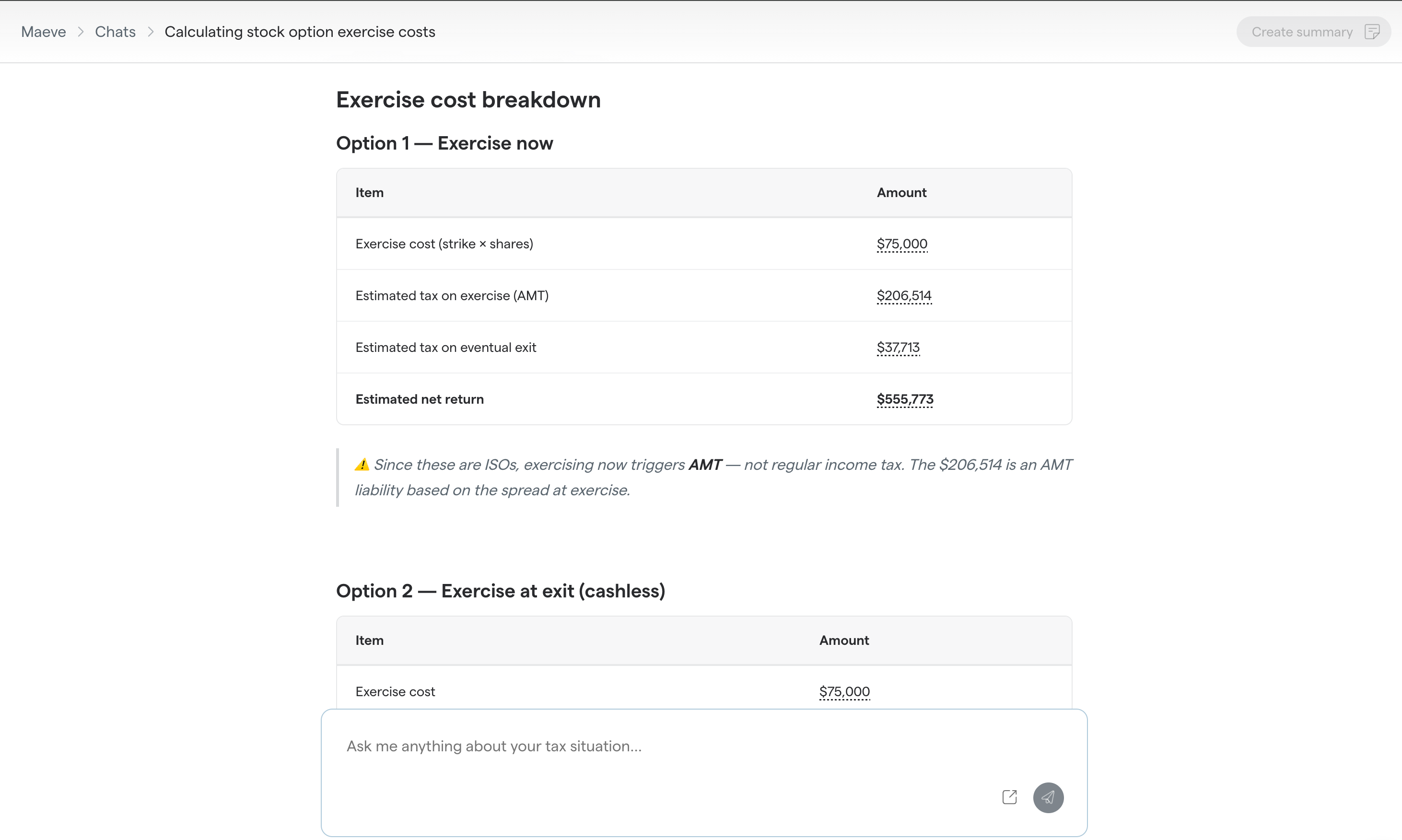
For illustrative purposes only. Actual results may vary and there is no guarantee of any particular outcome.
Even with the right tools, equity decisions can be difficult to navigate. Secfi’s specialists bring focused expertise in pre-IPO shares, which can complement the guidance you may already receive from your financial advisor, CPA, or legal team.
Our licensed equity strategists specialize in pre-IPO compensation, so you can go beyond general advice and evaluate decisions based on your specific context.
That can be especially helpful because the right approach is usually not a single decision. In many cases, it may involve a combination of strategies, such as selling a portion of your shares while financing the rest to balance liquidity, risk, and long-term upside. The right team can reduce uncertainty and help you make high-stakes decisions with a clearer strategy.
If your equity is part of a broader financial plan, Secfi’s licensed wealth advisor team understands the realities of tech compensation, private securities, and liquidity planning. As a registered investment advisor (RIA) They can help you think through how your equity fits alongside goals like buying a home, caring for family, optimizing taxes, or diversifying your portfolio.
As a founding team member at Happy Money, Dan Sinner had been with the company for nearly a decade and helped scale it to a valuation of over $500 million.
Even with his level of experience, when it came time to make decisions about his own stock options, Dan found himself facing the same challenges many employees encounter.
One of the biggest issues was cost. Exercising his options required a lot of capital, at a time when he was also thinking about other major financial priorities, like buying a home.
“Believe it or not, even though I'm involved in a high-growth startup, I’m a relatively risk averse person when it comes to my personal finances,” Dan said.
At the same time, he was approaching a key deadline where his options could expire.
Like many executives, he didn’t see a clear path forward. He felt like his only options were using personal capital to exercise, or “just hang on and keep going, keep pushing through, and then figure out when I have to figure it out.”
Neither felt like an ideal strategy.
That’s when Dan turned to Secfi. Working with our team, Dan was able to better understand his equity, including the costs, risks, tax considerations, and potential outcomes associated with exercising. His first impression was the team’s breadth of knowledge for his exact situation.
He ultimately chose to use non-recourse financing to cover the cost of exercising his options. This allowed him to move forward without using personal capital upfront, decreasing his risk while maintaining ownership.
Dan realized that if navigating these decisions was challenging for him as an executive, it was likely even more difficult for employees across the company.
As a result, Happy Money partnered with Secfi to provide both education and financing options to employees company-wide. Dan felt better knowing they could connect employees with Secfi and say “Here’s a partner who we trust, and that you can go dive into your own research on it.”
This gave employees access to:
By supporting employees in this way, Dan feels Happy Money is further contributing to their company culture of transparency.
Testimonials are specific to an individual Client’s experience and may not be representative of all Clients. Unless otherwise indicated, Clients offering a Testimonial do not receive compensation and their statement does not present a conflict of interest.
Pre-IPO equity can be one of the most valuable parts of your compensation, but it often leaves executives and employees with more questions than answers.
From timing and taxes to cost and risk, the decisions involved can be complex, and easy to delay without a clear plan for liquidity.
But with the right support and access to capital, you can choose a more strategic approach, so your equity goes from paper to a more actionable part of your financial strategy.
By combining planning, guidance, and execution, Secfi enables you to move from evaluating your options to acting on them, without needing to coordinate across multiple providers.
If you want to explore your options in more detail, you can start by modeling your equity with Maeve, our encrypted AI built for the nuances of equity like yours. Or if you’d like to connect with our team directly, reach out today.
There are several ways to access liquidity from pre-IPO equity, depending on your goals and timing. Common options include waiting for a liquidity event like an IPO or acquisition, selling shares through a secondary market, exercising stock options with personal capital, or using financing solutions to act on your equity without selling shares upfront.
Approaches like non-recourse financing have become more common, enabling employees and executives to cover exercise costs and taxes without using personal funds, while still retaining ownership. Platforms like Secfi provide tools and guidance to help evaluate and execute these different strategies based on your situation.
Selling shares in a secondary market can make sense when you need liquidity before an IPO or want to reduce your exposure to a single company. This is often relevant for major financial goals, such as buying a home, diversifying your portfolio, or managing personal financial risk.
However, secondary sales depend on buyer demand, company approval, and market conditions, and shares are often sold at a discount to their most recent valuation. Because of these tradeoffs, many people evaluate secondary sales alongside other options, sometimes with support from platforms like Secfi to better understand pricing, timing, and potential outcomes.
Exercising stock options before an IPO involves several risks. You may need to commit significant upfront capital to purchase shares, and you could owe taxes, including alternative minimum tax (AMT), even if you haven’t received any liquidity.
There is also the risk that the company’s future performance may not meet expectations, meaning the value of your shares may not be fully realized. In addition, exercising early can increase concentration risk by tying more of your personal wealth to a single, illiquid asset.
Because of these factors, many employees and executives model different scenarios and explore financing options, including non-recourse structures offered by companies like Secfi, to reduce upfront cost and risk.
Non-recourse financing enables you to exercise your stock options or access liquidity without using your own capital upfront. Instead of requiring immediate repayment, the financing is tied to a future liquidity event, such as an IPO or acquisition.
If the company has a successful exit, repayment comes from the proceeds. If not, you are not personally responsible for repayment, which means your personal assets are not at risk.
This structure can help address common challenges like upfront exercise costs and tax obligations, while allowing you to retain ownership and participate in future upside. Providers like Secfi specialize in this type of financing, offering solutions designed specifically for pre-IPO equity.
Choosing between exercising, selling, or waiting for an exit depends on your financial goals, risk tolerance, and timeline. If your priority is maximizing long-term upside, you may choose to hold your equity or exercise early. If you need liquidity or want to reduce concentration risk, a secondary sale may be more appropriate.
If you want to act on your equity but avoid using personal cash or taking on significant financial risk, financing options may be worth considering. In many cases, the best approach is not a single decision but a combination of strategies over time.
Working with tools and advisors that specialize in equity compensation, such as Secfi and its purpose-built AI tool Maeve, can help you model different scenarios and make more informed decisions based on your specific situation.
The tool shown here uses artificial intelligence and is for illustrative purposes only and not necessarily indicative of future results and there is no guarantee that similar results can be achieved. The information provided by the tool is not professional advice and is not intended by Secfi, Inc., its affiliates, and Secfi representatives, to be deemed as investment, legal, tax or other professional advice or recommendations of any kind, or to form the basis of any decision to do or to refrain from doing anything. Secfi does not review the accuracy or completeness of the information provided to us within the tool.