Stock option for a home purchase

11 min
0 result
San Francisco native (yes, really). @uw and Lowell High alum. I like to nerd out on fintech, stock options and taxes.
A home purchase can create an awkward timing problem for startup employees: your equity may seem valuable, but exercising it can require a lot of cash before the shares are actually liquid.
That timing problem can show up whether you want to buy soon or you're planning a few years ahead. If you exercise now, you may need cash for the strike price and taxes. If you wait, your exercise cost or tax bill could rise, and you may still not have liquidity when you're ready to buy.
Stock option financing for a home purchase can include non-recourse financing from funders like Secfi, traditional loans, SBLOCs (Securities-Backed Line of Credits), or qualifying for a mortgage based on your stock-based assets or income. Your choice depends on your timeline, whether your options are vested, what it would cost to exercise, how taxes could work, and whether the financing creates too much risk before you buy.
Stock option financing refers to using specialized funding to cover exercise costs, tax bills, or liquidity needs related to your equity. In the context of a home purchase, this typically helps you avoid draining personal cash savings that are needed for a down payment or closing costs.
While some people may think stock option financing needs to be used to buy a home outright, there are many ways it can support a home purchase. For example, it may help cover exercise costs or taxes, preserve cash for your down payment and reserves, or give you more flexibility while you plan around a future liquidity event such as an IPO.
There is often a major gap between your paper value and the cash needed for a home. Most startup equity is illiquid, meaning you can't easily sell it to pay for a house.
Even more challenging, turning options into shares often needs a large cash outlay for the strike price and associated taxes. If you have Incentive Stock Options (ISOs), you may face a high Alternative Minimum Tax (AMT) bill. This creates a situation where you could look potentially able to buy a house on paper, but your bank account is empty because your cash is tied up in unexercised options or tax payments.
For a home purchase, stock option financing is often part of a broader plan. You may be comparing ways to fund the exercise, preserve personal cash, create down payment money, support your mortgage application, or use a blended strategy that combines more than one path.
| Path to home purchase | What it may help with | Who we believe this is the best for | Main trade-off |
|---|---|---|---|
Non-recourse stock option financing | Exercise costs and taxes | Eligible private company employees who want to exercise options while preserving cash and upside | Financing costs and giving up a portion of future proceeds after a successful exit |
Traditional personal loan | General liquidity | Borrowers with high income and good credit | Monthly payments and potential impact on debt-to-income ratio |
SBLOC or portfolio line of credit | Borrowing against liquid stocks or investments | Employees with large public stock or brokerage holdings | Variable rates and margin-call risk if asset values fall |
Use stock-based income or assets for mortgage qualification | Mortgage approval | Buyers with documented stock compensation, vested shares, or liquid assets | Lender-specific rules, documentation requirements, and possible asset haircuts |
Selling shares or cashless exercise | Immediate down payment cash | Public company employees or eligible private company shareholders with an approved sale path | Taxes and losing potential future upside on the shares sold |
Your strategy depends heavily on when you plan to buy your home.
Buying in the next few months. If you're close to a purchase, protecting your cash and debt-to-income ratio is a priority. Lenders may require detailed documentation for any funds used for the down payment.
Buying within the next year. This may give you time to model exercise timing, potential taxes, and whether financing could help you preserve cash before you need liquidity.
Planning a few years ahead. This allows for a staged strategy. You might exercise a portion of your options each year to stay under certain tax thresholds, while building a cash reserve for a future home.
Eligible employees may use non-recourse financing from companies like Secfi to exercise options and potentially cover associated taxes. This allows you to own your shares without using personal savings.
If you're buying a home soon. Non-recourse financing helps preserve your cash for a down payment, closing costs, and emergency reserves. You don't need to make monthly payments like a regular loan because it's not required with this type of financing. Ask your lender how they would treat it before you apply.
In some cases, non-recourse financing can give you some cash to use at your discretion.
If you're planning ahead. Exercising earlier with financing can help start the capital gains holding period sooner. This may put you in a better after-tax position at exit, especially if the company's value increases later and more of the gain may qualify for long-term capital gains treatment.
Planning ahead may also give you more room to exercise in stages. For ISOs, that can matter because exercising too many shares in one year can increase AMT exposure, and some options may lose ISO tax treatment under the $100,000 ISO rule. If you pay AMT, you may be able to recover some of it later through AMT credits, but the timing may not line up with your home purchase.
The trade-off is that exercising earlier means owning illiquid private shares for longer. If the company doesn't exit, or exits at a lower value than expected, you may not get the outcome you modeled.
For a comparison of non-recourse financing providers: ESO Fund vs EquityBee vs Secfi: Which stock option financing provider is right for you?
If you have public stock, diversified brokerage assets, or a very high salary, a traditional loan or Securities-Backed Line of Credit (SBLOC) may be simpler than financing private company options.
An SBLOC lets you borrow against a liquid investment portfolio instead of selling shares. That can help you access cash while keeping your investments, but it can also come with variable interest rates and margin-call risk if the portfolio value drops.
A personal loan may be more straightforward, but it usually creates regular repayment obligations. Those payments can affect your debt-to-income ratio, which may matter if you're applying for a mortgage.
Stock options may not directly become down payment cash, but stock-based compensation or exercised shares may help with mortgage qualification in some cases. Lenders may look at your income history, vested stock compensation, liquid assets, and documentation when deciding how much you can borrow.
We've found that private company options are often harder to count than public company stock or Restricted Stock Units (RSUs), because their value can be difficult to verify and they may not be liquid. If you want to use equity to help qualify for a larger loan, ask your lender early about their requirements for stock-based income and assets.
Selling shares can be the simplest way to create home-buying cash, but it depends on whether the shares are liquid.
Public companies. You can often use a cashless exercise, where you exercise and sell enough shares simultaneously to cover the costs and keep the remaining cash for a down payment.
Private companies. This requires a tender offer, an approved secondary sale, or an acquisition.
The trade-off: selling provides immediate cash but creates a taxable event and stops you from benefiting if the stock price continues to rise. That could mean help with your down payment, but less potential future money to support mortgage payments or other investing activities.
Learn more: Should you sell your pre-IPO shares? Explore secondary markets and alternatives.
Taxes are often the largest expense in an exercise. NSOs are taxed as ordinary income upon exercise, while ISOs can trigger AMT.
At Secfi, we've had cases where employees learned they would have to pay more than 8 times their strike price in taxes (see example below).
For illustrative purposes only. Actual results may vary and there is no guarantee of any particular outcome.
We wrote more details about the "tax surprise" you might face here: The surprise factor: Why exercising your stock options can be far more expensive than you expect.
Taxes are difficult to calculate, even for experts. For example, Secfi Equity Strategist John Klingler shared:
"Even after doing this for years, if someone asks, 'What is my exact AMT?' you need much more information. You can provide an estimate, but to plan it properly, you need to understand much more of that person's financial situation."
We believe after-tax cash matters more than the gross value of your options. Planning your exercise timing around your home purchase can help you manage these liabilities so you don't end up with a surprise $400,000 tax bill right as you are trying to close on a house.
That's why we created Maeve, a free AI equity assistant to help you make those estimates.
Learn more: Why we built Maeve.
At Secfi, we help startup employees understand and act on their equity. Buying a home is often one of the major milestones our clients are planning toward, so we have tools and resources in place to help make that decision a bit easier.
Here's how Secfi can help if you're considering financing for a home purchase:
Non-recourse financing. Our non-recourse financing may help eligible employees exercise stock options without using personal savings or taking out a traditional loan. You don't make monthly payments, and your personal assets aren't used as collateral. In exchange, you give up a portion of future proceeds after an exit. We've provided over $800 million in this type of financing to startup employees, more than any other company in this category.
Maeve. Our AI equity assistant can help you model different paths to stock option financing using your actual equity details. You can import grant details directly from Carta, or upload equity documents and tax information, so the numbers are based on your unique situation. Ask Maeve questions relating to anything in this article, and it can give you potential outcomes, including tax estimates.
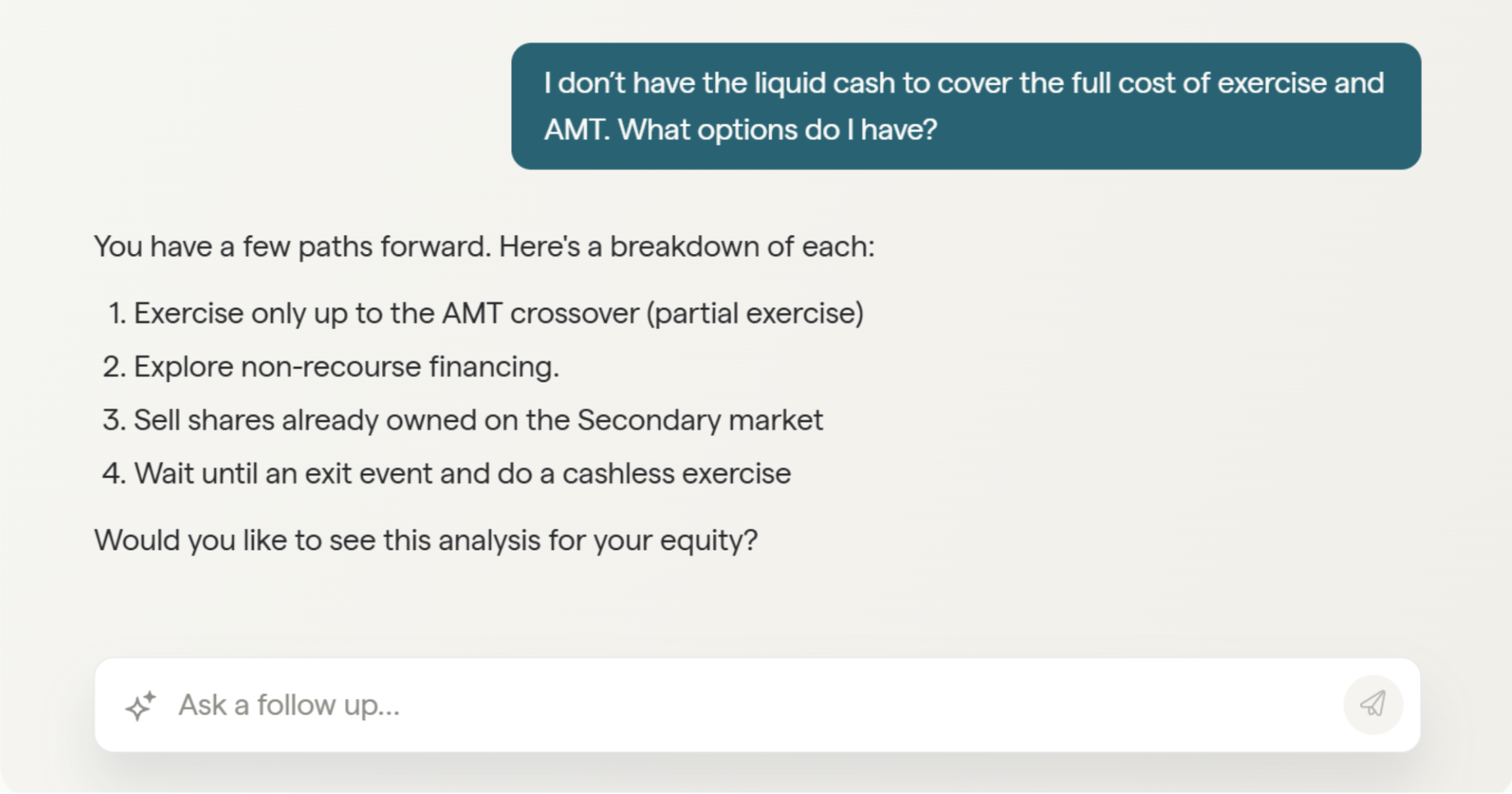
Example of a response from Maeve. For illustrative purposes only. Actual results may vary and there is no guarantee of any particular outcome.
Secfi's Wealth team. Our team can help you think through the bigger financial picture of buying a home, and how that fits into your other financial goals. That might include how much cash to keep available before buying, whether exercising now or later makes sense, and how much concentrated equity risk you're comfortable taking on. As certified financial planners, they're required to act in your best interests.
Stock option financing shouldn't be evaluated in isolation. It needs to fit with your mortgage, cash reserves, tax plan, and overall comfort with the risks of startup equity.
Using financing can be a good choice if you want to keep your potential upside while keeping your cash available for a down payment. In many cases a blended strategy might be a good fit: financing some costs, selling shares if a liquidity path is available, and exercising in stages where possible.
Generally, no. Most mortgage lenders require cash for a down payment. You would first need to sell the shares or use financing to provide enough cash to cover the purchase.
Traditional loans and SBLOCs usually count as debt. Non-recourse financing is structured differently, but you should still ask your mortgage lender how they will view the arrangement during underwriting.
The main risk is that the company may not have a successful exit. With non-recourse financing, the funder generally takes that risk, but you will still have given up a portion of your future upside and may face tax consequences.
We believe this depends on your conviction in the company. Selling provides immediate cash and certainty, while financing allows you to maintain ownership and benefit from future stock price growth.
https://kbfinancialadvisors.com/how-to-use-stock-options-to-buy-a-house/
https://augustuswealth.com/blog/how-to-pay-for-your-stock-options-what-you-must-know/
https://manual.compoundplanning.com/chapters/stock-option-financing
The tool shown here uses artificial intelligence and is for illustrative purposes only and not necessarily indicative of future results and there is no guarantee that similar results can be achieved. The information provided by the tool is not professional advice and is not intended by Secfi, Inc., its affiliates, and Secfi representatives, to be deemed as investment, legal, tax or other professional advice or recommendations of any kind, or to form the basis of any decision to do or to refrain from doing anything. Secfi does not review the accuracy or completeness of the information provided to us within the tool.