Post-termination exercise period: What happens to your stock options after you leave

16 min
0 result
San Francisco native (yes, really). @uw and Lowell High alum. I like to nerd out on fintech, stock options and taxes.
A post-termination exercise period (PTEP) is the amount of time you have after leaving a company to exercise your vested stock options before they expire. For many startup employees, that window is around 90 days, which may not feel like much time to make a potentially major financial decision.
Your actual deadline depends on your company’s equity plan and grant agreement. But even if your company gives you longer to exercise, there’s also a separate three-month federal tax window to consider if you have incentive stock options (ISOs).
Fortunately, if you’re in this situation, there are tools and teams available that can help you figure everything out in time.
Let’s start with the basics, then get into some of the nuances. In this article, we’ll cover:
How to plan for your post-termination exercise period
What to consider before exercising during your post-termination exercise period
How Secfi can help you exercise before your post-termination exercise period ends
How Barry used Secfi to exercise within a 90-day window
You can use Secfi’s free AI equity assistant, Maeve, to review your grant details and model different post-termination exercise period scenarios, including exercise costs, taxes, and timing.
Any options that haven’t vested by the time you leave your company are usually forfeited, regardless of whether you chose to leave or were let go. For the options that have vested, the next step is deciding whether you want to exercise them before your post-termination exercise period ends.
To do this, you’ll need to figure out how much it might cost to exercise, including taxes, which can add up. Then, based on that number, you’ll need to decide if exercising is worth it based on your financial situation.
Here’s how to navigate the decision:
Before deciding what to do, work out how much exercising could actually cost. To do this, first gather all the information you need from your grant documents or equity platform.
Find your strike price and number of vested options, then factor in potential taxes based on your option type and current fair market value. Here’s where it can get interesting, because taxes can make the exercise cost much higher than the strike price alone suggests.
When exercising options, you can be taxed on the “spread”. This is the difference between the strike price and fair market value (FMV) on the exercise date. When exercising non-qualified stock options (NSOs), this spread is taxed at your ordinary income rate, which could be as high as 50% in places like California.
Incentive stock options (ISOs) are generally taxed more favorably, though the process is slightly more complex. When exercising any amount of ISOs, you will need to deal with something called the alternative minimum tax AMT. This is a special tax for high-income taxpayers and comes with some tricky rules, with the tax rate usually being 26% or 28%.
You’ll work out both your AMT and normal tax obligations, then pay whichever is higher. If it is the alternative minimum tax, then this is called “triggering AMT”.
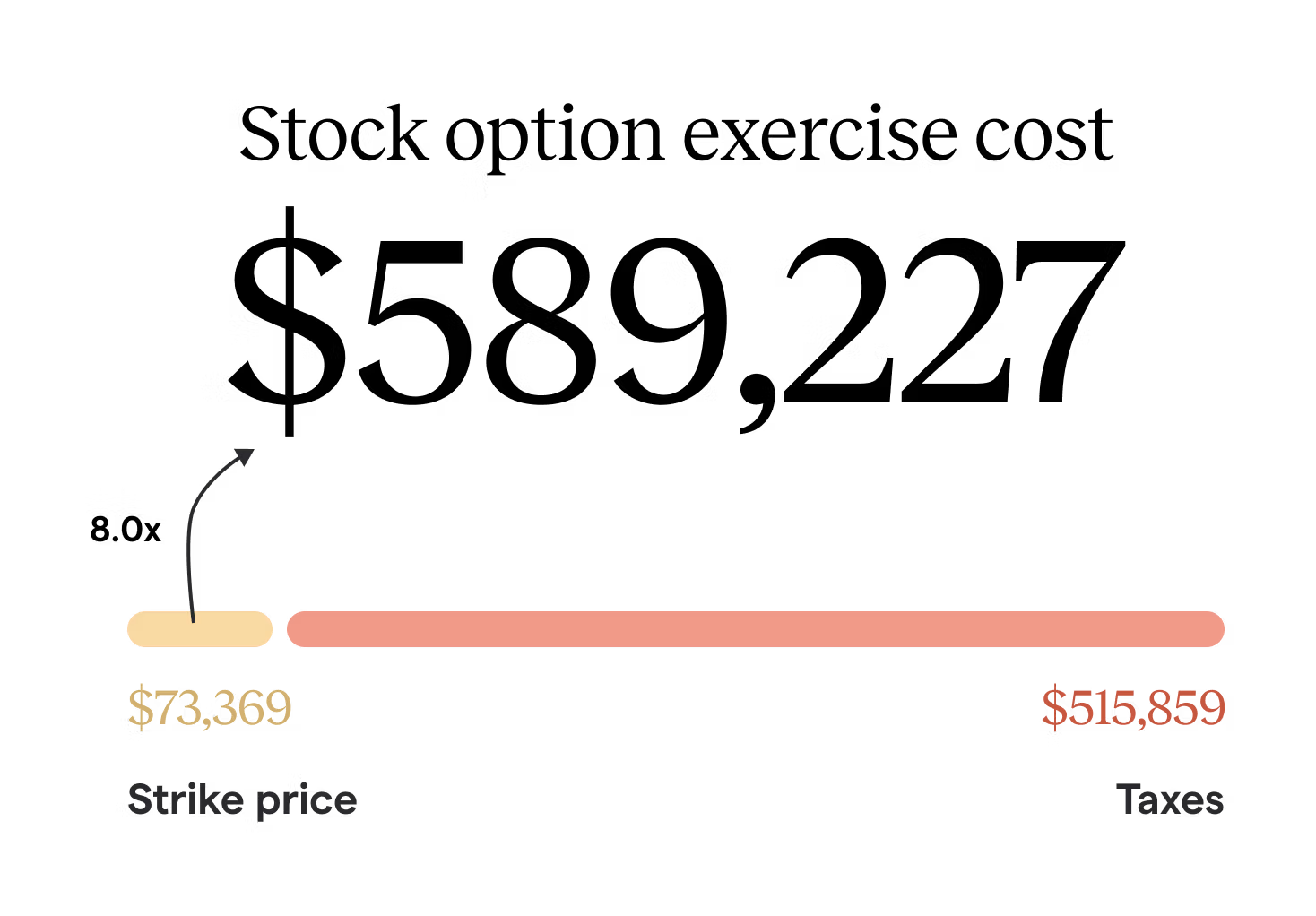
For illustrative purposes only. Actual results may vary and there is no guarantee of any particular outcome.
It’s easy to miss something in these calculations, so it’s worth using a modeling tool that’s more sophisticated than a DIY spreadsheet or generic AI. For instance, we purpose-built an AI equity assistant, Maeve, to help you model different scenarios like the cost to exercise, tax treatment from ISOs vs NSOs, and more based on your unique situation and equity details.
For Illustrative Purposes only. Actual results may vary and there is no guarantee of any particular result.
We sometimes call the post-termination exercise period the “90-day oh sh*t window.” But your actual timeline may be shorter or longer than 90 days depending on the structure of your grant. Go to the official documents as soon as you can to check:
Your stock option agreement
Your equity portal, like Shareworks or Carta
Any termination paperwork
Look for language around termination of service, exercise period, expiration, or post-termination exercise. You can also go directly to your company if anything is unclear.
If your exercise window is too short, it’s worth asking whether an extension is possible. Companies sometimes grant longer windows to long-tenured or early employees, people affected by layoffs or unusual circumstances, or as part of a negotiated departure package.
There’s no guarantee your company will agree. An extension may require approval under the company’s equity plan, potentially from its board or compensation committee.
But an extension can also have tax consequences for ISOs.
If you have ISOs, there’s another deadline to keep in mind.
To retain the preferable ISO tax treatment, you generally need to exercise within three calendar months after your employment ends. That doesn’t always equal exactly 90 days. Depending on the months involved, three calendar months can fall somewhere between 89 and 92 days.
If your company gives you longer than three months to exercise, your options may still remain valid under the company’s plan. However, if you exercise after the federal three-month window, they’ll generally be treated as nonstatutory or NSOs for tax purposes.
There are some exceptions to the federal deadline. For example, if your employment ends because you’re permanently and totally disabled, federal tax rules generally extend the ISO exercise window for retaining ISO treatment to one year.
| Deadline | Time to exercise | What it affects | What can happen if you miss it |
|---|---|---|---|
Company post-termination exercise period | Often 90 days, but can vary significantly based on your company | How long your vested options remain exercisable | Your vested options generally expire, and you lose the right to buy the shares |
Federal government ISO tax window | Three calendar months, which can range between 89-92 days | Whether eligible options retain ISO tax treatment | Your options may still be exercisable, but they’ll generally receive NSO tax treatment |
When your post-termination exercise deadline is approaching, you may have several options to fund exercising all or part of your shares, including:
Use your own cash: You keep all of the potential future upside, but you’re also investing your cash into a single private company, which heavily concentrates your assets into one place.
Use traditional financing: Some traditional funders like banks might let you take out a loan to help cover the exercise cost. But you may have monthly repayments and remain personally responsible for the debt, even if the company never exits.
Use non-recourse financing: This can help cover the exercise price and applicable taxes, without needing you to use your own cash or personal assets. Repayment is generally tied to a future liquidity event like an IPO, and you don’t owe anything if there isn’t a successful exit.
Secfi offers non-recourse financing specifically for stock option exercises. If your deadline is coming up, financing can move quickly if we’ve already worked with employees at your company. We’ve worked with employees at 90% of unicorns in the US, so reach out to see if you qualify for financing, even if you have a tight window.
Choosing whether to exercise or forfeit your options is a huge financial decision. Both sides carry different risks, adding pressure to an already typically stressful time.
To help you navigate the decision, you should consider:
The company’s potential future value and liquidity. Consider how confident you are in the company, how long you may need to wait for an IPO, acquisition, or secondary sale, and how concentrated your finances would become in one private company.
Comparing exercising all, some, or none of your options. Depending on your grant, you may be able to exercise only part of your vested options rather than treating the decision as all-or-nothing. Tools like Maeve can help you model these different scenarios.
How much of the exercise you’re comfortable funding yourself. You may be able to use your own cash, financing, or a combination of both. Think about how much cash you want to keep available, and like any investment, how much exposure you’re comfortable taking on in one private company.
How you’d pay for the exercise. You might use savings, exercise only part of the grant, explore financing, or consider a secondary transaction if one is available.
Read more: How do you exercise stock options? Everything you need to know.
At Secfi, we’ve helped over 62,000 startup employees and executives act on their equity. For us, it’s personal. Our founders had to walk away from equity in their former roles because they couldn’t afford to exercise their options and cover the related taxes.
Today, we’re the largest provider of non-recourse financing for employees who want to own shares in the companies they’ve worked hard for over the years.
For startup leaders and HR teams, Secfi also offers company-wide equity education, so your employees have an experienced third party to ask questions about their stock options and exercise deadlines.
Here’s why people at companies including Gusto, Reddit, and SpaceX work with Secfi.
Secfi’s free AI equity assistant, Maeve, is built specifically for equity planning, so it can use your actual grant and tax data alongside Secfi’s proprietary tax calculation engine. That means answers will be more consistent than if you plugged your info into ChatGPT or Gemini, which give rough estimates and often change their answers based on slight differences in phrasing.
Maeve also shows which numbers come from Secfi’s calculation engine, so you can check the math and assumptions. If you use Carta, you can connect your equity information directly. You can also upload relevant documents, and Maeve can extract the details if you don’t want to enter them manually.
Use Maeve to compare scenarios relevant to your post-termination exercise period, such as:
Exercising only part of your grant
Exercising on different dates
Potential taxes, including AMT
Different company exit values
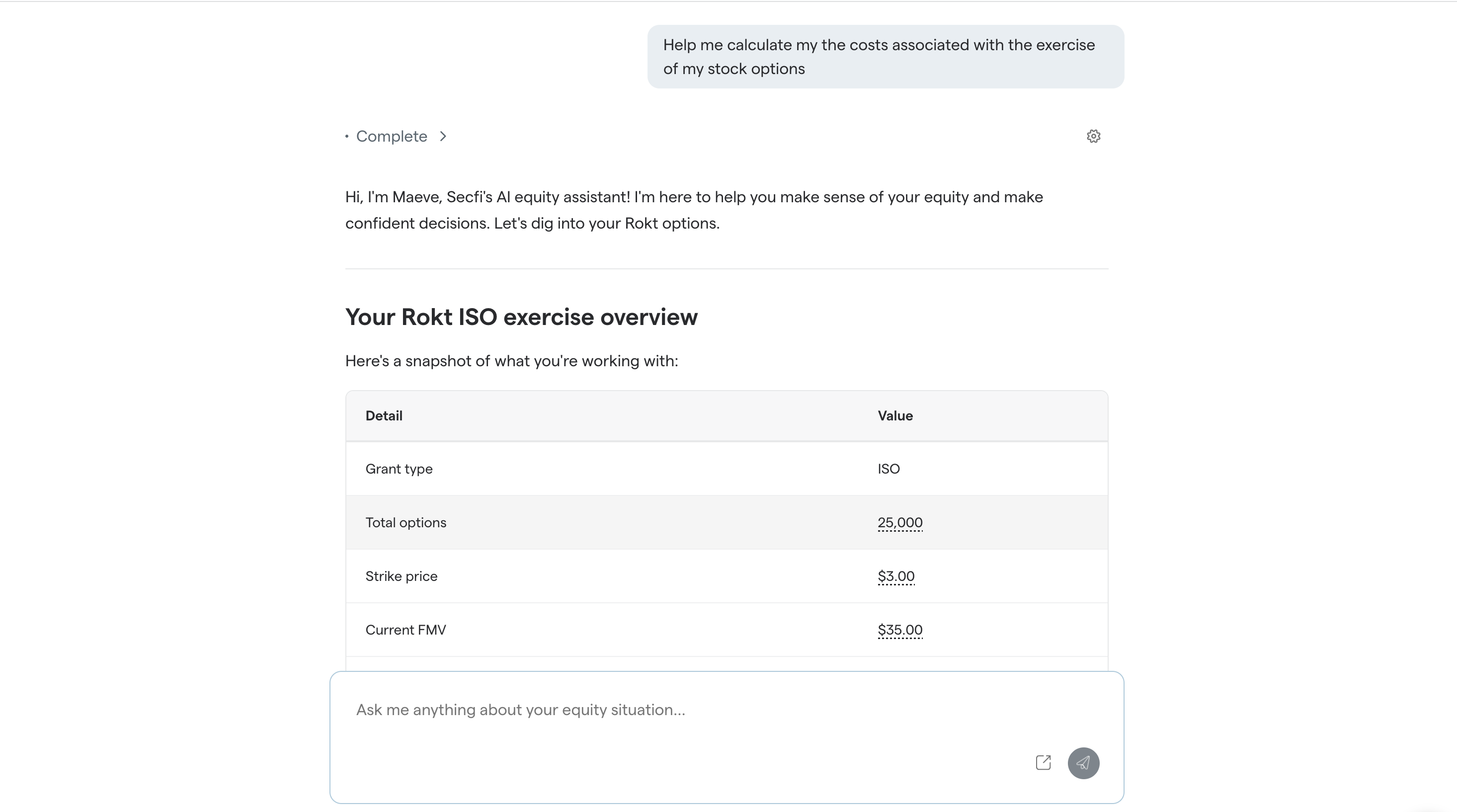
For Illustrative Purposes only. Actual results may vary and there is no guarantee of any particular result.
Learn more: Why we built Maeve.
If you decide to exercise, Secfi’s non-recourse financing doesn’t come with monthly payments. Your personal assets, such as your home or savings, aren’t ever used as collateral with our non-recourse financing.
You only pay us back if the company has a successful exit, plus a portion of what you made from those shares. If the company doesn’t successfully exit or the shares become worthless, you generally don’t have to repay the financing.
Depending on your situation, you may be able to use some of your own cash to exercise a portion of shares, and non-recourse financing for another portion of the exercise and associated taxes. This can be particularly useful during a post-termination exercise period, because you may want to preserve cash, but also want to participate in potential upside if the company looks like it will grow.
We’ve provided over $800 million in non-recourse financing to startup employees, and can usually move quickly if we’ve already assessed your company.
However, because we take on risk when we provide non-recourse financing to startup employees and executives, we usually only work with later-stage companies with valuations around $1 billion. Get started to see if non-recourse financing would be the right fit for your exercise.
Many financial advisors are very good at retirement planning and public-market investing. But they probably don’t regularly work with private-company stock options, including 409A valuations, AMT credits, and how to avoid AMT when exercising options.
That can be a problem when your post-termination exercise period is already running. You may need to make decisions quickly, including in the context of how much cash you need to keep available after leaving your job.
Secfi Wealth works specifically with startup employees and executives whose finances include private-company equity, so our advisors are used to these kinds of decisions. They have a fiduciary duty to act in your best interests and can help you look at your post-termination exercise window alongside your other financial goals.
Learn more: Stock option planning: How to avoid costly equity mistakes.
When Barry left Confluent, he had 90 days to exercise his vested stock options before losing them. Once he factored in both the exercise cost and potential tax bill, he wasn’t comfortable putting that much of his own money at risk.
“I didn’t fully understand the tax implications…That was one of the big things that was kind of an eye-opener,” he said.
Barry compared different equity financing providers and ultimately chose Secfi because everything was explained clearly, and all of his questions were answered without any pressure to make a decision.
Secfi’s financing helped him exercise before the deadline without having to fund the full amount himself. Not long after, Barry was delighted when Confluent went public, and he was able to share in its upside.
“I can’t speak highly enough [about working with Secfi]. It was just so transparent,” he said. “And there was so much information. I didn't know what I didn't know.”
Read Barry’s full story: How Barry used Secfi to afford his Confluent stock options.
Testimonials are specific to an individual Client’s experience and may not be representative of all Clients. Unless otherwise indicated, Clients offering a Testimonial do not receive compensation and their statement does not present a conflict of interest.
A post-termination exercise period can force a big equity decision into a short window, so the most important thing is to understand your deadline and the trade-offs before you act.
You can use Secfi’s free AI equity assistant, Maeve, to estimate your exercise costs and taxes, and model different scenarios. If you want help thinking through next steps, or to see if you qualify for non-recourse financing, get in touch with Secfi.
If you miss your company’s post-termination exercise deadline, your vested but unexercised options will generally expire. That means you lose the right to buy those shares at your strike price after your termination date.
This can be a painful outcome if the company later grows and has a successful IPO or acquisition. Still, exercising before the deadline isn’t automatically the right decision. You’re putting money into private-company shares that may remain illiquid for years or eventually lose value, so it’s worth considering the potential tax impact and how the exercise fits into your broader equity compensation.
You also may have more flexibility than you first assume. Depending on your grant, stock plan, and company rules, you could potentially exercise only part of your options, or get non-recourse financing from a company like Secfi if you don’t want to use your cash now.
A 10-year post-termination exercise window means you may have up to 10 years after termination of employment to exercise vested stock options, subject to the terms of your grant and company stock plan.
However, if you hold ISOs, the longer company deadline doesn’t preserve ISO tax treatment for the full 10 years. You generally need to exercise within three calendar months after employment ends to retain ISO treatment, unless an exception applies. That means the tax impact can change even though the options are still exercisable.
Often, yes. Depending on your grant, vesting schedule, and company rules, you may be able to exercise only part of your vested options rather than exercising everything at once.
That can reduce the upfront exercise cost and potential tax impact while still letting you keep some exposure to the company. Secfi’s AI equity assistant, Maeve, can help you model partial exercise scenarios and compare the potential costs and outcomes.
Usually, you keep RSUs that have already vested and forfeit any unvested RSUs when you leave, but the exact treatment depends on your company’s equity compensation plan, vesting schedule, and grant agreement.
RSUs are different from stock options because there’s generally no exercise decision. Once vested, the shares are typically delivered according to the plan terms, although taxes and company-specific rules can still affect what happens after termination of employment.
You may be able to use savings, exercise only part of your grant, take out traditional financing, or explore non-recourse financing.
For eligible employees, Secfi’s non-recourse financing can help cover the exercise price and associated taxes without requiring monthly repayments or putting unrelated personal assets on the line. This can be especially useful when a termination date creates a short window to make a decision.
Yes. Secfi can help you understand your grant details, stock plan, vesting schedule, and potential tax impact, then model exercise costs and taxes with Maeve and explore financing if cost is the main blocker.
If your deadline is approaching, it’s best to contact Secfi as early as possible. Financing can sometimes move more quickly for companies Secfi has already assessed.
The tool shown here uses artificial intelligence and is for illustrative purposes only and not necessarily indicative of future results and there is no guarantee that similar results can be achieved. The information provided by the tool is not professional advice and is not intended by Secfi, Inc., its affiliates, and Secfi representatives, to be deemed as investment, legal, tax or other professional advice or recommendations of any kind, or to form the basis of any decision to do or to refrain from doing anything. Secfi does not review the accuracy or completeness of the information provided to us within the tool.