What happens to my stock options when I’m laid off?

14 min
0 result
John’s a Director at Secfi, helping founders, executives and employees navigate equity compensation and access to liquidity through his expertise in finance.
After leaving a company, making decisions about your vested stock options might be the last thing on your mind. But the chances are you’re facing a stock option exercise window, and decisions need to be made relatively quickly.
If you’ve already been laid off, you’re probably scrambling to figure out what happens next, or maybe your instincts are kicking in because something doesn’t quite feel right at your company and you want to know what to prepare for. Whatever the case, it’s not a fun situation.
Your first questions might include:
But in the layoff scramble, make sure you carve out time to decide what you want to do about your stock options.
In this article, we’ll cover:
Secfi’s free AI equity assistant, Maeve, can help you plan and prepare for what happens to your stock options if you’re laid off.
If you worked for a publicly traded company and received restricted stock units (RSUs), there's usually very little to do after a layoff. You generally keep any shares you've already received through vesting, while your unvested RSUs are forfeited when you leave.
But if you have stock options from a pre-IPO startup, things are a little more complicated. The following apply whether you earned incentive stock options (ISOs) or non-qualified stock options (NSOs):
That means your main decision is whether to spend money exercising your remaining vested options before they expire, which isn’t an easy choice to make if you’ve just lost your main source of income.
At most startups, the post-termination exercise window is just 90 days, although some companies offer longer periods. If you miss your deadline, your vested but unexercised options generally expire, meaning you lose the right to buy those shares.
If your company has a shorter window and you need more time, you could ask your former employer for an extension. It's uncommon for companies to agree, but it may still be worth asking.
Note: If you have ISOs, federal tax rules generally require you to exercise within three months of leaving your job to retain their favorable tax treatment. Three months isn't always exactly 90 days, so make sure you confirm the specific dates to avoid a potentially expensive mistake. If you exercise after that, your options are generally taxed as NSOs, even if your company's exercise window is still open.
If you’re holding vested stock options and facing a layoff, this is what to consider doing:
Once you’ve confirmed your exercise timelines, figure out how much it would cost to exercise your vested stock options. Start by multiplying the number of options you want to exercise by your strike price.
You'll also need to account for any potential taxes, which depend on the type of options you hold:
Taxes can get expensive quickly, we’ve seen cases where the total exercise price ends up being more than 8 times what was originally expected. In our article about “the surprise factor”, we share an example where someone might pay around $73,000 to exercise their shares but over $500,000 in taxes.
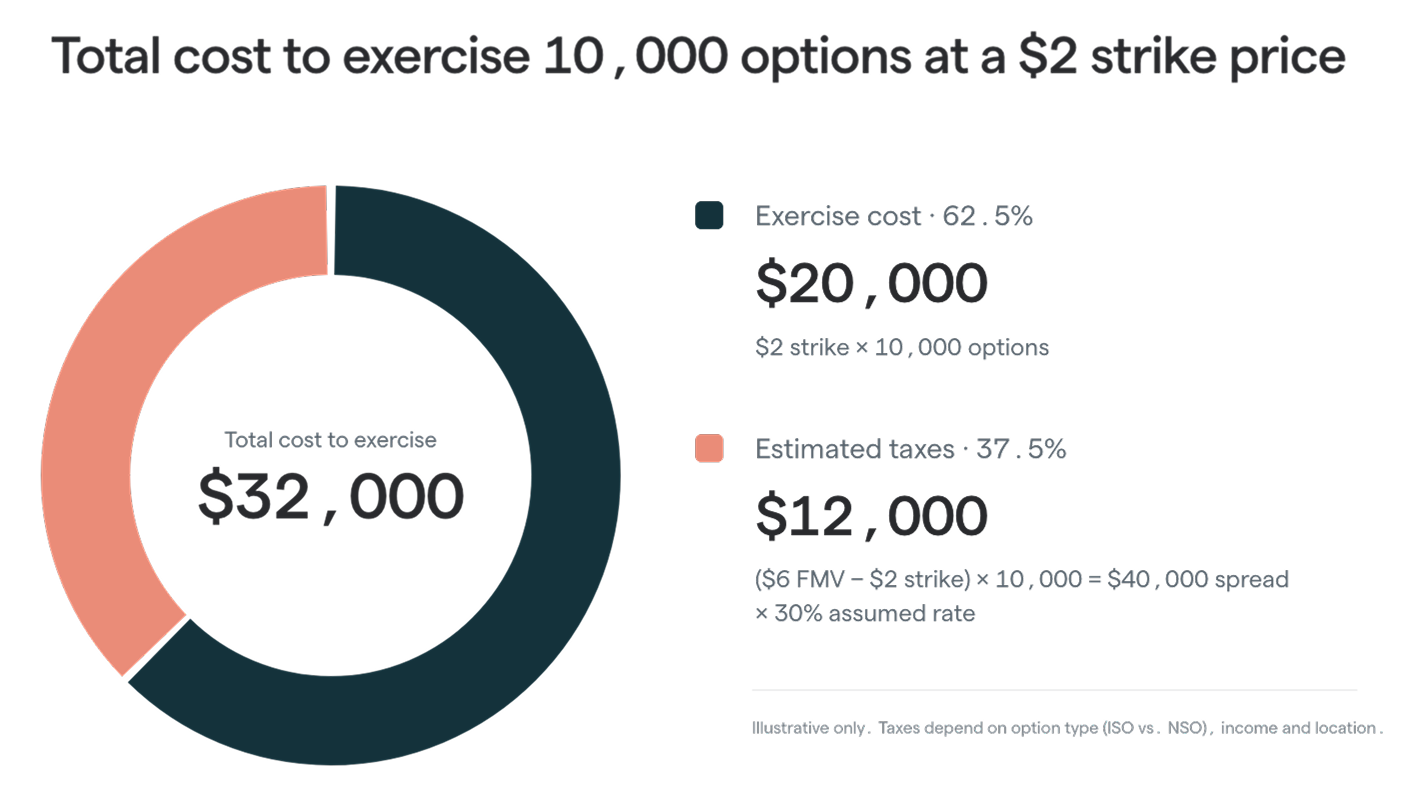
For illustrative purposes only. Actual results may vary, and there is no guarantee of any particular outcome.
Tax calculations get complicated quickly, so instead of doing them on the back of an envelope, try using our free AI equity assistant Maeve for your first pass. Maeve was developed by our team at Secfi, where we help startup employees and executives understand and act on their equity. If you prefer to discuss with a human, our financial advisors specialize in equity like yours.
For illustrative purposes only. Actual results may vary, and there is no guarantee of any particular outcome.
Once you know the potential costs, consider whether exercising makes sense for your financial situation, especially now that you've lost your regular income.
Exercising means investing your money in private-company shares that you may not be able to sell for years. And there's no guarantee that your company will eventually have a successful IPO or acquisition.
But if your company does grow and eventually has a successful exit, the shares you exercised could become worth significantly more than you paid for them.
A few factors worth considering include:
Remember, exercising doesn't have to be an all-or-nothing decision. You can exercise some, all, or none of your vested options, depending on what you're comfortable spending and the risk you're willing to take.
Even if you decide exercising makes financial sense, you'll need to figure out how to pay for it. And if you've just been laid off, it makes sense to be cautious about spending your savings while looking for a new job.
You could use your own cash, take out a traditional loan, or explore non-recourse financing. Each comes with trade-offs. Using cash reduces your financial cushion, while traditional loans generally require repayment regardless of what happens to your company. Non-recourse financing can help you cover the upfront costs without putting your other personal assets at risk, although eligibility is selective and financing typically comes with fees.
Secfi was founded by startup employees who had to leave their previous companies without exercising their equity because they couldn’t fully afford (or understand how) to do it.
If you’ve been laid off and need help ASAP, or if you’re just concerned because of other layoffs you’ve seen in the sector, there’s a lot you can do to put yourself in a more confident position.
Here’s why employees at companies including Anthropic, Canva, and Reddit use Secfi for their equity.
Secfi's AI equity assistant, Maeve, can help you understand the financial implications of exercising your stock options before your post-termination deadline.
Unlike general-purpose LLMs such as ChatGPT, Maeve connects to your equity grants and tax profile and uses Secfi's proprietary financial calculation engines. That means you can model potential outcomes based on your specific circumstances, and you’ll get more consistent answers than standard predictive-text calculations.
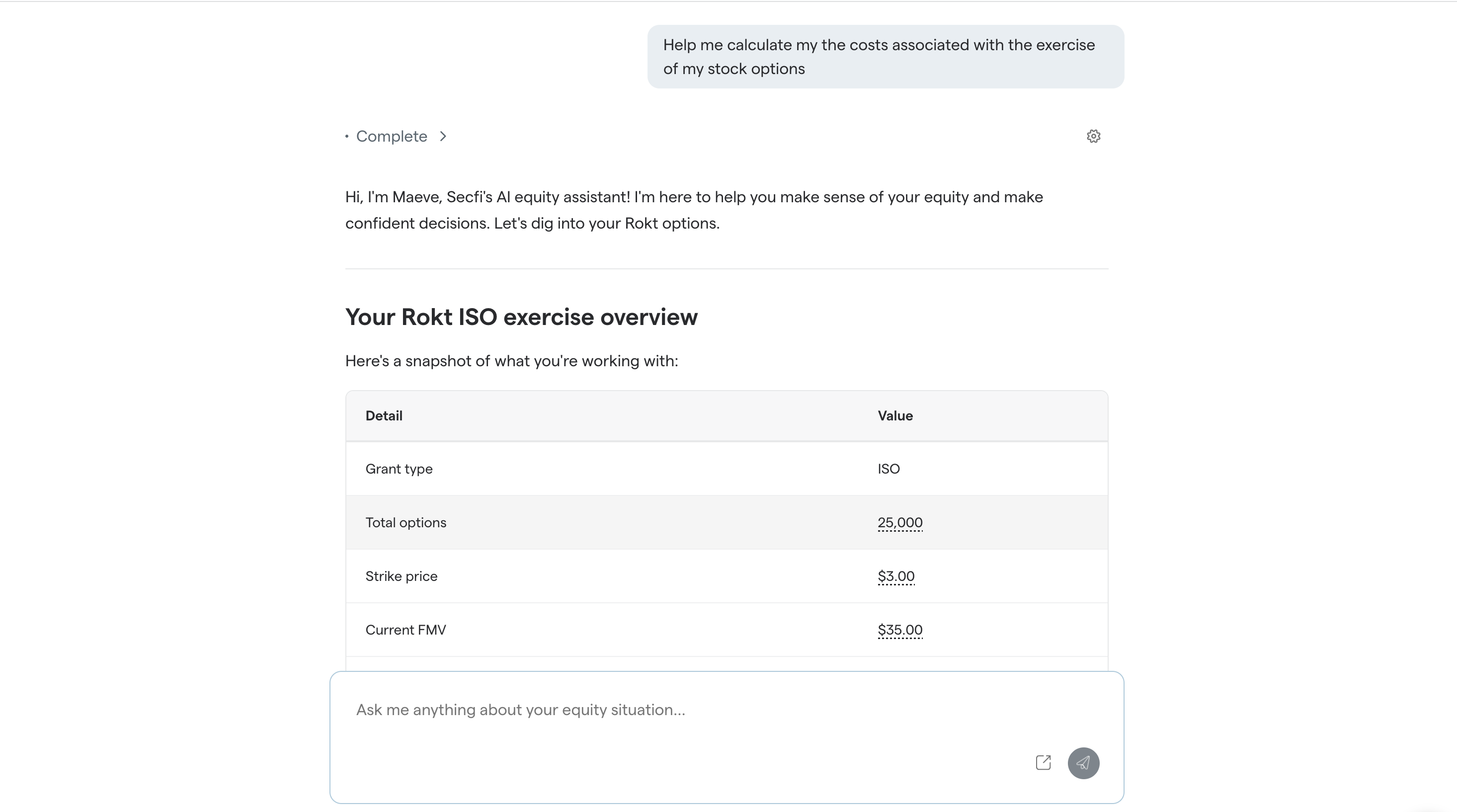
For illustrative purposes only. Actual results may vary, and there is no guarantee of any particular outcome.
Connect your Carta account, upload your grant documents, or enter your equity details manually, and Maeve can help you:
Maeve also lets you check the assumptions behind its calculations, so you can better understand where the numbers come from before making a decision.
And if you'd rather use ChatGPT, Secfi now offers a Model Context Protocol (MCP) integration that lets you connect your Secfi account and access your equity information and Secfi's calculation tools directly within your AI assistant. Simply ask to "Connect my Secfi account" and follow the authentication steps.
For illustrative purposes only. Actual results may vary, and there is no guarantee of any particular outcome.
If you want to exercise your vested stock options but can't afford the upfront costs, or would rather preserve your savings while looking for a new job, Secfi's non-recourse financing may be an option.
For eligible employees, Secfi can cover the cost of exercising your options and associated taxes while you retain ownership of your shares. There's no repayment until a qualifying liquidity event, such as an IPO or acquisition, under the financing terms. If your company never exits, you generally won't have to repay the financing, and your other personal assets aren't at risk.
Financing is subject to eligibility requirements, including your company's financial outlook, and isn't available to everyone. If you're approaching the point where you’ve left your company and are facing a 90-day exercise deadline, it's worth checking your eligibility as early as possible to allow time for approval and paperwork. If your company has already been approved, in some cases we can move quickly even if you have a limited time to exercise.
As of July 2026, we’ve provided over $800 million in this type of financing. And if you’ve already purchased shares and just want to sell them, we offer secondary sale support where eligible.
Deciding whether to exercise stock options can be especially difficult when you've just lost your regular income.
Secfi Wealth has financial advisors who specialize in private-company equity and can help you evaluate your options alongside your broader financial situation.
For example, an advisor can help you assess how much you can afford to spend on exercising, understand the potential tax consequences, and decide whether exercising all, some, or none of your options makes sense given your financial goals.
When Joe was laid off from his role as a technical trainer at Confluent, he had just 90 days to exercise his vested stock options before they expired.
Joe believed in Confluent's future, but exercising meant selling a significant portion of his personal investments to cover the exercise costs and potential taxes. With his next job still uncertain, he wasn't comfortable taking that financial risk.
"I wasn't willing to sell those assets when I didn't know what my next position would be," he said.
Instead, Joe turned to Secfi's non-recourse financing to cover his exercise costs without using his savings. This allowed him to retain ownership of his shares and participate in any potential future upside.
Confluent went public in 2021, and Joe benefited from having exercised his options. He’s since been able to pursue investment opportunities and work with a financial advisor to diversify his portfolio.
Read the full story: Why Joe financed his stock options after leaving Confluent.
This case study is an illustration of our capabilities provided to an individual client. Client results may vary, and there can be no guarantee of similar results. It is not known whether the client approves or disapproves of Secfi Advisory Limited or its affiliates as a whole. Unless otherwise indicated, Clients offering a Testimonial do not receive compensation and their statement does not present a conflict of interest.
Getting laid off doesn't necessarily mean losing your stock options. But with a limited exercise window, you'll need to decide whether buying your vested shares makes financial sense, especially when you're between jobs.
If you're unsure what to do with your stock options after being laid off, Secfi can help you understand your potential costs, compare exercise scenarios, and explore financing options if you're eligible.
Get in touch with Secfi to discuss your equity and see what options may be available before your exercise deadline.
The $100,000 rule is an IRS limit on incentive stock options (ISOs). It means the total grant-date fair market value of shares that first become exercisable as ISOs in a calendar year cannot exceed $100,000. Any amount above that limit is generally treated as non-qualified stock options (NSOs) for tax purposes. We share more about it in Secfi’s article: What is the $100k rule? A guide to the ISO/NSO split.
After termination, you generally forfeit your unvested stock options and have a limited window, often 90 days, to exercise your vested options before they expire. Your exact deadline depends on your company's equity plan.
Secfi's AI equity assistant, Maeve, can help you estimate exercise costs and potential taxes before your deadline. If you're worried about using your savings, Secfi also offers non-recourse financing to eligible employees.
If your company is acquired, your stock options may be cashed out, converted into options in the acquiring company, or canceled, depending on the acquisition agreement. Unvested options may also be accelerated, allowing you to exercise them earlier than originally scheduled. However, a buyout doesn't guarantee a payout, especially if your options are underwater or investors receive priority in the distribution of proceeds. Read Secfi’s article for guidance: What happens when my startup gets acquired? What should I do with my stock options?
The tool shown here uses artificial intelligence and is for illustrative purposes only and not necessarily indicative of future results, and there is no guarantee that similar results can be achieved. The information provided by the tool is not professional advice and is not intended by Secfi, Inc., its affiliates, and Secfi representatives, to be deemed as investment, legal, tax, or other professional advice or recommendations of any kind, or to form the basis of any decision to do or to refrain from doing anything. Secfi does not review the accuracy or completeness of the information provided to us within the tool.