Anthropic IPO: What employees should know about exercising stock options before going public

23 min
0 result
San Francisco native (yes, really). @uw and Lowell High alum. I like to nerd out on fintech, stock options and taxes.
Anthropic IPO: What employees should know about exercising stock options before going public
After filing a draft S-1 registration statement with the SEC in June, Anthropic made its long-awaited S-1 public on October 26, 2026. Anthropic will price its IPO on Wednesday, November 18, and begin trading under “ANT” on Thursday, November 19.
If you work at Anthropic, the excitement may come with a fair amount of anxiety. Colleagues are comparing notes, friends and family might suddenly be half-jokingly asking when they can borrow some cash, and you may be wondering: What if I make the wrong decision now and kick myself for it later?
This is a concern we often see around IPOs for late-stage startups. Many of our clients tell us they wish they’d taken action sooner, for a better chance at taking home more and managing their tax burden.
Luckily, you don’t need to know the exact price or date of your IPO to be prepared. In fact, the period before those details are public is often more important when it comes to exercising and tax decisions.
You might decide to exercise all or part of your options before the IPO, or deliberately wait. You might fund the exercise yourself or, if you qualify, use non-recourse financing to help cover exercise and associated tax costs without putting personal assets on the line.
To help you make that choice, this article will cover:
If you’re an employee or executive waiting for news of the Anthropic IPO, or any other startup, try our free AI equity assistant Maeve to model different scenarios for your stock options. Also available as an MCP as a connector for Claude or a plugin for ChatGPT.
The main questions we see from people at pre-IPO companies are: how can I keep more of the potential upside, reduce taxes, avoid losing my equity, and limit how much personal cash I need to put in?
The easiest way to answer these questions is to put real numbers behind them.
To see how much exercise timing could affect an Anthropic employee’s outcome, let’s look at a hypothetical employee named Chloe. She lives in California and joined Anthropic in late 2023 with 200,000 ISOs at a strike price of $1.08 per share.
Anthropic’s 409A as of July puts the stock at about $58 per share. Three years in, 75% of her grant has vested, or 150,000 options, worth about $8.5M. For the scenarios below, we’ll assume Anthropic trades at $100 a share when Chloe sells. All figures reflect Anthropic’s 10-for-1 stock split in September 2026.
We’ll compare a few paths Chloe could have gone down:
In October, and with the IPO quickly approaching, Chloe believed in where Anthropic was headed and decided to exercise before the company went public, a first step toward turning her paper wealth into something real.
Exercising all 150,000 vested options meant sending $162k to Anthropic, with the IRS and California cutting in at about $3M through AMT, roughly $3.1M in all. While that’s a big tax bill, much of the AMT could come back as a credit in the year of sale.
By exercising earlier, Chloe was essentially paying for time. Given it’s been more than two years since her grant date, the purpose of exercising pre-IPO was to start her one-year clock, so shares sold from November 2027 onward will qualify for long-term capital gains on the entire gain above her $1.08 strike price.
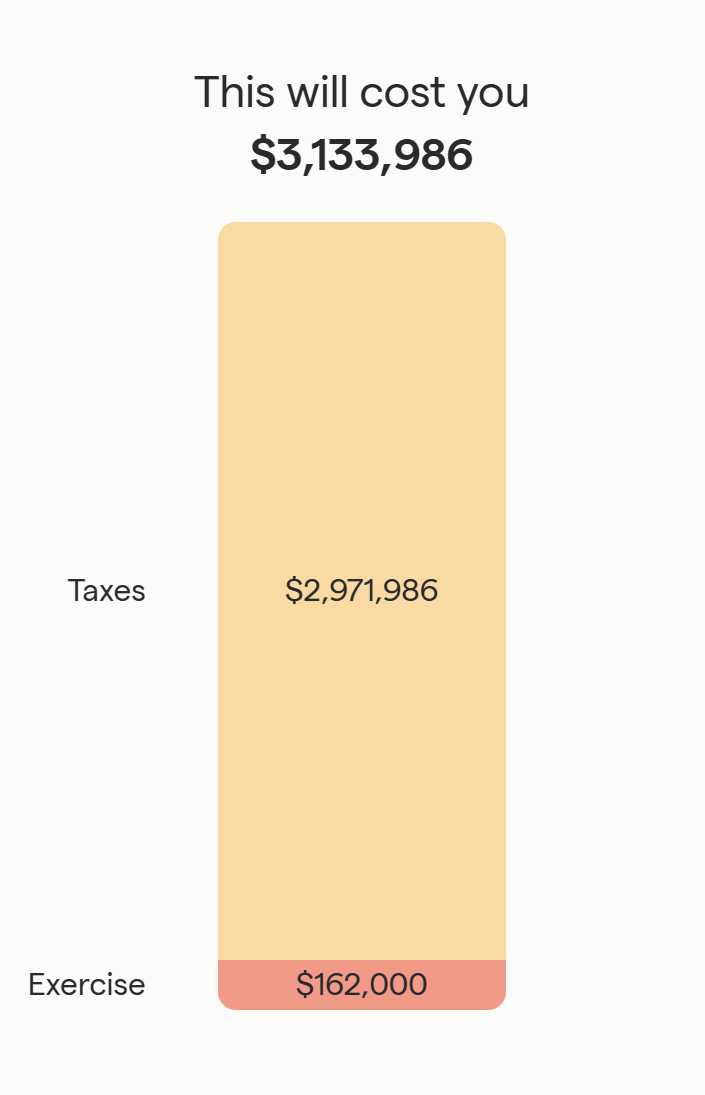
For illustrative purposes only. Actual results may vary, and there is no guarantee of any particular outcome. Assumptions: CA resident, single, $300k base income, post-split figures.
Let’s say Chloe decided to hold off. A company’s 409A rarely stays idle as an IPO gets closer. With a listing on the way, the 409A started climbing toward where Anthropic expects its shares to trade publicly. Here we assume Anthropic’s 409A rose to $85 per share, although this is an illustrative number.
Patience is typically rewarded in stressful decision-making, but in this example, Chloe was penalized with the same strike price and a much larger spread, meaning more AMT. With an exercise cost of $162k and about $4.4M in AMT, her total cost to exercise comes out to about $4.6M, roughly $1.4M-$1.5M more for the same exact shares, just weeks apart.
If Anthropic’s share price holds, she ends up with the same net gain as in path 1. She just has to put up more cash to get there.
Just a few weeks' difference could also rob Chloe of the ability to decide for herself whether to exercise or keep holding off. If a pre-IPO blackout period kicked in, her window to exercise could close entirely. And even if she could still exercise, the higher 409A means more AMT, which could stay tied up in credits for years if Anthropic’s share price falls.
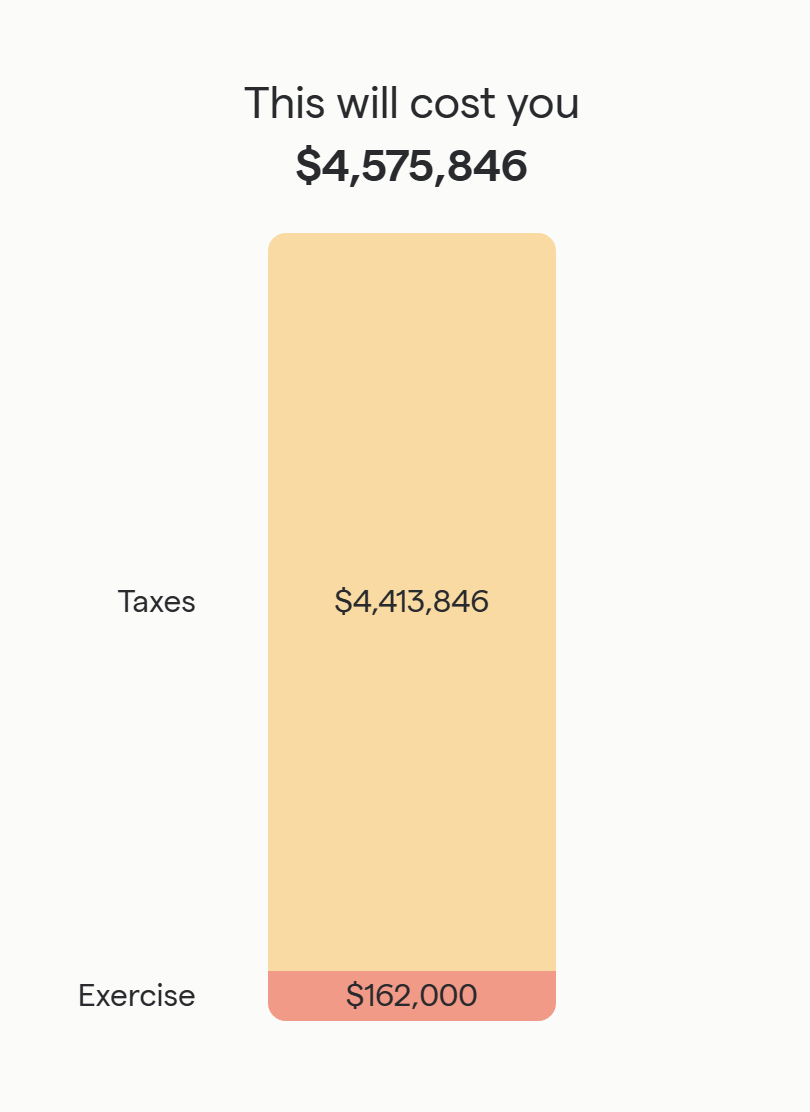
For illustrative purposes only. Actual results may vary, and there is no guarantee of any particular outcome. Assumptions: CA resident, single, $300k base income, post-split figures.
This time Chloe doesn’t want to deal with exercise costs, AMT, or holding periods, and wants to touch her options as little as possible. Here, she chooses a cashless exercise after the IPO, effectively exercising and selling the same day.
But keeping things simple is expensive. Every dollar of Chloe’s gain above the strike is taxed as ordinary income, about 52% between federal and California, instead of about 37% at long-term capital gains rates.
Assuming Anthropic trades at $100 when her lock-up ends, Chloe has to send Uncle Sam and the state of California about $7.8M in tax and gets to put about $7M in her pocket.
If Chloe had exercised early and sold at the same $100 share price, the same shares would have left her with about $9.4M, roughly $2.4M more. That’s about 1,000 years of Claude Max 20x or over 100,000 Waymo rides in San Francisco.
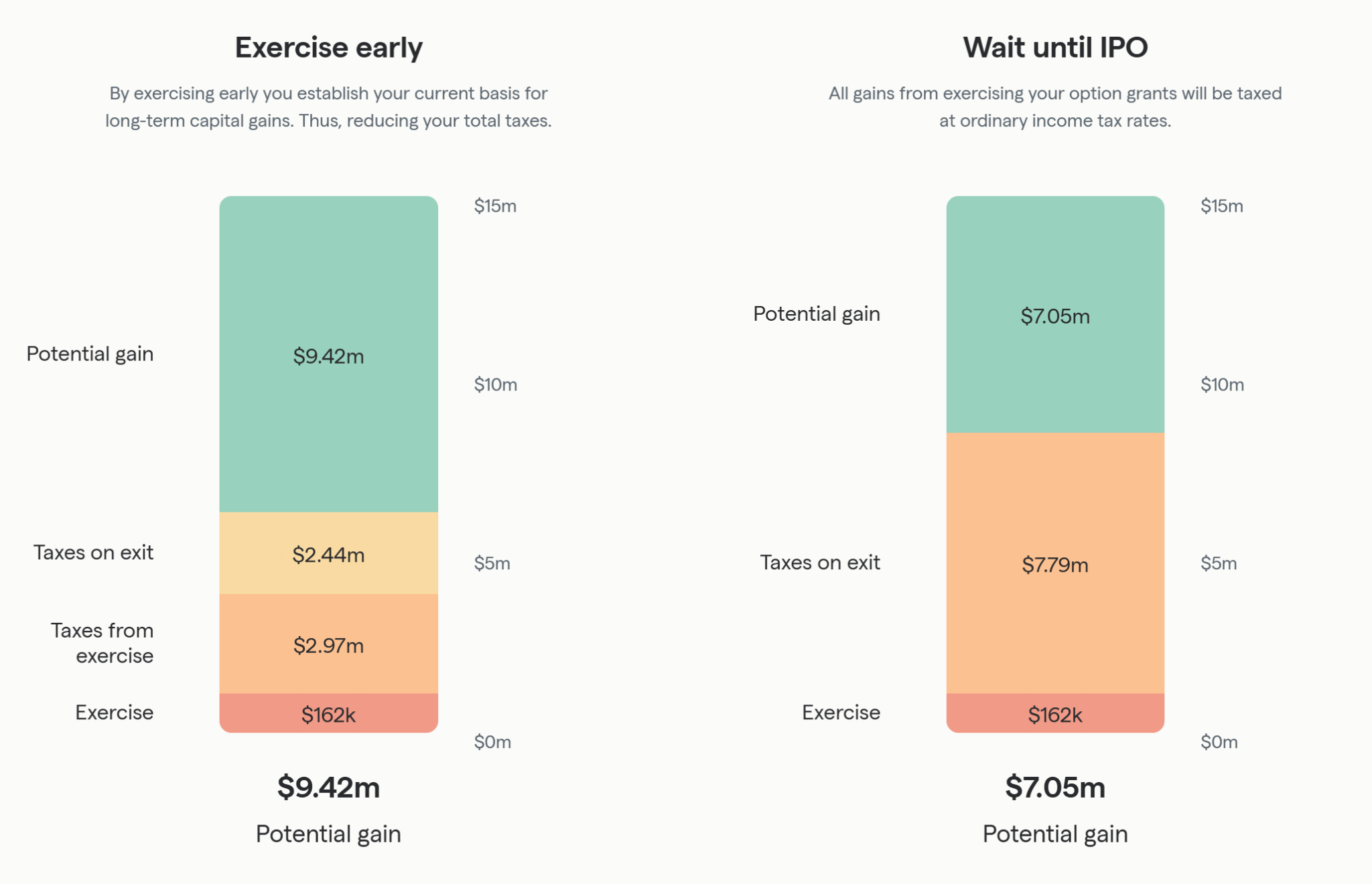
For illustrative purposes only. Actual results may vary, and there is no guarantee of any particular outcome. Assumptions: CA resident, single, $300k base income, post-split figures, $100 sale price, AMT credit assumed fully recovered at sale.
Lastly, what if Anthropic goes on a bull run? For fun, let’s take a look at a final scenario where Anthropic trades at $200 instead of $100.
Say Chloe exercised early at the $58 409A and holds onto her shares. Fast-forward over a year, and Anthropic has beaten IPO expectations and trades at $200. Now picture the version of Chloe who waited and did a cashless exercise after the IPO at the same $200. Exercising early leaves her with about $19M, compared with about $14M going cashless, a difference of about $5M. That gap comes almost entirely from her total tax bill: about $10.9M if she exercises early versus about $15.7M if she waits.
Chloe’s story shows something that holds as the price climbs: the higher Anthropic’s share price goes, the wider the gap between Chloe’s potential gains from exercising early and waiting until after the IPO.
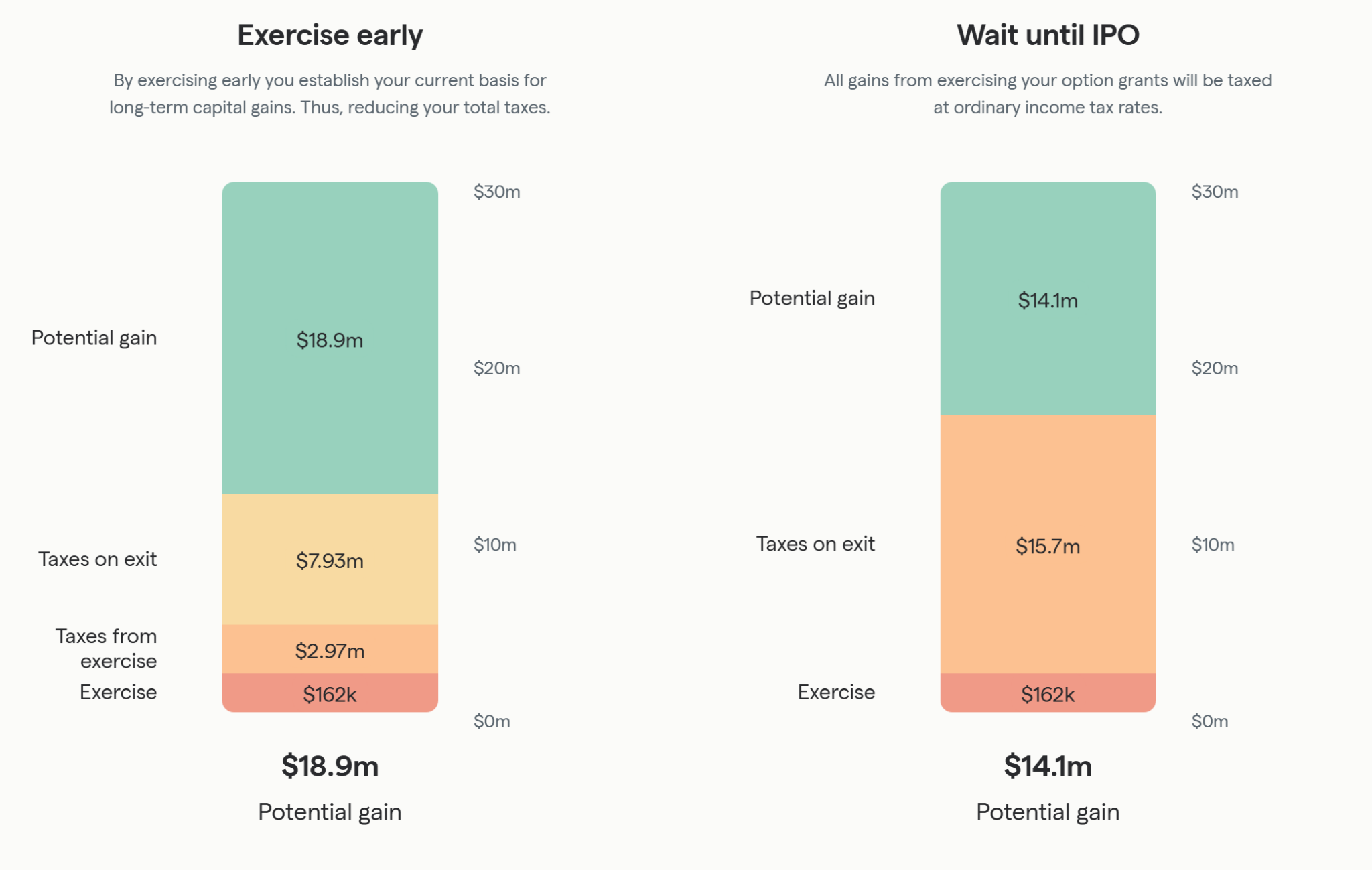
For illustrative purposes only. Actual results may vary, and there is no guarantee of any particular outcome. Assumptions: CA resident, single, $300k base income, post-split figures, $200 sale price, AMT credit assumed fully recovered at sale.
There are many things to take away from these scenarios, but first and foremost, Chloe is in a fantastically fortunate position. Yes, she has some difficult choices to make, but each of these is a great outcome. The question isn’t what Chloe should do to succeed; it’s what can she do to maximize her opportunities?
Exercising pre-IPO cost her about $3.1M up front but left her about $2.4M better off at an exit of $100, and about $5M better off at $200. Why? Taxes. Exercising earlier lets the whole gain qualify for long-term capital gains at about 37%, instead of 52% at her ordinary income rate.
This is a $3.1M check for an asset she cannot readily sell. Chloe’s AMT is due with estimated tax payments in January and when she files in April, before her lock-up fully lifts. Selling shares early to cover it would cost those shares their long-term capital gains rate. If the share price drops, she has prepaid tax on gains that may not exist. On top of this, much of her wealth is already tied to Anthropic through her job and unvested equity.
So what should Chloe do? That’s only for her to decide. And although each path has a price, with the right information, we can do our best to compare payoffs.
Exercising before an IPO starts the clock toward more favorable tax treatment and could reduce your ultimate tax bill. But in some cases, the upfront cost and risk of putting more money into an illiquid private company may outweigh those potential benefits.
There isn’t one right answer for every employee. Treat any exercise like an investment decision: you’re allocating a portion of your portfolio to a private company, so weigh how much you’re comfortable putting in and think through different exit scenarios. You also don’t have to go all in. You can just exercise part of your grant.
And don’t count on exercising the week before the IPO. Many companies impose blackout periods around a listing, temporarily blocking exercises and trades. Check your plan documents and employee communications so you know when your window might close.
Here are some factors to look at first.
Start with the most concrete number: how much cash you need to buy your options. Your basic exercise cost is your strike price multiplied by the number of options you exercise.
Let’s use a simple example, but remember to check with a tax professional about your own situation.
If you have 20,000 vested options with a $5 strike price, exercising all of them would cost $100,000.
That number won’t change just because Anthropic’s valuation increases. Your strike price is set when the grant is issued.
But buying your shares is only one part of the potential cost.
This is where the numbers can get much more complicated, and painful. We call this the “surprise factor” because many startup employees and executives end up looking at total exercise costs that are up to 8 to 10 times what they initially expected.
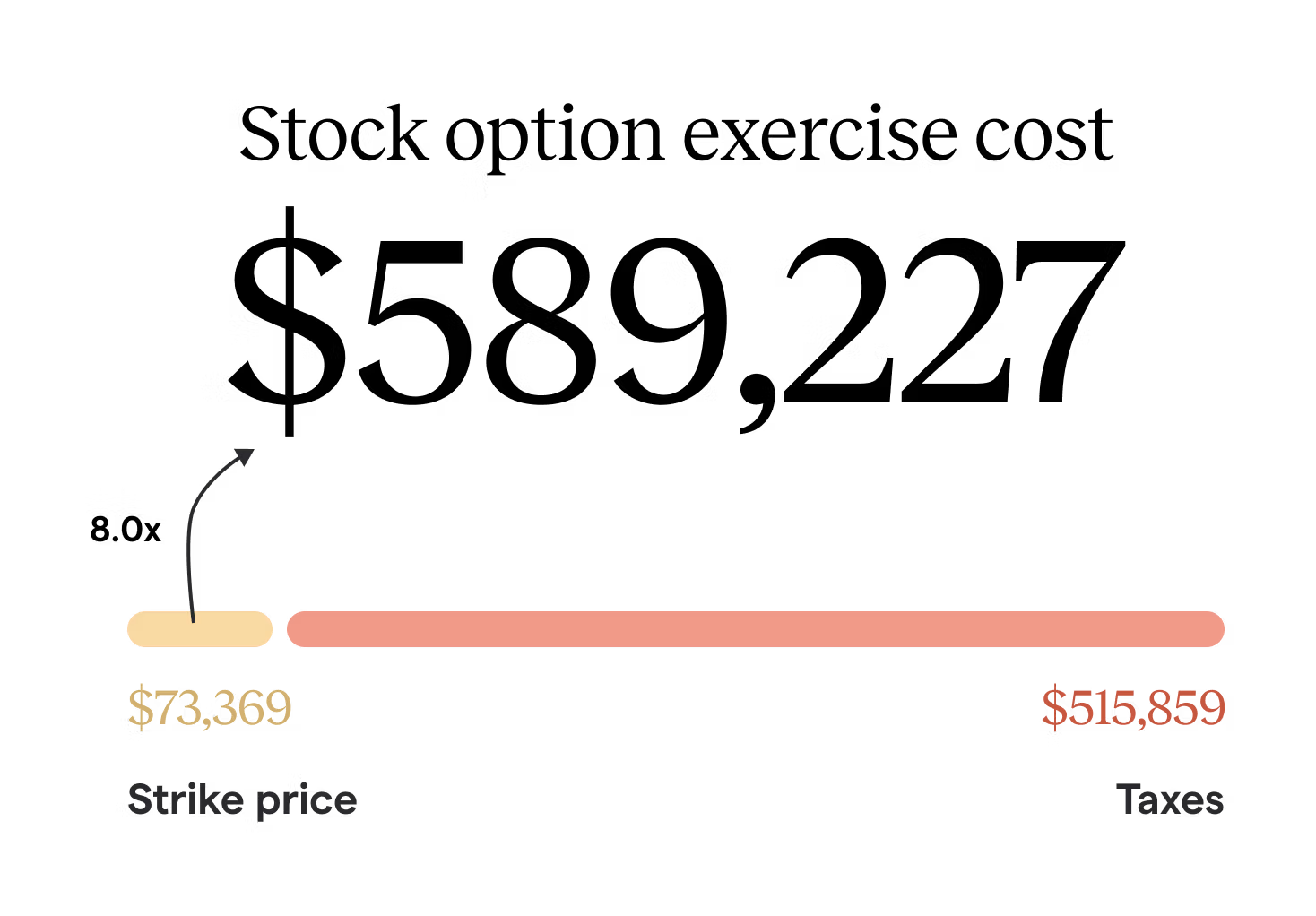
For illustrative purposes only. Actual results may vary, and there is no guarantee of any particular outcome.
With incentive stock options (ISOs), exercising and holding the shares can increase your alternative minimum tax (AMT) liability.
AMT is a separate tax system designed to ensure high earners pay enough in taxes. Each year, you calculate your tax liability under both the regular tax system and the AMT system, then generally pay whichever amount is higher. AMT is calculated partly using the difference between your strike price and the fair market value of the shares when you exercise ISOs. This is called the spread.
If Anthropic’s 409A valuation has risen since your initial options grant, that spread will have grown too, and a bigger spread usually means a bigger tax bill when you exercise.
Continuing the earlier example, imagine your strike price is $5. If the current 409A value is $20, the spread is $15 per share. If the 409A later rises to $50, the spread becomes $45.
That larger spread can mean significantly more AMT, even though your original $5 strike price hasn’t changed.
Waiting therefore isn’t always neutral. The exercise itself costs the same, but the tax bill could become much larger if Anthropic’s fair market value continues to rise. The trade-off is taking on that investment risk sooner: your money is tied up in private market shares until you have a chance to sell, and their eventual value isn’t guaranteed. There is also, of course, the opportunity cost of having your money elsewhere.
Note that if you hold non-qualified stock options (NSOs) instead, the spread between your strike price and the fair market value at exercise is generally taxed as ordinary income which is a generally higher rate than AMT. So the timing still matters even though the tax mechanics are different.
If you’re thinking about exercising before an IPO, it helps to understand what happens when you eventually sell those shares.
There can be a potential tax benefit to exercising sooner. If you exercise ISOs and meet the relevant holding-period requirements (usually one year from exercise and two from grant) before eventually selling your shares, your gain will qualify for long-term capital gains treatment rather than higher ordinary income tax rates.
For NSOs, the spread at exercise is generally taxed as ordinary income. Any additional gain above the 409A at exercise is generally capital gain, and holding the shares for more than one year after exercise may allow that post-exercise gain to qualify for long-term capital gains treatment.
Exercising earlier can start that holding period sooner.
It’s also worth knowing that if you do pay AMT after exercising ISOs, you might generate an AMT credit that can reduce your tax bill in future years. You can generally use the credit when your regular tax liability is higher than your AMT liability, so recovering it is dependent on the sale price of the shares and may take years if you don’t sell or the value goes down.
A future liquidity event, such as selling shares after an IPO, could create a larger regular tax bill and allow you to use more of that accumulated credit. Any unused credit can generally carry forward to future years.
Modeling this yourself with spreadsheets and LLMs is tempting, but it’s extremely easy to make mistakes or forget to add important context. That’s why we built our AI equity assistant Maeve, which is also available as a connector in Claude. You can upload or connect your equity and tax details and immediately ask it questions based on our tax and equity calculators.
For illustrative purposes only. Actual results may vary, and there is no guarantee of any particular outcome.
Part of the decision is estimating what your shares could eventually be worth. For Anthropic employees, if your shares go public at a higher valuation, exercising before the IPO may reduce your eventual tax bill if the shares appreciate and you meet holding periods, but it also requires cash, may trigger AMT, and carries the risk that the shares lose value.
But an IPO doesn’t necessarily mean you can sell immediately. IPOs commonly include lock-up periods that prevent existing shareholders from selling for a set period, often around 90 to 180 days. For instance, Anthropic’s amended S-1, filed November 2, 2026, proposes a different lock-up approach.
Instead of one release date, it is split into a staggered, yearlong schedule with more than 20 separate unlock windows. The schedule works roughly like this:
If you work at Anthropic, check your own lock-up agreement or equity plan documents to see which group you fall into. The right to sell in an early window doesn’t mean you have to use it, and company trading windows and insider trading policies can still limit when you’re able to sell.
During this time, the public share price can move in either direction. A strong IPO price doesn’t guarantee your shares will still be worth that amount when you’re first allowed to sell.
That’s why it helps to model several outcomes versus anchoring your plan to one expected IPO price. You could compare what your exercised shares might be worth at different post-IPO prices, then look at the estimated after-tax proceeds under each scenario.
You also need to decide how much company-specific risk you’re comfortable taking. If you work at Anthropic, your salary and unvested equity are already tied to the company, then exercising a large grant ties even more of your net worth to that one bet. Concentration is often how employees build wealth, diversifying is usually how they keep it.
If you work at Anthropic or another private company that appears to be moving toward an IPO, this is a good time to get your equity plans in order while you still have several paths available.
Our founders started Secfi because they didn’t fully understand the tax implications of their own options, and so couldn’t afford to exercise them. That’s exactly the situation we want to help you avoid.
As of July 2026, we’ve helped more than 62,000 employees and executives with startup equity understand and act on their options. Here’s how we’ve helped employees and executives at SpaceX and Canva around IPOs.
Our free AI equity assistant, Maeve, can connect directly to your equity information through Carta or with any other information you provide. Get started right away and ask questions like:
If you work at Anthropic, you probably don’t need someone to explain the difference between predictive text and calculations. But it’s worth noting that Maeve was built using Secfi’s tax and equity calculators, using Anthropic's AI model as our foundation.
Maeve lets you check assumptions so you can find out what’s behind every calculation, and connects to secondary market data to give you a sense of what your options could be worth.
For illustrative purposes only. Actual results may vary, and there is no guarantee of any particular outcome.
If you want to exercise your stock options, cash might be the biggest obstacle. As an IPO gets closer, timing can add extra pressure if you’re trying to come up with enough money to pay the full cost. You may want to exercise before a higher 409A valuation increases the potential tax cost, and company blackout periods or other IPO-related restrictions could narrow the window further.
In some cases, buying the options plus paying potential AMT would require hundreds of thousands of dollars. Even if you technically have that money, you may not want to move such a large portion of your savings into shares while your salary and unvested equity are already tied to the same company.
For employees who qualify, Secfi’s non-recourse financing can cover the cost of exercising stock options and associated taxes, including potential AMT. You retain ownership of the shares instead of selling them to fund the exercise.
Unlike traditional personal debt, there are no monthly repayments. If your company later has a qualifying liquidity event, such as an IPO or acquisition, you repay the amount financed according to the terms of your agreement, including the applicable fees. If there is no successful exit, you don’t repay the advance, and Secfi can’t pursue your savings or other personal assets.
That downside protection is why Secfi is selective and generally focuses on later-stage private companies with a clearer potential path to liquidity. An employee at a company like Anthropic may fit the type of situation Secfi evaluates more closely than someone holding options in a very early-stage startup, although eligibility always depends on the individual transaction. The good news is that in some cases with pre-approved companies, this can move very quickly if you have a tight timeline.
Learn more about how Secfi’s non-recourse financing works.
At a certain point, running the numbers yourself or with your trusty AI assistant may not be enough.
An IPO could affect far more than the tax attached to one option exercise. You may need to decide how concentrated you want your wealth to be in your company, whether exercising affects plans to buy a home, and what you eventually want to do with the shares after a liquidity event.
This is familiar territory for Secfi’s financial advisors. We regularly work with employees and executives who are dealing with IPOs and other situations specific to working at a startup. Instead of spending the first half of a meeting explaining Anthropic’s IPO, you can spend it working through your questions and figure out what you can afford to do, and when, in relation to your full financial picture.
Secfi’s Wealth team doesn’t work on commissions, and they have a fiduciary duty to advise in your best financial interests.
If you work at Anthropic, or another company approaching an IPO, there’s a lot you still can’t know yet: the exact IPO date, eventual share price, or how the market will react once the company goes public.
But you can understand what you own and how different choices could affect your eventual outcome. That preparation can make a big difference, no matter what the headlines say.
Start by using Maeve or our Claude connector to model different exercise and IPO scenarios with your equity details. If the numbers are significant or the decision affects your wider financial plan, you can also speak with our team about financial advising or non-recourse financing.
Anthropic confidentially submitted a draft S-1 on June 1, 2026, and publicly filed its S-1 on October 26, 2026, planning a Nasdaq listing as ANT. The amended filing offers 825 million shares at $70 to $78 per share.
Anthropic will price its IPO on Wednesday, November 18, and begin trading under “ANT” on Thursday, November 19.
Anthropic is still privately held, so you can’t currently buy its shares through a normal public brokerage account. Accredited investors may sometimes be able to access pre-IPO shares through private secondary markets, subject to share availability and Anthropic’s approval of the transaction.
Once the initial public offering is completed, public investors may be able to buy Anthropic shares through the public market.
Your stock options generally don’t disappear when Anthropic goes public. Vested options can typically still be exercised according to the terms of your grant, while shares you already own may become publicly traded after any applicable IPO lock-up or trading restrictions expire.
The IPO can change the tax and liquidity calculation, though. Once shares are publicly traded, employees may have more ways to fund an exercise or sell shares, but waiting can also mean a larger spread between your strike price and fair market value. That’s why Secfi recommends comparing the pre-IPO and post-IPO scenarios rather than assuming the IPO itself solves the decision.
Anthropic’s private valuation has risen rapidly alongside its revenue growth. In May 2026, Reuters reported that Anthropic raised $65 billion in a Series H funding round at a $965 billion valuation, with an annualized revenue run rate of roughly $47 billion at the time. By July, Reuters reported that Anthropic’s annualized revenue had crossed $65 billion.
The IPO puts a public-market number on it for the first time. In its amended S-1, Anthropic said it will offer 825 million shares at $70 to $78 per share, which would give it a market valuation of $1.3 trillion to $1.45 trillion.
The tool shown here uses artificial intelligence and is for illustrative purposes only and not necessarily indicative of future results, and there is no guarantee that similar results can be achieved. The information provided by the tool is not professional advice and is not intended by Secfi, Inc., its affiliates, and Secfi representatives, to be deemed as investment, legal, tax, or other professional advice or recommendations of any kind, or to form the basis of any decision to do or to refrain from doing anything. Secfi does not review the accuracy or completeness of the information provided to us within the tool.