Pre-IPO advisory services: Equity planning for employees and executives

18 min
0 result
John’s a Director at Secfi, helping founders, executives and employees navigate equity compensation and access to liquidity through his expertise in finance.
If you're a startup employee with stock options and your company is heading toward an IPO, you could be looking at once-in-a-lifetime wealth. Naturally, you want to play your cards right. But finding pre-IPO advisory services that help employees and shareholders prepare can be surprisingly difficult.
There's a lot of pressure when making equity decisions. Exercise too soon, and you could tie up your savings in shares you can't sell. Wait too long, and you could face a much bigger tax bill or miss an important deadline. But many traditional financial advisors have limited experience with private-company equity.
And if you're an employer, most pre-IPO advisory services focus on preparing companies to go public. Though you probably also want your employees to make the most of their equity, your HR and finance teams generally aren't able to provide individualized financial advice.
Specialist pre-IPO advisors for tech workers can help answer questions like:
Exercising: Should I exercise my stock options now? How many? What if I can't afford to exercise?
Taxes: How much could I owe, and when? How can I potentially reduce my tax bill?
Planning: How do I plan for an IPO when I don't know when it might happen? How can I make the most of my equity without taking on too much risk?
In this article, we’ll help you figure out what pre-IPO advisory services you might need, and when. If you’re an employer, we’ll also share how to help employees answer these questions without having to take on any of the advising yourself.
We’ll cover:
What pre-IPO advisory services are available for employees?
When should you seek pre-IPO advisory services?
What to look for in a pre-IPO advisory service
How Secfi helps employees and employers prepare for an IPO
How a Happy Money executive brought Secfi's pre-IPO advisory services to his entire company
Note: Secfi provides pre-IPO advisory services for startups, including their employees and executives. Get in touch with our team or start with our free AI equity assistant Maeve.
If your startup doesn’t offer enough equity education for your team, you may want to find advisory services to help you with one or all of these:
When you get employee stock options, you'll need to decide when (and whether) to exercise. Recent research shows that two-thirds of options are never exercised, and one of the top reasons is that many employees don’t even know they need to!
Exercising means buying your company's shares at the predetermined price specified in your stock option agreement, known as the strike price. Exercise timing can have major tax implications, particularly if you hold incentive stock options (ISOs).
For example, exercising ISOs and holding the shares through the end of the calendar year can trigger the alternative minimum tax (AMT), a parallel federal tax system. The difference between your strike price and the shares' fair market value (FMV) may increase your AMT liability, even if you haven't sold any shares.
This is why exercising before an IPO can sometimes reduce your taxes. If your company's fair market value increases significantly, that difference grows, potentially increasing the AMT you owe.
In our Anthropic IPO case study, an illustrative employee’s estimated AMT bill rose from about $3.1 million to about $4.6 million as the company’s 409A hypothetically changed from $58 to $85 per share in the run-up to its IPO. That’s just weeks of difference. Your own situation will vary, but we’ve seen potential seven-figure tax bills for our clients before.
This case study is an illustration of our capabilities provided to an individual client. Client results may vary, and there can be no guarantee of similar results. It is not known whether the client approves or disapproves of Secfi Advisory Limited or its affiliates as a whole.
However, not everyone who exercises ISOs owes AMT, and exercising sooner also means risking your cash on private shares that may never become liquid.
Pre-IPO advisors who specialize in equity compensation can help you:
Compare exercising now, waiting, or exercising portions of your options across several tax years.
Estimate exercise costs, potential AMT, and the tax implications of different strategies.
Understand how your decisions today could affect your taxes and potential proceeds after an IPO.
Your approach will also depend on your equity type. Non-qualified stock options (NSOs), ISOs, and restricted stock units (RSUs) have different tax treatments.
For more detail, see our guide to equity compensation planning.
Even if exercising before an IPO could be beneficial, you may not have enough cash to do it. Especially when you take into account a large tax bill. Or even if you do have the cash, it could feel risky to put so much of it into one company.
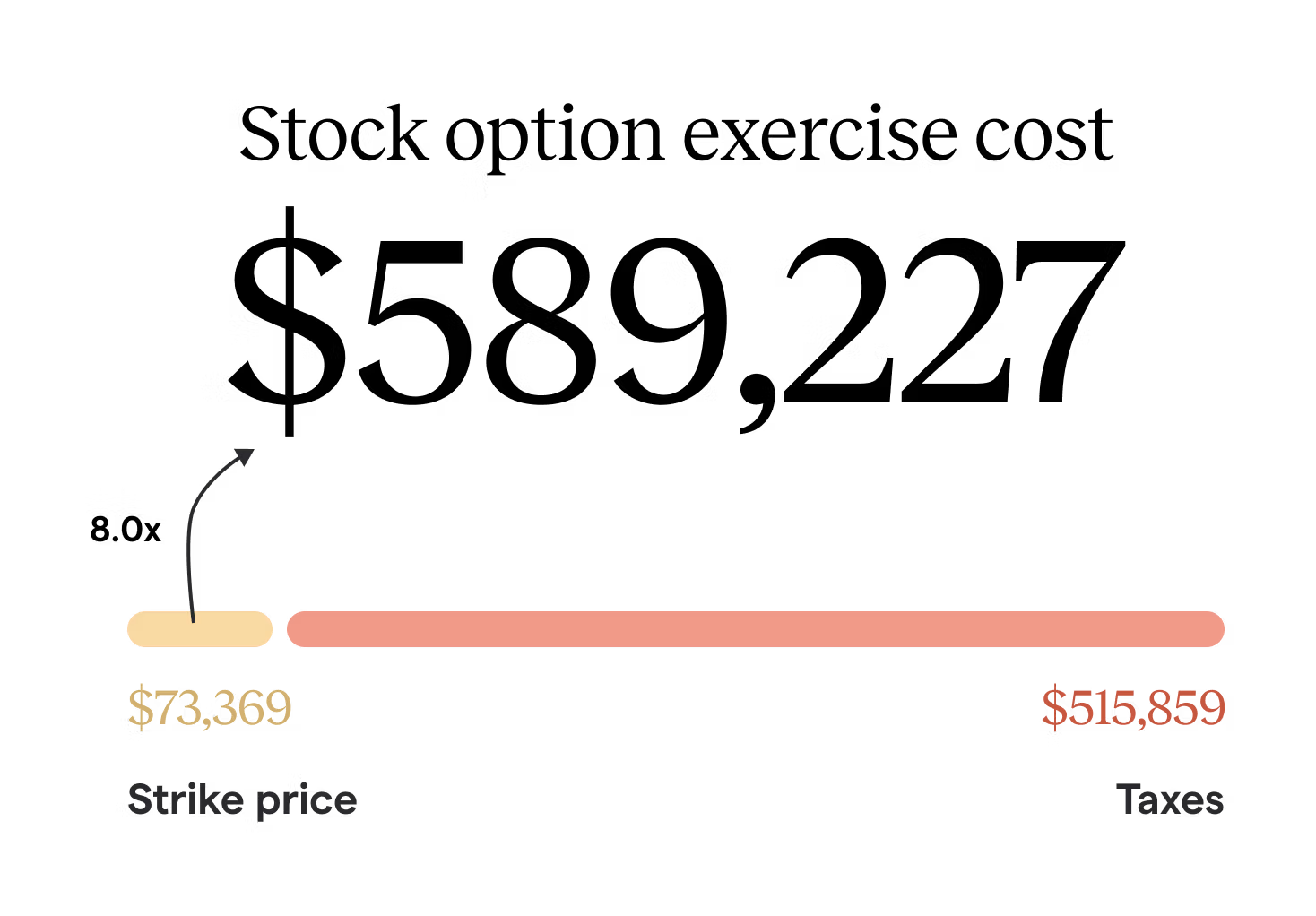
For illustrative purposes only. Actual results may vary, and there is no guarantee of any particular outcome.
Some pre-IPO advisory services can help you explore different financing pathways to cover exercise expenses without committing all your personal savings.
In some cases, you may be able to get a bank loan or personal line of credit to cover financing your exercise and related taxes. But these usually come with interest and a major risk to your credit score if you’re not able to pay it back.
We’ve also seen people take loans from friends or family, although this can complicate personal relationships in certain situations.
Another option is non-recourse financing, which funds stock option exercises and covers associated taxes without putting your other personal assets at risk. In some cases, you can also get extra cash for discretionary spending. Repayment is generally tied to a future liquidity event, such as an IPO or acquisition. And there are no monthly repayments, which can be a relief compared to traditional financing.
At Secfi, we specialize in non-recourse financing for eligible startup employees. We'll explain how our financing works and who may qualify later in this article.
For many startup employees and executives, company equity could represent a significant portion of your potential net worth. Advisors who don’t specialize in pre-IPO advising might not even take this into account, whereas it’s often very much something to plan around.
But how do you plan your finances around an asset that could become valuable, but that you currently can't easily sell?
Experienced pre-IPO financial advisors can help you consider your equity alongside your other investments, savings, and financial priorities.
For instance, you might want to buy a home, fund your children's education, pay off debts, or retire early. An advisor can help you consider how much money to keep invested in your company, how much cash you may need, and when it might make sense to diversify.
The same advisors can also be helpful after an IPO. If your planning goes well and the company also has a successful exit, diversification becomes important. You’ll want to balance the potential future upside of any shares you own, but also consider putting some into different investments.
Your company can explain how its stock option plan works and provide general equity education, but HR and finance teams typically aren't qualified to give you personalized financial advice about what to do with your shares.
Some companies go a step further by partnering with third-party providers like Secfi. This can give you access to one-on-one equity guidance and financial planning from specialists in pre-IPO advisory services. Then you can confidentially ask questions about your equity in the context of your company, but with more specifics than general company resources.
You don't necessarily need to wait for an IPO announcement before seeking financial guidance. Planning early can give you more flexibility, especially when it comes to taxes and deciding when to exercise or sell your shares.
A few things to consider as you plan are:
Vesting schedule: Check your vesting schedule to understand how many options you can exercise now and how many will become available before a potential IPO. If you leave your company before you're fully vested, you'll generally forfeit your unvested options.
Exercise deadlines: Many startups give departing employees 90 days to exercise their vested options, although some offer longer windows. If you miss your applicable deadline, you'll generally lose those options.
IPO selling restrictions: An IPO lock-up period, commonly around 180 days, may prevent you from selling shares immediately after your company goes public. You may also face trading windows or blackout periods.
Here's how your advisory needs might change as your company progresses toward an IPO.
| Stage | Financial decisions to consider | Advisory services that may help |
|---|---|---|
While your company is still private | When to exercise options, potential AMT, how much cash you can afford to invest | Equity and tax planning, financing |
As an IPO becomes more likely | Potential after-tax proceeds, liquidity needs, and how much equity to retain | Scenario modeling, tax planning, wealth management |
During the IPO and lock-up period | When shares can be sold, taxes on potential sales, and a plan for selling | Liquidity planning, investment management |
Once shares become tradable | How much to sell, diversification, and investing the proceeds | Wealth management, tax planning |
Before choosing your pre-IPO advisory service, consider:
Look for advisors who regularly work with startup employees and executives. They should understand stock option exercises, 409A valuations (which help establish the fair market value of private-company common stock), AMT, IPO lock-ups, and secondary transactions.
A traditional financial advisor may be experienced with publicly traded investments but less familiar with the restrictions and tax considerations associated with private-company equity.
Consider the decision you're trying to make.
If you're struggling with an exercise deadline, you may need tax planning and financing support. If you're expecting substantial proceeds from an IPO, wealth management and diversification planning may be more relevant.
Some providers specialize in one area, while others, including Secfi, offer several services together.
Before choosing an advisor, understand how they're paid. Some charge a flat fee or a percentage of the assets they manage, while others earn commissions for selling certain financial products, such as investments or insurance.
Commissions can create a potential conflict of interest if an advisor has a financial incentive to recommend one product over another. Look for a fee-only advisor who doesn't earn sales commissions, and ask whether they have a fiduciary duty, meaning they're legally required to put your interests first when providing investment advice.
Financing and secondary sale services have different fee structures. Financing providers may charge fees and receive a portion of future equity gains, while secondary sale providers may charge transaction fees.
For more detailed guidance on evaluating an individual advisor, read our article on how to choose a financial advisor for stock options.
Secfi specializes in helping startup employees and executives navigate the financial decisions that come with owning private-company equity. As of July 2026, more than 62,000 startup employees and executives trust Secfi to help them make decisions about their stock options.
We offer pre-IPO advisory services, equity planning tools, and financing solutions to help you prepare for a potential IPO, along with company-wide programs for employers who want to support their teams.
Finding a financial advisor who understands the complexities of private-company equity can be difficult, especially when you're navigating exercise deadlines and a potential IPO.
If you want personalized guidance, Secfi Wealth offers pre-IPO advisory services so you can plan and manage your investments with advisors who specialize in helping startup employees and executives manage their equity before and after an IPO.
We can help you model and compare different outcomes, and come up with a personalized financial plan that can be adjusted based on your changing needs.
For example, our advisors can help you decide how many stock options to exercise each year to manage your potential AMT liability, handle the $100k rule for ISOs, or make a plan so you can be prepared if your company does file for an IPO.
More importantly, they’ll take your short- and long-term goals into consideration. If you’re planning around a growing family or aging parents, or want to save up for a sabbatical or your own startup one day, they can help plan your equity and other assets around that.
Our Wealth team is fee-only. We don’t take commissions, and we act as a fiduciary (basically, in your best interests).
But if you’re not ready to work with pre-IPO advisory services yet, you can use our free AI equity assistant Maeve.
Maeve was built to help you model scenarios based on your financial information. By running calculations through Secfi’s dedicated tax and equity calculators, Maeve can produce more consistent results than what you might get from a predictive text AI.
For example, if your company is considering an IPO, you could use Maeve to estimate the cost of exercising your vested stock options, calculate potential AMT, and see how much your shares might be worth after taxes at different hypothetical IPO valuations. You can also compare exercising now, exercising in stages, or waiting to understand the potential financial trade-offs.
You can enter your stock option details manually or by uploading documents, or connect directly to Carta if you have an account. If you prefer to work within the existing context of ChatGPT, our MCP brings calculators into your chats.
For illustrative purposes only. Actual results may vary, and there is no guarantee of any particular outcome.
If you're unsure what to do with your stock options before an IPO, a good starting point is understanding what your different choices might actually cost. Maeve can help you better understand your existing and potential future scenarios before you make any decisions.
You might want to exercise your stock options before an IPO, but the upfront costs and potential taxes could be much higher than you expected. And you may not want to put your personal savings at risk to cover them.
Secfi helps solve this with non-recourse financing so eligible startup employees and executives can cover these costs. As of July 2026, we've provided more than $800 million in non-recourse financing.
With this financing, you retain ownership of your shares, without monthly repayments. If your company has a successful exit, the financed amount and fees are repaid according to the agreement. If no qualifying exit occurs, you're generally not personally responsible for repayment.
Because there’s no monthly payment and lower risk on your end, financing is very selective, and eligibility and terms depend on your company and individual circumstances.
If you're an HR or finance leader at a company approaching an IPO, preparing employees for the financial implications of going public can be an important part of the process.
Your company can explain its equity compensation plans and provide general education. However, individual decisions involving taxes, investments, and personal financial circumstances often require advice from appropriately qualified professionals.
When we surveyed 1,000 startup employees, 90% said they'd be more likely to join a company that offers equity education.
Secfi partners with companies to help you make that possible for employees, including:
Equity education: Sessions covering stock option basics, exercise strategies, tax considerations, and preparation for an IPO or other liquidity event.
Planning tools and guidance: Resources to help employees estimate exercise costs, potential taxes, and the value of their equity under different scenarios.
Financing solutions: Access to non-recourse financing for eligible employees who want to exercise their options without using their personal savings. It doesn’t require a transfer of share ownership or impact your 409A valuation, and company involvement is minimal, so you can focus on preparing your business for its IPO.
Our company programs can also provide more advanced education for executives, covering topics such as estate planning, trusts, and charitable giving.
Learn more about Secfi's equity education programs for employers.
Dan was Chief Customer Officer at Happy Money, which he helped grow for nearly a decade. But the cost of exercising his equity was higher than he felt comfortable paying out of pocket.
He had recently gotten married and wanted to buy a house, so committing a significant amount of personal savings to private-company shares wasn't an appealing option.
Dan found the equity decisions complicated:
"Even as an executive, we're supposed to know all the things about all the things, which is not necessarily true."
He turned to Secfi for help understanding his equity and exploring his financing options. With Secfi's support, Dan was able to finance the cost of exercising his stock options without committing the cash he wanted to preserve for his other financial goals.
The experience also made him realize that other Happy Money employees were likely facing similar challenges. Dan and the company's leadership subsequently partnered with Secfi to offer equity education and financing opportunities across the company. Employees gained access to resources to help them understand their stock options and explore financing.
Dan's experience shows how pre-IPO advisory services can help an individual shareholder make a more informed decision, and how an employer can extend that support to its workforce.
Read the full story: Why a Happy Money executive introduced Secfi to the whole company.
This case study is an illustration of our capabilities provided to an individual client. Client results may vary, and there can be no guarantee of similar results. It is not known whether the client approves or disapproves of Secfi Advisory Limited or its affiliates as a whole. Clients offering a Testimonial do not receive compensation, and their statement does not present a conflict of interest.
You can't control when your company goes public, and waiting for an IPO announcement might feel like the safest option. But by then, exercising your stock options could be more expensive, and you may have fewer choices available.
Secfi's pre-IPO advisory services can help you understand your options and make a plan that works for your finances, even if your company's IPO timeline is still uncertain.
Start exploring your equity with Maeve, or contact Secfi to find out how our advisors can help.
The tool shown here uses artificial intelligence and is for illustrative purposes only and not necessarily indicative of future results, and there is no guarantee that similar results can be achieved. The information provided by the tool is not professional advice and is not intended by Secfi, Inc., its affiliates, and Secfi representatives, to be deemed as investment, legal, tax, or other professional advice or recommendations of any kind, or to form the basis of any decision to do or to refrain from doing anything. Secfi does not review the accuracy or completeness of the information provided to us within the tool.
Corporate IPO advisory services help companies prepare for an initial public offering. An IPO consultant or advisory team may assist with IPO readiness, due diligence, financial reporting under GAAP, SEC reporting, corporate governance, internal controls, and regulatory compliance.
For employees and shareholders, pre-IPO advisory services like those offered by Secfi focus on personal financial decisions, including stock option exercises, tax planning, and managing potential wealth from a future IPO.
A company's IPO readiness refers to how prepared it is to become a public company, including its financial reporting, governance, and other regulatory requirements. However, even if your company is preparing for a public listing, that doesn't guarantee an IPO will happen.
Employees should consider how the potential IPO timeline might affect their stock option exercise decisions, taxes, and future opportunities to sell shares.
Your personal IPO readiness checklist should include reviewing your equity grants, vesting schedule, exercise deadlines, estimated taxes, and potential share value. You'll also want to understand any IPO lock-up restrictions and how your company equity fits into your wider financial plans.
A financial advisor who specializes in private-company equity, like the team at Secfi Wealth, can help you prepare this information and evaluate your options.
A company's IPO advisory team typically focuses on the business's IPO process, including financial reporting, regulatory requirements, and preparation for going public. Its role generally doesn't extend to advising individual employees on their personal taxes or investment decisions.
However, some employers partner with independent providers like Secfi to offer equity education and access to personalized financial guidance.
No. An IPO readiness assessment helps a company identify areas that need attention before a potential initial public offering, such as technical accounting, revenue recognition, internal controls over financial reporting (ICFR), and SOX compliance.
Even when a company has addressed these requirements, market conditions, valuation expectations, and other factors can delay or prevent an IPO. An advisor can help you plan without relying on a guaranteed exit date.